Tokyo Drifter: Suzuki's Pop-Art Yakuza Delirium
Nikkatsu cut his budget, so he made the sets white and let colour do the acting
Contents
Eighty-three minutes. That is the whole of Tokyo Drifter (1966), and Nikkatsu got it for a routine programmer’s budget from a contract director they were already unhappy with, and what came back was one of the most beautiful objects in the history of the crime film.
The story is nothing. A loyal yakuza’s boss goes straight; a rival gang applies pressure; the loyal man is cut loose and takes to the road, drifting between cities while the plot pursues him. Seijun Suzuki was handed this and made the reasonable professional decision that nobody was going to remember the plot, so he would spend his entire effort on everything else.
I came to it the way a lot of people did, through the reputation — the Criterion-era wave of Suzuki discovery that hit Western cinephiles in the late nineties, arriving on my shelf as a rental tape with a cover that promised something cooler than the film could possibly be. The film was cooler.
The white set
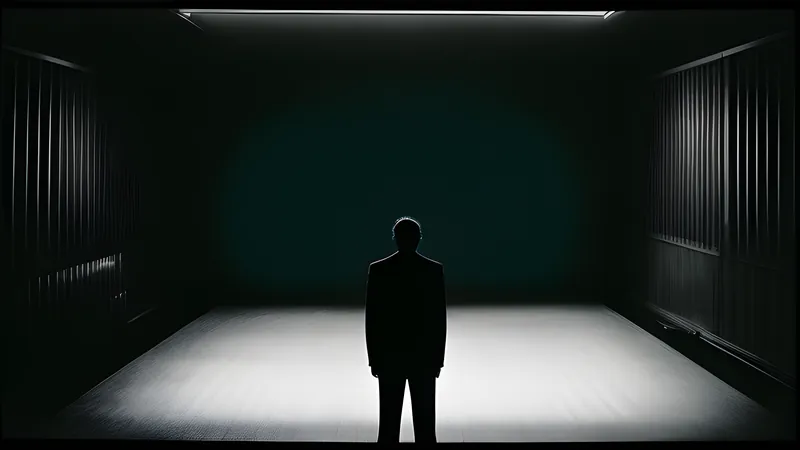
The finale takes place in a nightclub that has been reduced to a white void: a floor, a stair, a bar, a few objects, and otherwise nothing. No walls you can locate. No ceiling. Figures in coloured suits move through pure blankness under hard light, and the composition works because Takeo Kimura, Suzuki’s designer and his most important collaborator, understood that if you remove the environment entirely then every object you put back in becomes enormous.
That set is famous as a piece of style. It is also, mechanically, a solution to a money problem. A white void is cheap. You cannot see what has not been built. Suzuki and Kimura worked out that the constraint Nikkatsu was imposing — less money, fewer days, no location work — could be inverted, because a film with no sets has nothing to look wrong. The abstraction was forced and they took the forcing as a licence.
Look at what it enables. Sight lines become graphic rather than architectural, so Suzuki can put two men at opposite ends of a shot with nothing between them and the space reads as pure tension. Colour becomes the only information: a yellow suit against white is a character. And blood, when it arrives, has somewhere to land.
The mechanics of the colour
Shigeyoshi Mine shot it, and the film’s colour scheme is the most disciplined thing about it. Suzuki works in blocks — a scene will be given a colour and will keep it, absolutely, until the cut. The famous opening runs in near-monochrome, a bleached high-contrast black and white, and then the film detonates into colour and never apologises.
The discipline is what makes it work. A film that is randomly gorgeous is exhausting; Tokyo Drifter assigns each sequence a palette and holds it, so the shifts between sequences carry meaning by contrast alone. When Tetsu is safe, the world has a colour. When he is hunted, the colour changes under him. The audience learns the system in twenty minutes and then Suzuki plays it like an instrument.
Then there is the song. Tetsuya Watari, who plays Phoenix Tetsu, sings the title theme, and the film uses it with an absolutely straight face and no restraint at all — Tetsu walking down a street whistling his own theme tune, the melody arriving diegetically and non-diegetically and eventually somewhere in between. It is a joke, it is sincere, and it is the film’s clearest statement that it knows it is a film. Chieko Matsubara sings it too, in the club, and the whole picture organises itself around a piece of music the way a musical does.
The editing carries the same logic. Suzuki cuts on graphic match rather than on action — a shape in one frame rhyming with a shape in the next, a colour handing off to a colour — so the film advances by association while the story limps along behind. It is the reason the picture feels fast despite having almost no plot momentum. Your eye is being pulled forward continuously even when nothing has happened. Kimura and Suzuki are essentially building a sequence of posters and daring you to notice that the connective tissue has been removed.
What Nikkatsu wanted
Understanding why this film exists requires understanding the factory. Nikkatsu had a production line: mukokuseki akushon, borderless action, programmers built to formula and shipped to fill a double bill. Suzuki was a contract man on that line, and he had already been quietly deforming the formula for years — Youth of the Beast in 1963 is the breakthrough, Gate of Flesh in 1964 the one where the colour scheme becomes an argument.
The studio’s response to a director who kept making the films look strange was to reduce his resources, which is the standard managerial instinct and precisely the wrong one. Tokyo Drifter is what a suppressed film-maker does with a smaller budget: he removes everything the studio cared about and keeps the frame.
The endgame is well documented. The following year Suzuki delivered Branded to Kill, Nikkatsu’s president declared his films incomprehensible, and Suzuki was sacked and effectively blacklisted from feature work for a decade. He sued. He won a settlement. The Japanese film community rallied. And the two pictures that ended his studio career became the two everybody watches.
The ancestor
The lazy comparison is Godard. It has something in it: Alphaville is a year earlier and does comparable things with genre and abstraction. The traffic there runs parallel rather than causal, two contract-adjacent men arriving independently at the same use of a genre skeleton.
The real ancestor is the MGM musical. Tokyo Drifter is built on the grammar of The Band Wagon and An American in Paris: the abstract stage, the colour-block set, the number that abandons realism entirely, the hero who sings his own theme, the plot as connective tissue between arrangements. Suzuki took the yakuza film and scored it like Minnelli, and the white nightclub is a dream ballet with guns in it. Once you see that, the film’s cheerfulness stops being incongruous.
The other cross-reference worth making is Danger: Diabolik, Bava’s 1968 pop-art crime fantasia — another studio genre picture in which a director with a design brain and no money turned the constraint into a manifesto. Bava and Suzuki never met and made the same discovery in the same decade.
The case against
The plot is genuinely incoherent, and the people who say so are right. Loyalties reverse without preparation. Geography collapses — Tetsu is in Tokyo, then a snowbound northern town, then somewhere else, and the transitions are elliptical to the point of rudeness. Characters arrive with a history the film declines to supply.
Suzuki’s defenders treat this as intentional. Some of it is. Some of it is a man who has stopped caring about the script’s obligations, and it produces a middle act where the film’s momentum drains away because you have no idea what anyone wants. Compare the propulsion of Youth of the Beast, which is just as stylish and actually tracks.
And Watari, for all his poise, is a limited centre. He looks magnificent. He carries the suit. The performance underneath is thin, and a film this abstract needed a face doing more work — the thing Branded to Kill gets from Jō Shishido’s absurd, brilliant intensity.
The verdict
Take it as design, and it is a masterpiece — the most purely beautiful crime film of the 1960s, and one of the few where you could pause on any frame and hang it. Take it as story, and it is a wreck. Both readings are correct, and the argument between them is the point of watching it.
What settles it for me is the film’s confidence. This is a director in total command of every decision at exactly the moment the studio decided he had lost control, and the picture is a document of a man being punished for being better at his job than the job required. It runs eighty-three minutes and wastes none of them.
The restorations are excellent and the colour is the entire film, so the transfer matters more here than almost anywhere — the whites have to be white, the yellow has to hurt. Watch it, then Branded to Kill, then go back to Youth of the Beast to see what he could do when he wanted to make sense.
Spoilers below
Kurata, Tetsu’s boss, sells him.
The film’s whole engine is Tetsu’s loyalty — he takes beatings, he takes exile, he refuses recruitment by the rival Otsuka, he drifts across Japan rather than break faith with a man who has gone legitimate and does not need him any more. And Kurata has been dealing with Otsuka the entire time.
The reveal is delivered without drama, which is the most Suzuki thing in the picture. There is no anguished confrontation. Tetsu learns it, absorbs it, and the film moves to the white nightclub for the ending.
What happens there is the argument. Tetsu kills. He kills Kurata, and he takes the room apart, and Kenji Aizawa — the drifter who has shadowed the film like a conscience — is there for it. And then Chiharu, the woman who has waited the whole picture, offers Tetsu the thing every yakuza film ends with: come back, stay, be a person.
He refuses. He walks away from her across the white floor, singing, into nothing, and the film ends on an empty abstract space with a man vanishing into it. The genre’s contract says the drifter comes home or dies. Suzuki declines both and hands you a graphic composition instead — a figure, a void, a song — which is either the emptiest ending in the yakuza canon or the only honest one. Nikkatsu read it as contempt. It looks from here like a man telling the truth about what the studio had made him.
Related Content