THX 1138: Lucas Before the Galaxy Far, Far Away
The cold, white debut that made the man who would warm cinema up
Contents
There is a version of George Lucas that most people never think about: severe, formalist, allergic to sentiment, more interested in framing a figure against blank space than in giving anyone a hero to root for. That Lucas made exactly one feature before the merchandise swallowed the myth. THX 1138 came out in 1971, sank at the box office, and then sat for decades as the strange cold thing at the front of the filmography — the debut nobody expects from the man who later taught a generation to cheer.
Watch it now and the surprise is how uncompromising it is. This is a young director with a student’s confidence and no commercial instinct at all, making a future that feels less like a story and more like a specimen under glass.
The student film that grew teeth
THX 1138 began at USC as a fifteen-minute short, Electronic Labyrinth: THX 1138 4EB (1967), which won a national student film prize and got Lucas noticed. When Francis Ford Coppola set up American Zoetrope as a renegade northern-California alternative to the studios, the deal that launched it was Warner Bros bankrolling a slate of young talent — and Lucas’s expanded THX was the first cab off the rank. That origin matters, because the film keeps the logic of an experimental short blown up to feature length: image and sound doing the work that plot usually does.
Robert Duvall plays THX 1138, a worker in a subterranean society where citizens have numbers instead of names, shaved heads, identical white tunics, and a mandatory drug regimen that flattens desire and fear into nothing. He assembles android police officers on a production line — the chrome-faced cops who will later hunt him. His roommate LUH 3417 (Maggie McOmie) swaps his medication for placebos, feeling returns, the two of them do the forbidden thing and fall for each other, and the state notices. Donald Pleasence hovers at the edges as SEN 5241, a superior whose need for company is its own kind of malfunction.
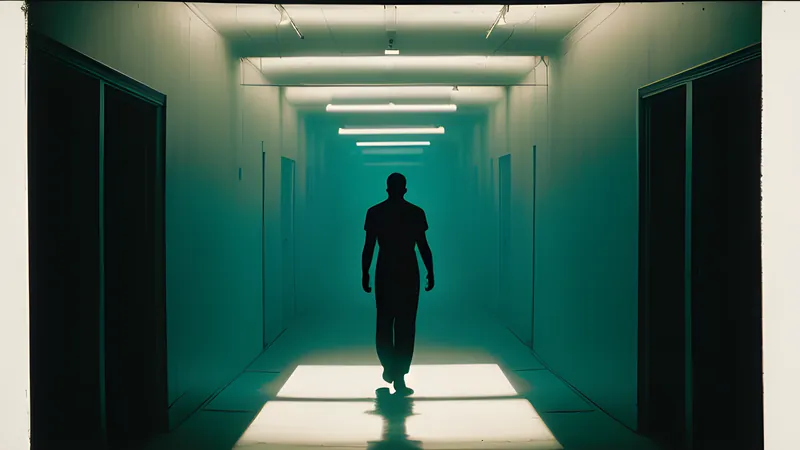
The plot is skeletal on purpose. What Lucas is really building is a mood of total administration, a world where the surveillance is so complete it has stopped feeling like oppression and started feeling like weather.
Why the white void works
The single most important creative decision in THX 1138 is the colour of nothing. Much of the film unfolds in blank white limbo — prison sequences where the floor, walls and ceiling dissolve into a horizonless glare, so figures seem to stand on the surface of an overexposed photograph. Lucas and his cinematographers (Albert Robbins and David Myers shot it) exploited the fact that a truly empty white set has no visible edges, which means the camera can hold a person in a void with no cut to a wall to break the spell.
That trick does something a matte painting or a sci-fi corridor never could. A corridor tells you where the walls are, and walls imply an outside. The white void refuses the outside. It is a prison with no visible bars because it has already colonised the horizon, and that is a far more frightening idea than any cell. When THX and SEN wander the limbo trying to find an edge, the film makes their hopelessness architectural.
Above ground the palette is just as controlled: sterile fluorescents, monochrome uniforms, the occasional shock of the chrome police faces catching the light like hubcaps. Lucas cut the film himself, and the editing has the clipped, unsentimental rhythm of someone who trusts a held shot to unnerve you more than a fast one. The influence is worn openly — this is a cousin of Jean-Luc Godard’s Alphaville, another future built out of the present with no props budget, and a descendant of the clinical futurism Kubrick had just perfected in 2001. The lineage runs the other way too: the bureaucratic hell of Brazil owes this film its sense that the system’s cruelty is administrative before it is violent.
The sound is the surveillance
If you only watch THX 1138 you get half of it. The other half is Walter Murch, who co-wrote the screenplay with Lucas and built what he called a sound montage — a dense, continuous layer of overheard announcements, monitor chatter, confessional murmurs and machine hum that never lets a moment sit in silence. In this world you are always being spoken to and always being listened to, and Murch makes both facts audible at once.
The genius of it is that the voices rarely address anyone in particular. Automated systems soothe and instruct in the same flat tone whether they are dispensing a sedative or logging an execution. When THX visits a confession booth, the state’s calming voice answers with pre-recorded platitudes that have nothing to do with what he says. The horror is in the mismatch: a machine performing care with no one home behind it. That single idea — the tenderness of a system that does not know you exist — is one of the most quietly modern things in seventies science fiction, and it puts THX on the same shelf as Coppola’s own The Conversation, where surveillance curdles a man from the inside.
What Warner Bros took, and what it made Lucas
THX 1138 has a second life as an origin story for its director’s whole career. Warner Bros, baffled by the finished film, trimmed roughly four minutes and released it to little success. The cut infuriated Lucas — a formative wound about who controls the final shape of a movie — and it hardened a resolve that runs straight through everything after: own the negative, own the pipeline, never hand a studio the scissors again. The independence that eventually built Lucasfilm and the effects and sound houses around it has one of its taproots in this bruising.
The number itself became a signature he could not stop reaching for, turning up on a licence plate in American Graffiti and threaded through Star Wars as an in-joke that fans now catalogue. And in 2004 Lucas did to himself what Warner had done to him, only in reverse — a “director’s cut” that reinstated material and added digital creatures and set extensions to the underground crowds. Purists tend to prefer the leaner theatrical version, and I am with them: the grain and the emptiness are the point, and filling the frame with CGI foot traffic softens exactly the desolation the film was built to deliver. It is the same argument that hangs over every restored genre picture, and I have made the full version of it about which cut of Blade Runner is the film.
Where it sits, and what to watch around it
THX 1138 is the missing hinge in the seventies dystopia cycle — colder than most of its siblings, more interested in texture than in message. It shares that decade’s conviction that the future would arrive as a smoothly run system rather than a smoking ruin, an idea it passes on to corporate nightmares like Rollerball and to the clinical procedural dread of The Andromeda Strain. If Lucas gives you the anaesthetised interior of that world, the exterior collapse belongs to films like Escape from New York.
Come to it for the craft: the void, the sound, the nerve of a first feature that refuses to be liked. It is the last thing Lucas made before he decided the audience wanted to be moved rather than unsettled — and knowing where he started makes the swerve that followed far stranger and far more deliberate than it looks.
Spoilers below
THX’s arc is a slow thaw and a sudden flight. Once the drugs wear off, feeling returns as pain: he is put on trial in absentia by disembodied voices, sentenced, and finally warehoused in the white limbo with SEN and a mysterious figure named SRT who claims to be a hologram that walked off its own broadcast. The escape, when it comes, is almost anticlimactic by design — the prisoners simply walk far enough that the emptiness runs out.
The chase that follows is the film’s sly masterstroke. THX flees on foot and then in a stolen car through the underground tunnels, pursued by the chrome police on motorcycles, while a budget counter ticks in the control room above. The pursuit ends for a purely administrative reason: continuing it would exceed the cost limit the state has assigned to recapturing a single citizen. THX outwits no one. He is spared by an accountant. That is the whole thesis in one gag: in a fully administered world, even your freedom is a line item, and you are released the moment you become too expensive to catch.
The final image earns its cold. THX climbs a service ladder toward a hatch and emerges onto the surface at last, a lone silhouette against a vast red sun, birds crossing the sky. Lucas holds it. After ninety minutes of white glare and machine murmur, the sheer natural excess of a sunset reads as overwhelming, almost hostile — beauty as an unfamiliar language. The film does not tell us whether the surface is survivable or what THX will do there, and refusing to answer is the point. He has escaped the system’s frame. Everything past that edge is unwritten, and for a director who would spend the rest of his life building tightly controlled worlds, ending on an unbounded horizon he declines to fill is the most revealing choice he ever made.
Related Content