Thirst: Park Chan-wook's Vampire Priest
A Catholic martyr, a Zola adaptation and the funniest film Park has ever made
Contents
The vampire film has one reliable engine, and it is guilt. Take a person, give them an appetite they did not choose, and watch them negotiate. Almost every serious entry in the form since Murnau runs on that negotiation, which is why the genre keeps producing priests, doctors, aristocrats and other people with elaborate internal codes to violate. Park Chan-wook’s Thirst, from 2009, is the one that noticed the negotiation is funny.
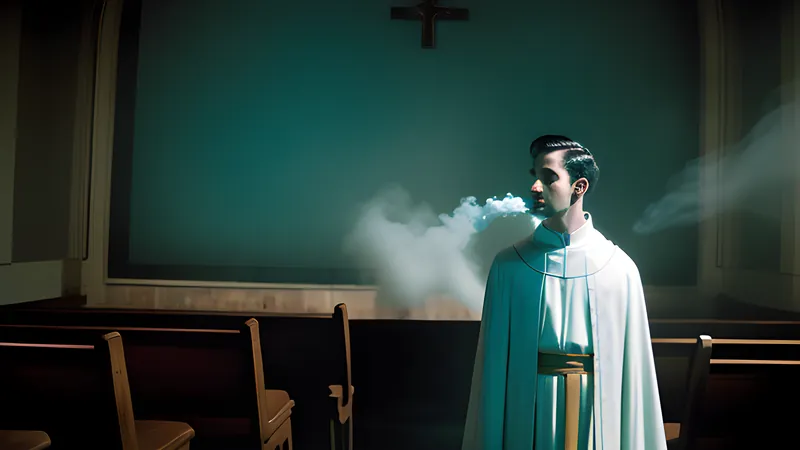
Song Kang-ho plays Sang-hyun, a Catholic priest working hospital chaplaincy, a man whose sanctity is not performance. He is genuinely, tediously good. He volunteers for a vaccine trial for a fictional and horrific disease — the Emmanuel Virus, which turns its victims into blistering, haemorrhaging wrecks — because someone should, and because he wants to be useful, and because a part of him would quite like to be a martyr. The trial kills him. A blood transfusion brings him back. He recovers completely, which nobody else in the trial does, and word gets out that the dead priest walked, and the desperate begin queueing at his door for miracles. He is also now a vampire, and the film’s central joke, sustained for two hours, is that this changes his opinions about almost nothing.
The Zola underneath
The collector’s note first, because it reframes the whole film. Thirst is an adaptation of Émile Zola’s Thérèse Raquin, published in 1867 — a naturalist novel about a stifled young woman married off to her sickly cousin, living above a haberdashery under the eye of a domineering mother-in-law, into whose airless household a lover is introduced. Zola’s interest was in what pressure does to temperament. Park borrows the household, the pressure and the cast, and drops a vampire into it.
Tae-ju (Kim Ok-vin) is the Thérèse: raised by the family as a foundling and then married off to Kang-woo (Shin Ha-kyun), a wheezing, infantilised man-child who plays mahjong with his mother’s friends and calls for his mummy at night. The mother-in-law, Lady Ra (Kim Hae-sook), presides over a dress shop with the total confidence of someone who has never once been contradicted. Sang-hyun, invited into the mahjong circle because he knew Kang-woo as a boy, arrives into this household as the lover — and, crucially, as a man who is already in a condition of appetite and shame, which is where Zola’s Thérèse ends up rather than where she starts.
Recognising the Zola does two things. It explains why the film’s second half turns into a domestic horror comedy about a marriage rather than a vampire hunt, which frustrated a lot of viewers expecting a Korean Interview with the Vampire. And it clarifies Park’s actual subject. Zola’s argument was mechanistic: put two temperaments in a box, apply pressure, watch the chemistry. Park takes that seriously enough to make his vampirism a virus — biology, not a curse, no bats, no capes, no invitation rules, no ancient bloodline. The film’s few concessions to the folklore are physical facts with no mystique attached.
Song Kang-ho’s terrible decency
The performance is the reason the film holds. Sang-hyun’s problem is that becoming a monster has not made him one. He needs blood; he refuses to kill for it. So he improvises — he drains coma patients a little at a time, he siphons off a hospital drip, he takes what will not be missed — and Park films this scrounging with the mundane fastidiousness of a man rinsing a mug. Song plays the whole thing with an air of mild administrative embarrassment. He is a saint with a logistics problem.
That is the engine of the comedy, and it is also the tragedy. Sang-hyun’s continence is the thing Tae-ju cannot forgive, because a man who denies himself is an accusation aimed at a woman who has been denied everything by other people. The film’s back half is an argument between an ascetic and an appetite, conducted at close range in a small flat.
Kim Ok-vin is extraordinary in it. She starts the film hunched and barefoot, running through the streets at night like an animal let off a chain, and finishes it as the most confident person on screen. She won the Blue Dragon for it, and deserved a great deal more attention outside Korea than she got.
Craft: the whites
Chung Chung-hoon shot it, and the palette is the argument. Thirst is a film about a man in a white cassock, in a white hospital, and the entire visual scheme is built to make white unbearable. Blood on white cotton reads as a stain in the domestic sense before it reads as horror — the eye’s first thought is that will not come out. Park repeats it: white bandages, white shirts, white walls, a white hospital gown, and a late-film interior so flatly, awfully over-lit that the eye starts looking for somewhere to rest and finds nowhere.
The other craft move worth naming is the mother-in-law. Lady Ra spends the film’s later stretches paralysed and mute in a wheelchair, fully conscious, parked in the corner of a room where things are happening that she can see perfectly well and can do nothing about. She can only move her eyes. Park keeps cutting to her — a witness who cannot testify, sitting in the frame like furniture — while the mahjong nights carry on around her. It is the cruellest sustained gag in Park’s filmography, and its bones come straight out of Zola, which is the kind of thing that happens when a director actually reads the book.
Park had come off the vengeance run that made his international name, and Thirst is where the moral fury of those films curdles into something more interesting than fury. It took the Jury Prize at Cannes in 2009, which is unusual company for a film containing a vampire vomiting.
The queue at the door
The strand most viewers forget is the one that gives the film its teeth. Once the rumour spreads that a priest died of the Emmanuel Virus and came back clean, the sick start arriving. They want to be touched. They bring their children. Sang-hyun, who knows exactly what happened to him and knows it was a transfusion rather than grace, has to stand in front of people dying of a disease he was inoculated against by accident and decide what to say.
Park is Korean, and Korea has a large, serious, unembarrassed Catholic minority — this is not an imported set-dressing, and the film treats the faith with more respect than most horror films manage while doing considerably worse things to it. The queue works because it inverts the usual vampire-and-cross shorthand. The traditional scene has the priest brandishing his faith as a weapon against the monster. Here the priest is the monster, the faith is intact, and it is the congregation’s belief that has become the problem: they have decided he is holy, and their certainty is a weight he cannot put down. His confessor, an elderly blind priest, is the only person he can be honest with, and even that conversation is conducted at an angle.
The film’s cleverest theological gag is that Sang-hyun never loses his faith. He loses his usefulness. He remains, to the last frame, a man who believes in a God who watches — which makes the sins he commits worse rather than easier, and which is the exact opposite of what happens to every fallen-priest character in the genre. Park is interested in the man who keeps the belief and does the murder anyway, because that is where the real horror lives.
The case against
It is too long, and the sag is in the middle third, where the affair establishes itself and the film circles. Park’s fondness for a set piece occasionally overrides the domestic pressure-cooker logic he has borrowed from Zola — a couple of sequences exist because they look magnificent and for no other reason. And the tonal management asks a lot: viewers who arrive wanting a horror film get a bedroom farce, viewers who arrive wanting the vengeance-trilogy Park get neither. The film’s reputation has improved steadily since 2009 for exactly this reason. It is easier to love once you have stopped waiting for it to become the film you expected.
If you want the version of this argument without the theology, Let the Right One In is the other great modern entry and takes the opposite route, stripping the appetite of all rhetoric. For the wider lineage, the vampire as sexual metaphor across a century covers the ground Thirst is playing on, and Korean genre cinema: ten to start with places it against its neighbours. It streams widely, and the disc transfers do right by Chung’s whites.
Spoilers below
Tae-ju’s first move, once she understands what Sang-hyun is, is to lie. She claims Kang-woo beats her, showing bruises she has inflicted on herself, and Sang-hyun — a man engineered by twenty years of pastoral work to believe the person in front of him — drowns the husband on a fishing trip. This is the Zola murder, transposed to a lake, and Park stages it with the sick comedy of two people who are very bad at this.
Then Zola’s revenge arrives. The couple are haunted by Kang-woo, who turns up dripping in their bed, sits between them, and is either a hallucination or a ghost; the film declines to say, and the ambiguity is the point, since Zola’s original haunting was purely psychological and Park has already established that his supernatural has rules. They cannot sleep. They cannot be alone. The marriage they killed for is a wet corpse lying between them.
Sang-hyun turns Tae-ju after she dies in a fight, and the film’s last act is his slow recognition that he has made something that will not stop. She kills freely and lies about it. He begins clearing up after her the way you clear up after a dog. Lady Ra, paralysed, blinks out the truth of her son’s murder to the mahjong circle, and Tae-ju’s response is to kill the entire table.
The ending is a suicide dressed as a date. Sang-hyun drives them to a cliff at the coast and waits for dawn, and Tae-ju — who has spent the film demanding to be given everything — spends her last minutes scrabbling under the car, into the boot, anywhere for shade, while he holds her still. They burn together on the bonnet as the sun comes up, and the film’s final image belongs to Lady Ra, alive, in her chair, watching two piles of ash on a headland. The martyr got his martyrdom. It took a murder, an affair and an atrocity to arrange, and the only witness cannot say a word about it.
Related Content