They Look Like People: The Low-Fi Paranoia Two-Hander
Perry Blackshear made a demon-invasion film about whether your mate will still hold your hand
Contents
The film cost roughly nothing. Perry Blackshear wrote it, directed it, shot it and cut it, which is the sort of credit list that usually signals a calling card rather than a finished thing. They Look Like People premiered at Slamdance in 2015 and then did what small films do — festival passes, a slow crawl onto streaming, a growing cult of people pressing it on friends with the same slightly embarrassed urgency you’d use to recommend a therapist.
I came to it late, on a laptop, expecting the usual micro-budget bargain: forgive the sound, admire the ambition. That bargain never came up. The film is quiet on purpose, ugly in the places it chooses to be ugly, and it is doing something almost no horror film of its size attempts. It takes the oldest premise in the genre — the people around you have been replaced — and asks a question the premise usually skips. What do you owe someone whose reality has stopped matching yours?
Two men and a sublet
Wyatt (MacLeod Andrews) turns up in New York at the flat of Christian (Evan Dumouchel), an old friend he hasn’t seen in years. Christian has a spare room, a corporate job, an alpha-male self-help tape he plays in the mirror, and a crush on his boss Mara (Margaret Ying Drake). Wyatt has a duffel bag and a voice on the phone telling him that people are being hollowed out and swapped, and that a war is coming on a specific date.
That is the whole architecture. Two men, a flat, a basement, a deadline. Blackshear shoots most of it in rooms that look like rooms, with available light and the kind of framing that keeps both actors in the same shot far longer than a nervous editor would allow. The film’s central relationship is a friendship between two men who are both, separately, drowning — one in delusion, one in the performance of confidence — and neither of whom has the vocabulary to say so.
What’s remarkable is how funny it is for long stretches. Christian’s self-improvement routine is a genuinely well-observed bit of comedy about masculine insecurity, played straight enough that you laugh with a wince. The film earns its dread partly by refusing to be dreadful all the time. When the tone finally tips, you’ve spent forty minutes liking these people.
The craft: what Blackshear does with sound and a locked frame
Here is the mechanic worth stealing. Horror films about auditory hallucination almost always give the audience the hallucination — distorted whispers, a rumble on the low end, some processed vocal treatment that tells you this is the scary bit. Blackshear does use sound design as Wyatt’s subjectivity, and it’s effective, all wet clicking and something breathing in a register the room shouldn’t contain. The clever part is what he does with the image.
He mostly doesn’t show you. The camera stays on Wyatt’s face while he listens. You are watching a man react to something you cannot verify, which puts you in exactly Christian’s position rather than Wyatt’s. The film hands you the sound so you feel the fear and withholds the sight so you keep the doubt. That split — audio subjective, image objective — is the entire thesis rendered as technique, and it costs nothing to execute, which is presumably why it works so well at this budget.
The other choice is patience with the two-shot. There’s a long sequence of the pair messing about with a camcorder and a boom mic, play-acting at being a film crew, and Blackshear just lets it run. It’s the sort of scene a script doctor removes. It is also the scene that buys the ending its power, because it establishes that these two have a private language of daftness that predates whatever is wrong now.
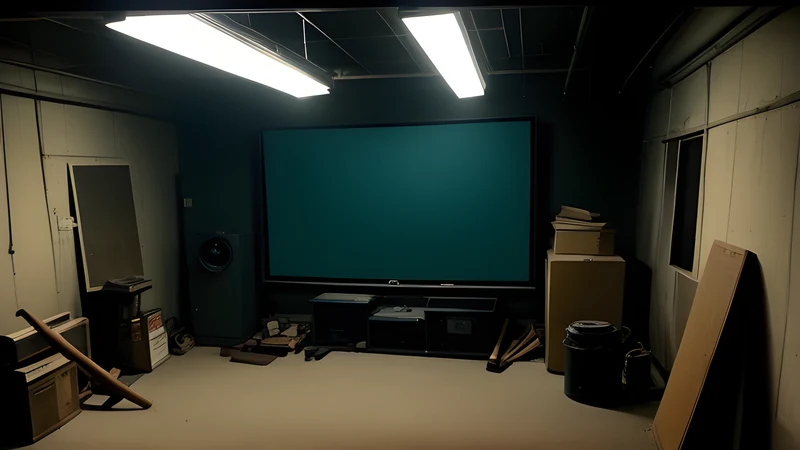
The basement is the third element. Axes, sledgehammers, sulphuric acid, a bare bulb — the iconography of the survivalist prepper, assembled with terrible care. Blackshear frames it as a hardware shop rather than a slaughterhouse. The horror is in the reasonableness of the arrangement.
The real ancestor
Everyone reaches for Invasion of the Body Snatchers here, and the lineage is real enough — Blackshear’s premise is the pod-people premise with the pods removed. Philip Kaufman’s 1978 version, which I’ve argued out-dreads its own original, gets closest in mood, all clammy interiors and friends you can no longer read. But the true ancestor is elsewhere.
Look at Roman Polanski’s apartment films, and specifically at the way The Tenant refuses to arbitrate between a persecuted man and a paranoid one. Look, closer to home, at the whole 1970s stretch of American conspiracy cinema I’ve catalogued in ten essential 1970s paranoia thrillers — films built on the terrible possibility that the frightened man is correct. Blackshear inherits that ambiguity and does something the 70s films almost never did with it: he makes it a question about love rather than about institutions.
The nearest contemporary cousin is Resolution, Justin Benson and Aaron Moorhead’s 2012 debut, which I’ve written about as a film that argues with its own narrative. Same year-zero economics, same two-men-in-a-remote-place structure, same trick of using a friendship as the load-bearing wall of a horror film. Both films understand that the cheapest thing in cinema is a face, and that the face is also the most expensive thing to fake.
There’s a family resemblance to the pressure-cooker of a single location, too — the tradition I mapped in ten one-location thrillers. Blackshear’s flat is a one-location film that happens to have a front door nobody quite uses.
The case against
I’ll be straight about the flaws. The performances are the film — and Andrews is extraordinary, doing a great deal with a slack jaw and a thousand-yard stillness — but Dumouchel’s Christian occasionally strains, particularly in the office scenes, where the writing turns broader than the actor’s register. The Mara subplot is underbuilt; Drake is good, and the film gives her a shape rather than a character.
The middle sags. Around the fifty-minute mark the film runs a holding pattern, waiting for its clock to tick down, and the improvisational looseness that makes the friendship scenes sing becomes shapelessness. At eighty minutes there’s very little fat, and yet you can feel where a tighter cut lived.
And the sound design, so precise elsewhere, sometimes overplays — a couple of stings that a braver mix would have dropped entirely. The film’s argument is that we shouldn’t trust what Wyatt hears. Every time the mix insists a bit too hard, it slightly undermines its own case.
Why it lasts
They Look Like People is a horror film about mental illness that declines to make mental illness the monster. It also declines to be sentimental about it, which is the harder trick. Wyatt is genuinely dangerous. The film knows this, shows you the arsenal, and still refuses to reduce him to a threat.
What it proposes instead is that the only available response to someone whose world has come apart is presence — staying in the room, absorbing the risk, choosing the person over the evidence. That is a hell of a thing to build a horror film on, and it explains the film’s peculiar afterlife: it’s the one people describe as having moved them, which is a strange word for a film with an axe in the basement.
Blackshear went on to make The Siren and When I Consume You with more or less the same tiny company of collaborators, and both are worth your time. Neither has landed quite as hard. This one is a permanent fixture of the under-seen genre films worth hunting on the streaming edges — it rotates between services, it’s cheap to rent, and it will take eighty minutes of your evening and a good deal longer than that to leave.
Spoilers below
The last act is the whole film, so here it is.
Wyatt’s deadline arrives. He gets Christian into the basement, binds him to a chair, blindfolds him, and tells him that whatever he hears, he must not look — because if the thing in Christian is going to surface, it will surface now, and Wyatt has the tools to deal with it.
Christian, tied to a chair in a cellar full of axes and acid, blindfolded by a man he knows is unwell, makes a choice. He stays. He keeps the blindfold on. He tells his friend he trusts him.
Nothing comes. Wyatt hears the voices, hears the invasion, hears whatever he has been hearing since the first phone call — and it passes, and the room is just a room with two men in it, one of them weeping. The film does not confirm the demons and it does not debunk them. It ends on the only fact it considers verifiable, which is that Christian stayed.
That reveal reframes the whole thing. The blindfold isn’t a horror-film device; it’s a refusal to look for proof. Christian could open his eyes and settle the question — is my friend mad, or is he right? — and he declines, because the answer would change what he does next, and he has already decided what he does next.
The film has been arguing that position since the camcorder scene, since the self-help tape, since the two-shots Blackshear wouldn’t cut. Every formal choice is pointed at that basement. There’s a moment afterwards, back in daylight, where the film almost tips into reassurance, and Blackshear pulls up short of it — no diagnosis, no institution, no tidy hand-off to professionals. Just a next day, and the same two men, and one of them still hearing things.
Whether Wyatt gets better is left open, and it should be. The film’s honesty is that it can’t promise you the ending you want for him. What it can show you is somebody sitting in the dark with his eyes shut, on the word of a man everyone else would have sectioned. In a genre that spent decades telling us the person who believes the impossible is either a prophet or a lunatic, that’s the most radical ending on offer.
Related Content