Therese and Isabelle: Metzger's Tender Boarding-School Romance
Radley Metzger films Violette Leduc, and proves erotic cinema could be literature
Contents
Radley Metzger occupied a corner of cinema almost nobody else could reach: the point where the erotic film aspired to the condition of literature, and occasionally got there. Therese and Isabelle (1968) is the clearest proof of that ambition. Adapted from a censored novel by one of France’s most uncompromising writers, shot in luminous black-and-white, structured around interior monologue and memory, it is an art film that happens to concern desire, and a desire film that behaves throughout like art. I want to consider it as film history and craft — how it was made, what it borrowed from the literary avant-garde, and why restraint turned out to be Metzger’s most powerful tool.
From Leduc’s page to Metzger’s screen
The source is Violette Leduc, the fierce, confessional French author championed by Simone de Beauvoir. Leduc’s writing about female desire was frank enough that portions of it fell foul of her own publishers; the material that became Therese and Isabelle had a complicated censored history in print before Metzger ever reached for it. That literary pedigree is the key to the whole film. Metzger was not adapting a dirty book; he was adapting a serious and difficult one, and he treated its prose with the reverence a prestige director might bring to a canonical novel.
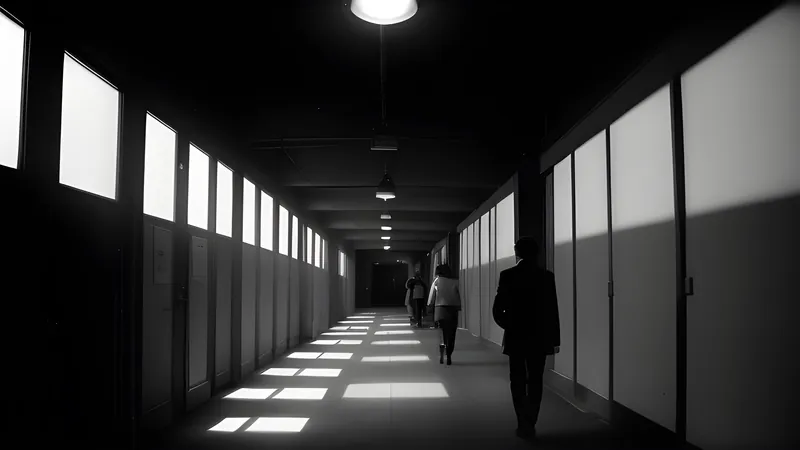
The story is memory itself. A woman named Thérèse returns, years later, to the shuttered boarding school where as an adolescent she fell in love with a fellow pupil, Isabelle. Walking the empty corridors, she remembers, and the film unfolds as her recollection — the tentative approach, the intensity, the private world two girls build against the institutional greyness around them. Essy Persson plays the remembering Thérèse and Anna Gaël plays Isabelle, and the film’s whole emotional register is set by the framing device: everything we see is already elegiac, already lost, filtered through an adult’s longing for a vanished first love.
Metzger shot in France, using real locations whose austere architecture becomes a character — long stone corridors, dormitories, the cold geometry of a religious school. The black-and-white photography is deliberately beautiful, high in contrast and soft in the intimate scenes, and the film leans heavily on voiceover drawn from Leduc’s interior monologue, so that we are often inside Thérèse’s remembering mind rather than simply watching events. It is a technique borrowed straight from literary modernism, and it is what lifts the film clear of the exploitation shelf it was commercially sold from.
Why the restraint is the point
The temptation, with material like this, is to show everything. Metzger’s discovery — and it is the discovery that defines his whole career — was that suggestion is more powerful than display, and that an erotic film gains rather than loses by withholding. His camera favours the faces, the glances, the charged distance between two people before anything happens; his editing elides where a cruder film would dwell; his real subject is anticipation and feeling rather than anatomy. The film is sensual and unmistakably about desire, and it achieves that atmosphere through mood, light and performance rather than through explicitness.
This restraint was partly a censorship calculation and partly an aesthetic conviction, and the two reinforced each other. Working in the late sixties, Metzger had to keep his films exhibitable, and the discipline that requirement imposed pushed him toward exactly the elegance that became his signature. He learned to build the erotic charge in the viewer’s imagination, in the pause and the implication, which is a far more durable technique than any amount of flesh. Films that show everything date quickly; films that suggest everything keep their power, because the imagination they engage never goes out of fashion.
Consider how much the film trusts the empty school itself to carry meaning. The corridors are shot as spaces of absence, haunted by a presence that is gone, and Metzger returns to them so that the architecture does the elegiac work a lesser director would spell out in dialogue. It is a genuinely cinematic solution to a literary problem, translating Leduc’s interiority into physical space.
The performances carry an enormous share of the load. Persson and Gaël have to make a first love feel both specific and universal, adolescent and eternal, and they do it largely through looks and small gestures. The voiceover gives us Thérèse’s inner life directly, and the contrast between the composed adult narration and the raw young feeling it describes generates much of the film’s ache. This is acting and writing doing the work that lesser erotic films hand to the camera alone.
Metzger the literary craftsman
Therese and Isabelle is the film that best explains why Metzger deserves the word “auteur” that admirers attach to him. Where Russ Meyer took American exploitation toward frantic satire and cartoon, Metzger took the European end toward sophistication, wit and formal control, importing and then making films that treated eros as a subject worthy of style. The full case for that reputation is in my essay on Radley Metzger, the auteur of elegant eros, and this film is Exhibit A.
The connections across his own work are worth tracing, because Metzger kept refining the same instrument. The playful sophistication of Score and the puzzle-box construction of The Lickerish Quartet both share this film’s conviction that adult subject matter deserves adult filmmaking — clever, self-aware, formally ambitious. Therese and Isabelle is the tender, elegiac end of that spectrum, the one where the wit gives way to genuine feeling. For a sense of how the period’s directors approached notorious literary sources, the earlier adaptation of the eighteenth-century scandal in Fanny Hill (1964) makes an illuminating companion, another film wrestling a “forbidden” book toward respectability.
It is worth pausing on how unusual Metzger’s operation was. Through his company he distributed sophisticated European films to American audiences and then began directing his own, which gave him a distributor’s instinct for what an art-house crowd would pay to see and a filmmaker’s ambition to give them something better than the market expected. That double vantage shaped Therese and Isabelle. He knew the commercial slot the film had to fill, and he used the room that slot allowed to make something genuinely refined, smuggling a serious literary adaptation into a category built for far cruder goods. The film’s poise is the poise of a man working knowingly against the grain of his own marketplace.
The collector’s point is that this film belongs on a shelf with the European art cinema of its moment rather than with the raincoat trade it was marketed to. Its true relatives are the memory-films and boarding-school dramas of the continental New Waves, and watching it that way — as a serious film about first love that happens to be honest about desire — restores it to the tradition it actually came from.
The verdict
Therese and Isabelle is Metzger’s most emotionally direct film and one of the strongest arguments that erotic cinema could carry real artistic weight. Its restraint has aged beautifully; where more explicit films of its era now look either quaint or grubby, this one retains its atmosphere and its ache, because it invested in mood and character rather than in shock. The literary framing gives it a melancholy that lingers, and the craft — the light, the corridors, the voice — remains genuinely lovely.
It asks for patience and a taste for the elliptical, and it rewards both. Anyone interested in how film learned to treat desire with intelligence should see it, and should see it as the serious work of memory and longing it is. For the wider context, the historically essential sexploitation canon situates Metzger’s elegance among the films that shaped the whole adult-cinema tradition, and shows how far his end of it stood from the rest.
Spoilers below
There is little to spoil in the conventional sense, because the film’s outcome is built into its structure from the first frame. The framing device tells you at once that this love is already over: the adult Thérèse walks an empty school, and the entire romance is delivered as recollection, which means we watch it knowing it did not last. The suspense is emotional rather than narrative — we are not waiting to learn what happens so much as feeling the weight of something already gone.
That elegiac frame is the film’s masterstroke. By setting the whole affair inside a memory, Metzger transforms an adolescent romance into a meditation on how first love survives only as longing, revisited by an older self who can no longer reach it. The girls’ intense private world is shadowed throughout by the institutional greyness around them and by our foreknowledge of its end, so that even its happiest passages carry a premonition of loss. When the remembering Thérèse finally turns to leave the empty school, the film closes on the oldest and most durable of erotic subjects, which was never the body at all but the ache of wanting something you can no longer have.
For the fuller portrait of the filmmaker behind it, Radley Metzger, the auteur of elegant eros traces the whole career this film sits at the heart of.
Related Content