The Zombie Walk Versus the Zombie Run
How the speed of the dead changed what the zombie film is allowed to mean
Contents
Somewhere around the turn of the millennium, the dead learned to sprint, and a whole genre changed its meaning without quite admitting it. For thirty-odd years the zombie had shuffled — arms slack, gait broken, slow as a bad conscience. Then, within a few short years, a wave of films sent the ghouls charging at full pelt, and audiences felt the difference in their pulse before they could name it in their heads. The argument over walking versus running is usually framed as a matter of taste, a bit of fan-forum trench warfare. It is really an argument about what the zombie is for, because the speed of the monster determines the kind of story it can tell.
The slow zombie is a mirror
George Romero did not invent the shuffling corpse by accident. The slowness is the entire point of his cinema, and it is worth being precise about why. A slow zombie is not, in isolation, frightening. One shambling ghoul is a joke you can walk away from at a brisk pace. The horror of Romero’s dead is arithmetic — they are slow but they never stop, never tire, never sleep, and they are everywhere, so the threat is a matter of sheer accumulation rather than any single ghoul. That arithmetic buys the films their most valuable asset: time. Because the monster is slow, the survivors have room to talk, to argue, to reveal themselves, and it is in that room that Romero does his real work.
Dawn of the Dead (1978) is the masterpiece of this design. The shopping mall gives the survivors a fortress and a paradise, and because the zombies outside are slow, the film can spend two hours watching the living become bored, greedy and complacent in their consumer heaven while the dead press mindlessly at the doors. The satire only works at walking pace. Speed things up and there is no time to shop, no time to grow soft, no time for the film to observe that the survivors have started to resemble the mannequins. I have written about the mall as the true monster in my full piece, and the mechanism is exactly this: slowness converts horror into observation. Romero used the whole cycle as a social X-ray, a project I trace across his career here, and none of it is possible if the dead can run you down in the car park.
The fast zombie is an alarm
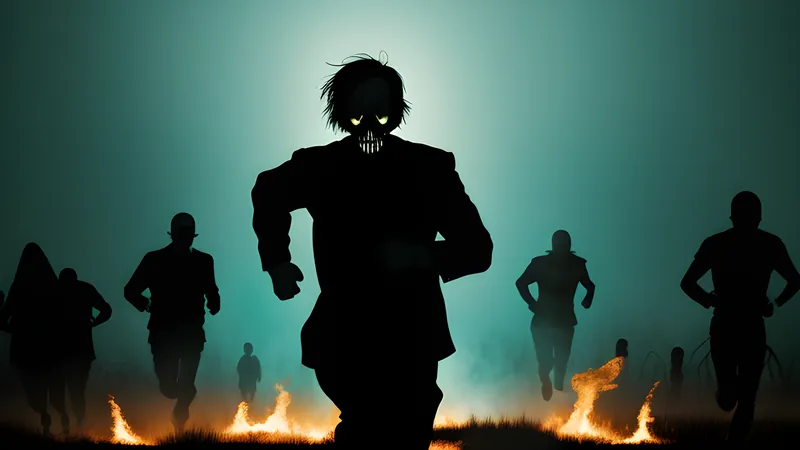
The sprinting dead do something the shuffler never could, and it is worth granting them their due. A fast zombie collapses the distance between safety and catastrophe to almost nothing, which produces a specific and genuine terror — the horror of no time. Danny Boyle’s 28 Days Later (2002) understood this precisely and shot its infected with jittery, undercranked, strobing camerawork so the eye cannot even track them cleanly; the visual grammar itself refuses the viewer a moment to plan. Zack Snyder’s Dawn of the Dead remake in 2004 took the same principle and applied it to Romero’s own template, and the result is a leaner, meaner survival machine that trades every ounce of the original’s satire for pure velocity.
The trade is real and it is honest. What the fast zombie offers is the physiology of panic — the racing heart, the tunnel vision, the reptile-brain scramble for the exit. That is a legitimate thing for a horror film to want. What it cannot offer is reflection, because reflection needs slack in the line, and the fast zombie’s whole design is to remove the slack. When the monster is a sprint, the film becomes a chase, and a chase is about adrenaline in the present tense. The slow zombie is about us, permanently; the fast zombie is about now, urgently. Both are worth making. They are simply not the same instrument.
Speed is a craft decision, not a canon dispute
The most useful way to see the divide is as a problem in editing and blocking rather than a matter of monster biology. A slow zombie is cut in long takes and wide shots, because the film wants you to see the whole geography — the doors, the distances, the dwindling supplies. A fast zombie is cut in fragments, close and quick, because the film wants you disoriented and breathless. The moment a director chooses the speed of the dead, that director has chosen a shooting style, a running time’s worth of pacing, and the emotional register of the entire film. This is why hybrid attempts so often feel confused: a film that wants both the satire and the sprint keeps changing the size of its own shots and never settles into either mode.
Yeon Sang-ho’s Train to Busan (2016) is the great modern proof that the fast zombie can carry weight, and it does so by solving the speed problem with a set. Trapping the action on a moving train reintroduces the one thing sprinting dead usually destroy — enclosed geography with rules, carriages that must be crossed one at a time, doors that buy seconds. The confined space gives the film back its slack, so the fast zombies deliver their panic while the corridors deliver the human drama of who will hold a door and who will shove a stranger through it. I have made the case for its aching central relationship in my review; the structural lesson is that the film earned its emotion by engineering pauses into a form built to have none.
The make-up chair versus the running track
The two zombies are also two different craft traditions, and the split runs all the way down to who gets hired. The slow zombie is a make-up artist’s monster. Tom Savini’s work across the Romero films is the reference point — the grey, sunken, rotting faces built to be lingered on, because a slow ghoul gives the camera time to study its wounds. The horror is decay, and decay rewards a long look. Savini’s dead are meant to be examined; the film stops and lets you see the exposed bone and the milky eye, and the leisurely pace of the monster is what makes that examination possible.
The fast zombie is a stunt performer’s monster, and its make-up is correspondingly cruder because nobody can see it. A sprinting infected is a blur, so the budget moves from the prosthetics bench to the stunt team and the editing suite, where the terror is manufactured in the cut rather than in the flesh. This is a real aesthetic loss that rarely gets acknowledged: the sprint made zombie make-up almost irrelevant, and a whole tradition of grotesque, hand-built decay went quiet because there was no longer any time to look at it. The fast film buys its adrenaline partly by discarding the very craftsmanship that made the slow film beautiful in its ghastly way. When a modern zombie picture wants the old dread back, the first thing it has to do is slow down enough to let the camera see a face — and the moment it does, the make-up chair is busy again.
What we lost, and what we gained
Be honest about the ledger. The sprint gave the genre a new lease of commercial life and a visceral charge the shuffle could never match, and it produced at least two or three genuinely excellent films. What it cost was patience, and patience was where the meaning lived. The slow zombie is a documentary about human beings under a long siege — how they ration, how they turn on each other, how a species behaves when the threat is permanent and unhurried. That is a rarer and more valuable thing than a good chase, and the industry’s long drift toward speed has quietly starved it, one adrenaline-soaked remake at a time.
The cleverest recent films know this and smuggle the slowness back in by other means, whether through geography like Train to Busan or through tone. A zombie film that wants to say something about the living has to buy itself time somehow, because time is the medium in which social observation happens — the same principle I traced through the ghost story in my essay on the architecture of fear, where dread is a function of what the space allows. If you want the full spread laid out as a viewing order, from Romero’s originals through the sprinters and back, I have gathered it in the zombie canon. Watch them at both speeds and the truth becomes plain: the pace of the dead is the thesis of the film, and a genre that only ever runs has forgotten how to think.
Related Content