The Woman in the Window: Lang's Dream-Logic Noir
A professor, a portrait, and a night that behaves exactly the way an anxiety behaves
Contents
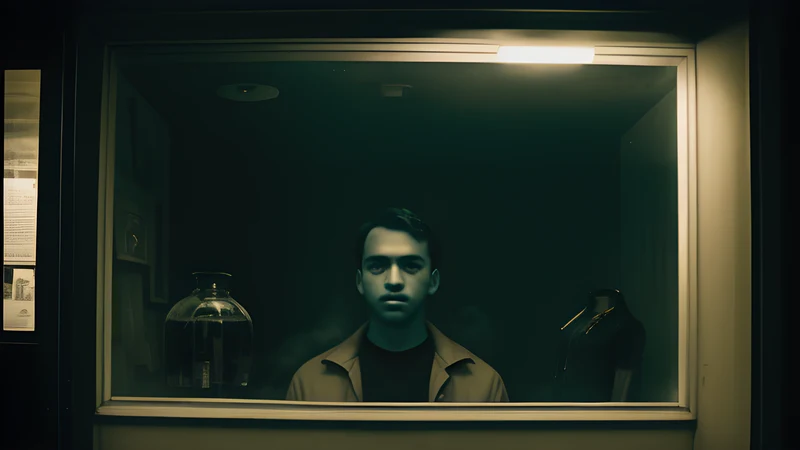
Professor Richard Wanley has put his wife and children on a train for the summer. He gives a lecture on homicide to a university audience, has dinner at his club with a doctor and the district attorney, and on the way in he stops to look at a painting displayed in the shop window next door: a portrait of a young woman. He looks at it the way a respectable man of fifty looks at something he has decided is safely out of reach. Then he goes inside, drinks a little, and dozes in a leather chair. When he comes out, the woman in the painting is standing beside her own portrait, looking at it too.
That is the first ten minutes of The Woman in the Window, directed by Fritz Lang in 1944 for International Pictures and released through RKO, and it is one of the most elegant set-ups in the American cinema. Nunnally Johnson adapted J.H. Wallis’s novel Once Off Guard and produced the picture, Milton Krasner photographed it, and Lang assembled a cast — Edward G. Robinson, Joan Bennett, Dan Duryea — that he liked enough to reassemble the following year for Scarlet Street, a harder and better film about a very similar man.
The reason to watch this one is the grammar. It is a film that thinks the way a bad night thinks.
The professor’s evening
Robinson plays Wanley as a man of settled habits and mild appetites who is aware, in an academic way, of what he is missing, and who has organised his self-image around the certainty that awareness is the same as safety. His lecture is about the psychology of murder, and Lang has him explain to a room of students that there are gradations of guilt — that the man who kills in defence of his life is a different animal from the man who plans it. He is very comfortable with the material. He believes he is describing other people.
At his club he jokes with his friends about the adventure they are all too old for, and the joke has a defensive edge that Robinson plays perfectly: a man laughing at a temptation to prove he is not tempted. Raymond Massey is the district attorney, dry and affable, a friend of thirty years. Lang plants him with total deliberation. He is a Chekhovian pistol in a dinner jacket.
Alice Reed (Bennett) invites Wanley to see more of the artist’s work, at her apartment. He goes, and the film has already told you why: a professor of psychology has spent the evening announcing his own respectability at length to anyone who will listen, which is what a man does when he is arguing with himself. What happens in the apartment I will leave alone. It is enough to say that a man arrives, that there is violence, and that within an hour of leaving his club Wanley — who lectures on homicide — is confronted with the difference between a gradation of guilt and a body.
Why it works: the shape of an anxiety
What Lang builds after that is the film’s genuine achievement, and it is a matter of pure structure. Wanley’s ordeal is not a chase. He is never running from anyone. He is running from the accumulation of small, mundane, procedural details, and the film’s suspense is generated almost entirely by paperwork and social obligation.
The district attorney invites him along to the crime scene, because they are friends and it is an interesting case, and Wanley cannot decline without being strange. So he stands at the scene of his own night and listens to a professional describe it. He hears the evidence discussed at his own club, over drinks, by men who have no idea they are talking to the subject. Every detail he failed to think of is produced in front of him by people being pleasant to him. Lang understood that the deepest form of dread is not being hunted. It is being included.
That is why the film feels like a dream. In a dream you are not attacked; you are simply, gradually, found out, by a process with no malice in it and no brakes. Lang stages the whole middle of the picture in that register: rooms that are too calm, friends who are too kind, a poison-ivy rash and a toll-booth attendant and a set of tyre tracks arriving one after another with the awful politeness of things you forgot. Robinson plays it beautifully — a man performing normality while doing arithmetic, his face doing two jobs in every shot.
Krasner’s photography supports the argument by refusing to signal it. The club is warm. The streets are wet and handsome. Nothing is expressionist in the way Lang’s German films are expressionist; the horror is that the world looks completely ordinary and is closing anyway. The one repeated motif Lang allows himself is glass — the shop window, reflections, faces layered over the portrait — and it does a lot of quiet work about the distance between a man and the thing he is looking at.
Dan Duryea arrives late as Heidt, a blackmailer, and gives the film the jolt it needs at exactly the right moment. Duryea’s speciality was a particular kind of grinning, chiselling malice, and Heidt is the purest example: a man who is delighted, in a small way, by his own leverage.
The argument about the ending
You cannot discuss this film for long without arriving at its final movement, which has divided people since 1944 and which I am going to keep behind the line where it belongs. What can be said above it is that the ending is the reason the film’s reputation sits slightly below Scarlet Street’s, that Lang devised it deliberately and defended it for the rest of his life, and that the defence is more interesting than the complaint.
The complaint is that the Production Code demanded a resolution and the film supplied a convenient one. The defence, which Lang made in interviews over decades, is that the obvious alternative — the machinery grinding to its inevitable conclusion — was the cliché, that he had already made that film and would make it again, and that what he chose instead is a deliberate statement about the character rather than a retreat from the plot. Both readings are live. The film is stronger if you take Lang at his word and read the whole picture as a study of what a mild man’s respectability costs him in the week his family leaves town, and weaker if you assume the Breen Office wrote the last reel.
Where it belongs on the shelf
For the collector, this is the first half of a Lang double bill and the lesser half, which does not make it minor. Watch it with Scarlet Street and the pairing becomes a demonstration: the same director, the same three actors, the same premise of a respectable middle-aged man wrecked by a woman in a picture, and two completely opposed levels of nerve. Lang made the polite version first and then, one year later, made the version with no exit.
Behind both stands M, where Lang established the subject he would spend forty years on: guilt as a physical process, and a man closed in on by systems rather than by people. And the sap-with-a-brain who talks himself into a catastrophe he could see coming from the first reel is the same figure Billy Wilder had put on screen the same year in Double Indemnity — the difference being that Wilder’s man wants something and Lang’s man only wants to have wanted something.
The verdict, mechanism below: The Woman in the Window is a superbly built machine with a controversial last gear, and it is worth your time for the middle hour alone, which is as good a piece of dread construction as the 1940s produced. Robinson is extraordinary, Duryea is a delight, and the film’s insight — that the most frightening thing in the world is a friend being helpful — has never been improved on. Go in knowing the argument exists and refusing to look it up, and the film will work on you exactly as designed.
Spoilers below
In the apartment, Alice’s lover — a wealthy man whose identity is a plot engine — arrives, finds Wanley there, and attacks him, throttling him. Alice hands Wanley a pair of scissors and he stabs the man to death. It is, by the standard he set in his own lecture that evening, close to justifiable. He does the fatal thing anyway: rather than call the police, he panics about scandal, and he and Alice dispose of the body in woodland outside the city.
What follows is the ordeal described above, and it is superb. The dead man turns out to be a financier whose disappearance is national news; his bodyguard, Heidt, works out what Alice has done and starts bleeding her; and Wanley’s friend Lalor, the district attorney, keeps cheerfully bringing him along to watch the investigation converge. Wanley makes every small error a clever man makes. Eventually the net is complete: Heidt is closing, the evidence is assembled, and Wanley — with no way out he can accept — takes poison in his armchair and drifts away.
Then a hand touches his shoulder and it is the club steward, waking him. He has been asleep in his chair all evening. There is no woman, no body, no blackmailer. The characters reappear as a hat-check girl and a doorman, and Wanley, unhurt and appalled, walks out past the portrait in the shop window. A woman stops to ask him for a light. He bolts.
That is the ending people call a cheat, and the case against it is obvious: a two-hour thriller resolved by a man waking up is the oldest evasion in narrative, and it lets both the Code and the audience off. But sit with what it actually does. Every element of the dream is drawn from the ten minutes before it — the lecture on gradations of guilt, the portrait, the joke at the club about adventure, the friend who is a prosecutor. Lang stages the whole nightmare as a psychology professor’s mind convicting him for a thought. The wish is the only thing the man ever actually committed, and the dream sentences him for it in full.
The final beat is the tell. Wanley flees from a real woman on a real street, terrified, and the joke is affectionate and merciless at once: he has been shown exactly what he is made of, and he has learned nothing except fear. Lang later insisted this was the point — the alternative, he said, was a man going to the chair, and he had no interest in filming that lesson again. He was right that he had made it already. He would make it again in 1945, without the safety net, and Scarlet Street is what this film looks like when Lang decides the professor does not get to wake up.
Related Content