The Wicker Man (1973): Folk Horror's Founding Text
Robin Hardy and Anthony Shaffer built the template every folk horror since has been borrowing from
Contents
There is a version of the horror film that keeps the lights on. No shadows to hide the monster, no fog, no midnight — instead a bright Hebridean spring, hedgerows in blossom, children dancing round a maypole while a brass band plays. Robin Hardy’s The Wicker Man is the founding document of that tradition, and half a century on it is still the cleanest example of how frightening daylight can be when everyone in the frame is smiling at you and only you don’t know the joke.
Anthony Shaffer wrote the screenplay, loosely inspired by David Pinner’s novel Ritual, and the two of them built something that behaves less like a horror film than a detective story that has wandered into the wrong genre. That structural trick is the whole engine. Understand it and you understand why so many films have tried to rebuild the machine since, and why most of them come out clumsier.
A policeman on the wrong island
Sergeant Neil Howie, played by Edward Woodward with a rigidity that curdles beautifully over ninety minutes, flies his little seaplane out to Summerisle, a private island off the west coast of Scotland. An anonymous letter has told him a girl, Rowan Morrison, has gone missing. Howie is a devout Christian, an engaged virgin, a man of procedure. The islanders are polite, evasive and, he slowly realises, entirely pagan — a community that worships the old gods of harvest and fertility under the benign lordship of Christopher Lee’s Lord Summerisle.
Woodward’s Howie spends the film doing exactly what a good policeman should: knocking on doors, checking the school register, examining the church, following the thread. Every answer he gets is a small provocation to his faith. The schoolteacher explains the phallic symbolism of the maypole to a room of giggling children. The chemist’s shop sells nothing he recognises. The graveyard is untended and the churchyard desecrated. Shaffer’s script keeps the mystery mechanically sound while turning the screws on the man solving it, so that the tension is theological as much as procedural.
Lee always called this his best film, and he worked for a reduced fee to get it made. You can see why he loved the part. Lord Summerisle is the anti-Dracula: no cape, no fangs, a tweed-and-velvet aristocrat quoting Walt Whitman and explaining crop rotation. Lee gives him genuine warmth, which is far more unsettling than menace. He believes what he believes with the serene confidence of a man who has never once been contradicted.
Why it works: the song and the sunshine
The thing most imitators miss is the music. Paul Giovanni and the band Magnet scored the film with folk songs — some traditional, some newly written to sound old — and Hardy uses them the way another director would use a score of strings and stingers. The songs are diegetic. People sing them, in pubs and fields and processions, so the film’s soundtrack is coming from inside the world. That collapses the safe distance between the audience and the ritual. You are not being told this is sinister by an orchestra in the pit; you are watching a community enjoy itself, and the horror is that they mean every word.
Hardy’s other masterstroke is the light. Cinematographer Harry Waxman shoots Summerisle as a tourist board would: golden, green, fertile, gorgeous. There is no visual grammar of dread anywhere in the first hour. Compare that to almost any other British horror of the period, all Gothic candlelight and Bava-red gels, and The Wicker Man looks like a documentary about a lovely place to retire. The dread is entirely structural. It lives in the gap between what Howie sees and what we, a half-step ahead of him, begin to suspect.
And Woodward is the secret weapon. Howie is not especially likeable — he is priggish, humourless, quick to disgust — and the film refuses to soften him. It respects his faith enough to let it be tested honestly. His conviction is genuine, and the film never sneers at it, which is precisely what makes the last act land with such weight rather than mere shock. A lazier film would have made him a fool to be punished. This one makes him a man.
The template it invented
Watch modern folk horror and you are watching children of Summerisle. Robert Eggers’ The Witch runs the same current in reverse — a devout family, a hostile landscape, faith curdling into the thing it fears — and shares The Wicker Man’s refusal to treat belief as stupidity. Ari Aster’s Midsommar is the most direct descendant, an almost shot-for-structure homage: the outsider, the smiling commune, the seductive daylight, the ritual calendar ticking down to something the visitors cannot read. Aster has been open about the debt.
The deeper ancestor, though, is worth tracing backwards too. Long before Hardy, cinema was fascinated by the survival of the old religion under the new, and Benjamin Christensen’s Häxan — a 1922 Swedish quasi-documentary about witchcraft and superstition — already understood that the most disturbing footage of pagan practice is the footage that treats it as ordinary anthropology. The Wicker Man is that instinct dramatised: the horror film as fieldwork.
What separates it from its imitators is confidence. It never explains itself, never cuts to a professor delivering exposition about the harvest cults, never apologises for the strangeness of Summerisle. The strangeness is simply the world, presented with total conviction, and the audience is left to assemble the meaning at the same speed as the doomed man on screen.
Which version to watch
Here the collector has to give a warning, because The Wicker Man has one of the most tangled release histories in British cinema. British Lion was collapsing during production, the film was cut for its original release, and the trimmed footage was for years thought lost — a persistent legend has it buried in the foundations of the M3 motorway, which is almost too perfect. Several cuts now circulate: the short theatrical version, a longer restoration, and the so-called Final Cut that Hardy himself supervised for the 2013 fortieth-anniversary release.
The Final Cut is the one to seek. It restores the crucial early sequence on the mainland that establishes Howie’s faith and his fiancée before he ever reaches the island, which makes the whole film play as tragedy rather than curiosity. Any decent restoration is worth your time, but avoid the shortest cut if you can; it removes the very material that gives the ending its terrible symmetry.
Ignore, entirely, the 2006 American remake. It exists. That is the kindest thing to say about it.
The verdict
Fifty years on, The Wicker Man has outlasted almost every horror film made around it because it discovered a form rather than a shock. It is a film about the collision of two complete, internally consistent faiths, filmed with the sunniness of a holiday brochure and the rigour of a police procedural, and it earns its reputation as folk horror’s ground zero through a plot that closes like a trap you helped build. If you have only ever heard about the ending, you owe it to yourself to arrive at it honestly, in order, with Howie. The film has been waiting patiently for you since 1973, and it knows exactly how the story goes.
Spoilers below
Everything above is safe. Below is the whole machine, exposed.
Rowan Morrison is not missing, and she was never in danger. The entire investigation is bait. Lord Summerisle and the islanders composed the anonymous letter, staged the disappearance, and drew Howie to Summerisle specifically because he is the sacrifice they need: a fool, a virgin, a man who came of his own free will, invested with the authority of a king (a policeman), and a representative of the god they have rejected. The failed apple harvest of the previous year demands an offering, and Howie is, by their theology, the perfect one.
Every dead end in his investigation was a door held open for him. The islanders let him think he was cornering them, when in fact they were herding him toward the clifftop and the towering wicker effigy waiting there. The reveal that Britt Ekland’s Willow tried and failed to seduce him the night before is retroactively devastating — his virginity, which he guarded on principle, is precisely what qualifies him for the fire.
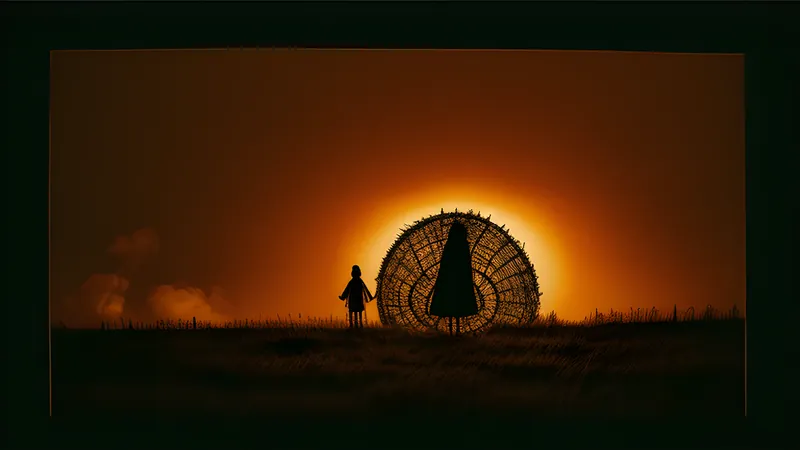
The final sequence remains one of horror’s great gut-punches because it withholds the one thing every other genre film grants: an escape. Howie is placed inside the wicker man alongside terrified livestock, and as the structure is set alight he does not break. He prays. He sings a psalm against their harvest hymn, two faiths shouting past each other, and the film cuts between his agony and the islanders’ joyful singing as the great burning head of the effigy topples toward a blood-orange sunset. There is no rescue, no last-minute reversal, no punishment for the pagans. Summerisle simply gets its harvest.
What makes it unbearable is that the film has been fair the whole time. Every clue was on screen. Howie’s doom was written in the first reel, and we, like him, were too busy solving the wrong mystery to read it. That is the trap Shaffer built, and no folk horror since — not The Witch, not Midsommar, for all their brilliance — has sprung it quite so cleanly. The lights stayed on the entire time, and it was still the dark that got him.
Related Content