The Whip and the Body: Bava's Gothic of Desire and Guilt
The 1963 castle melodrama the Italian censors seized, and the only gothic that admits what it wants
Contents
La frusta e il corpo was directed by “John M. Old”, which is Mario Bava wearing the Anglicised pseudonym Italian genre producers insisted on for export. It was released in Italy in August 1963, seized by magistrates, cut, prosecuted, and shipped abroad under two separate titles that both misrepresent it. Britain got Night Is the Phantom. America got What!, which is at least an honest summary of the distributor’s position.
What was actually in the can was a gothic romance about a woman who is whipped by a man she loves, likes it, and spends the rest of the film unable to decide whether he has come back from the dead or she has simply gone on doing it herself. Nothing in 1963 was doing this. Hammer was making handsome, faintly randy period horror in which desire was subtext and the vampire’s bite carried the freight, an arrangement we set out in Dracula 1958. Bava skips the metaphor entirely. There is no vampire here to stand in for appetite. There is a riding crop, and a woman’s face, and the film holds on the face.
The scene on the beach
Kurt Menliff returns to his family’s coastal castle, unwelcome. He was sent away in disgrace after driving a servant girl to suicide. His father the Count will barely look at him. His brother Christian has married Nevenka, who was Kurt’s before she was anyone’s, and the household’s entire social apparatus exists to pretend none of this happened.
Then Bava puts Kurt and Nevenka on a beach, alone, and Kurt takes a riding crop to her. The scene runs long. Daliah Lavi plays it as terror that turns into something else about halfway through, and Bava shoots her face in close-up while Carlo Rustichelli’s piano — a plaintive, almost sentimental theme that scores the entire film as tragic romance rather than horror — does the most subversive work in the picture. The music tells you this is a love scene. The image tells you it is an assault. The film’s whole moral vertigo lives in that mismatch, and Bava never resolves it because Nevenka cannot resolve it either.
The magistrates who seized the film understood exactly what was happening, which is more than can be said for most of its early reviewers. Their objection was that the film declines to condemn. Nevenka’s masochism is presented as a fact about a person rather than a pathology to be cured or a sin to be punished, and Italian cinema in 1963 had no category for that. The cuts made to the Italian release, and the wholesale re-editing abroad, produced versions in which the film’s central subject was largely absent — a pattern we follow across the genre in The censor’s scissors, where the removal of a film’s actual argument routinely left behind an incoherent object that then got blamed for being incoherent.
Lee, and the part nobody else would take
Christopher Lee took Kurt Menliff at a point when he was actively trying to escape Dracula, and it is one of the few roles in his early career that requires him to be sexually persuasive rather than merely predatory. He plays Kurt with a low, amused patience — a man who is entirely certain of what Nevenka wants because she has told him before, and who is prepared to wait in a corridor until she admits it again.
The performance’s discipline is in the restraint around it. Lee does very little. He stands still, he watches, and he lets the fact of his height do the intimidation, which frees him to keep his voice almost gentle. It is a cruel, quiet piece of work, and it is markedly better than the material had any right to expect. His voice was replaced for the Italian release, standard practice in an industry that shot silent and post-synchronised everything, which means Italian audiences never heard the performance’s best instrument.
Lavi has the harder job and is the reason the film survives. Nevenka has to be terrified, complicit, ashamed and hungry across single takes, sometimes within one shot, and Lavi plays the shame as the load-bearing emotion. She is not enjoying being whipped so much as failing to stop wanting it, which is a distinction the film understands and almost nobody who wrote about it in 1963 did.
Colour as a mind
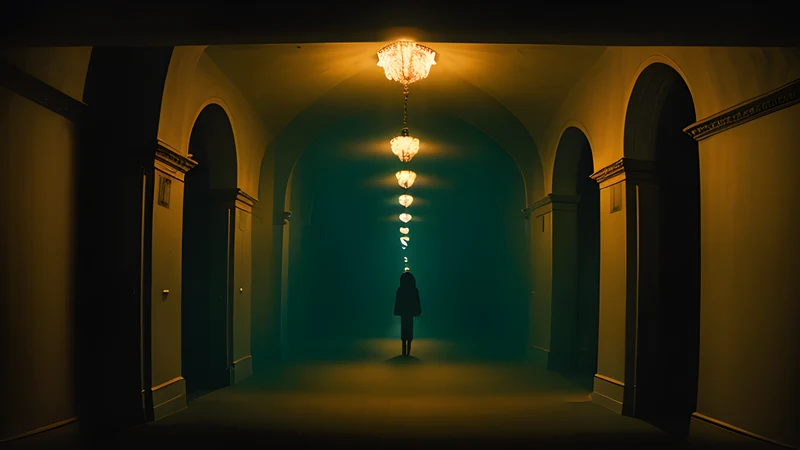
Bava shot this with Ubaldo Terzano, and by 1963 he had moved fully into the colour method he would spend the rest of his career refining. The castle is lit in reds, greens and cold blues that correspond to nothing in the rooms. A candle in shot throws crimson. A window admits emerald. The palette answers to Nevenka’s condition and to nothing else.
This is the technique that makes the film’s ghost story work, and it is worth being exact about the mechanism. Because Bava establishes from the first interior that this castle obeys a psychological lighting scheme, the audience has already agreed to a subjective image before the supernatural arrives. When Kurt starts appearing in Nevenka’s room, the film does not need to argue about whether he is real. The frame has been unreliable since reel one. Bava built the ambiguity into the gels rather than the script, which is a cameraman’s solution to a writer’s problem and the reason the ending lands as a confirmation rather than a twist. The same argument, in its later Argento and Refn forms, runs through Colour timing as horror.
His camera does the rest. The film is full of slow tracking moves down corridors toward doors, and Bava keeps arriving at the door a beat after you expect, so the rhythm of every scare is fractionally wrong. Wind moves the curtains constantly. Footprints appear in dust. He is running a haunted-house film with total conviction while the actual haunting is happening inside a woman’s head.
There is one further piece of craft that goes unremarked. Bava never shows the whip landing. Across a film named for the instrument, the strike is always off-frame, or masked by a body, or cut away from at the instant of contact, and what you get instead is Lavi’s reaction and the sound. This is partly the censor talking, and it is mostly technique: an impact you supply yourself is calibrated to your own imagination, which is by definition worse than anything a 1963 effects budget could stage. The film’s reputation as a notorious flogging picture rests on violence that is, shot for shot, almost entirely absent from it.
Where it sits
The ancestor is Emily Brontë by way of Freud — a returning man, a wild coast, a woman who cannot want anything sensible — and Bava is quite open about the Wuthering Heights borrowing, right down to the ghost at the window. The nearer relative is the ghost story that never quite commits, as in The Innocents two years earlier.
The descendant is Polanski. Repulsion arrived in 1965 and does the same thing in a South Kensington flat: a woman alone, a home that starts producing assailants, a film that photographs the delusion as fact and lets the audience discover the floor is gone. Polanski does it in black and white and with a psychiatric seriousness Bava never attempts. The structural move is identical, and Bava got there two years first with a whip and a castle and no critical respectability whatsoever. The lineage runs on to the modern unreliable-perspective film, catalogued in The unreliable narrator on screen.
Where to watch: only a version that restores the Italian cut at full length is worth the trouble. The What! edit is a different and much stupider film, and Rustichelli’s score — which is the film’s argument — was replaced in some territories.
Spoilers below
Kurt is murdered early, stabbed with the dagger that killed the servant girl Tanya years before, and the film spends its second half as a whodunit that everyone in the castle has a motive to have committed. The Count hated him. Christian had reason. Giorgia the housekeeper is Tanya’s mother, and she has never forgiven him. Bava lines up the suspects with total competence and none of it matters.
Nevenka killed him. She did it, and she has repressed it, and every subsequent visitation is her own production: the footprints, the whipping, the figure at the window, the corpse that leaves its crypt. She has been going out and doing it to herself, and the film’s most disturbing implication is that this is a solution rather than a symptom. Kurt dead is more available than Kurt alive. She has manufactured a lover who cannot leave, cannot be shamed by the household, and cannot refuse her, because she is operating him.
Bava plants the answer without underlining it. The apparitions only occur where Nevenka is. The other characters find evidence rather than Kurt. And the mud on the floor, which reads first as proof of a returning corpse, is proof that somebody walked in from outside — which the film eventually shows you was her.
The ending gives Christian the discovery and lets Nevenka die with the delusion intact, reaching for a man who is not in the room. The final cruelty belongs to Rustichelli. That sentimental piano theme, which has scored the whipping and the hauntings and the murder, plays out over her death exactly as it played over the beach, because the film has been a love story throughout and has simply been waiting for you to accept it.
Related Content