The Wailing: Na Hong-jin's Rain-Soaked Descent
A country policeman, a sick child, and a film that refuses to tell you who the devil is
Contents
The Wailing is a horror film about a man trying to work out what kind of horror film he is in, and failing, at a cost. Na Hong-jin’s 2016 epic — titled Gokseong after the real South Jeolla county where it was shot — runs a punishing 156 minutes and spends nearly every one of them keeping its footing on wet ground. It is a rural procedural, a possession picture, a plague story, a black comedy, and a folk nightmare, and it changes its mind about which of these it is exactly as often as its hero does. The genius is that the shifting is the subject.
A policeman out of his depth
Jong-gu (Kwak Do-won) is the least reassuring police officer imaginable: soft, slow, prone to naps and to arriving after the fact. When villagers in his mountain district start murdering their families — breaking out in weeping sores, going feral, then dead-eyed — he is the man notionally in charge of understanding it. He is not up to it, and Na plays that early inadequacy partly for laughs, letting Jong-gu bumble through crime scenes his stomach can’t handle. The comedy is a trap. It lowers your guard for the moment the sickness reaches his own house.
Because Jong-gu has a daughter, Hyo-jin (Kim Hwan-hee), and when she starts to change — the rash, the foul temper, the wrongness in the eyes — the film stops being anyone’s joke. Kim’s performance as an afflicted child is one of the most disturbing in modern horror, a wholesale swap of a bright kid for something that wears her face and enjoys the fit. Kwak, opposite her, gives Jong-gu the only arc that matters: a mediocre man discovering that love has made him capable of anything, including the wrong thing.
Three figures, no answers
Around the outbreak stand three enigmas, and the film’s whole engine is your inability to sort them. There is the Japanese stranger (Kunimura Jun), a hermit living in the hills whom the villagers blame on sight — an outsider, therefore a devil, in a piece of xenophobic reasoning the film both depicts and interrogates. There is Moo-myeong (Chun Woo-hee), a young woman in white who appears at the edges of scenes and speaks in warnings that may be guidance or misdirection. And there is Il-gwang (Hwang Jung-min), a flashy shaman hired to save Hyo-jin, whose spectacular exorcism ritual is the film’s set-piece and possibly its greatest deception.
Na refuses to hand you the map. Every reading the film offers, it also undercuts within twenty minutes. Is the stranger a demon, or a scapegoat destroyed by a village that needed one? Is the woman in white a guardian spirit, or the thing you should have feared? Is the shaman on your side? The film’s cruelty — and its brilliance — is that it makes doubt a moral act. Jong-gu has to decide who to trust with his daughter’s life while holding exactly the information you hold, which is not enough. His mistakes are the ones you would make.
Why it works
Na Hong-jin came to horror from crime. His first two films, the manhunt thriller tradition of The Chaser and the border-crossing brutality of The Yellow Sea, were about pursuit and violence in a recognisably solid world. The Wailing keeps that procedural spine — a cop, a case, a body count — and pours the supernatural into it until the genre floor gives way. The craft is in the mixture. Because the police-work feels grounded, the demonic reads as an intrusion rather than a premise, and because the comedy is real, the horror lands with a convert’s force.
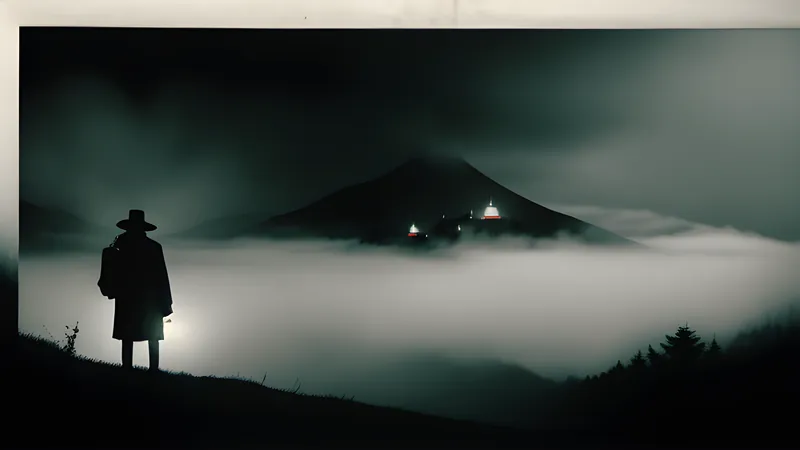
The physical production does an enormous amount of the work. Gokseong’s mountains are permanently soaked; the film is practically amphibious, mud and rain and low cloud smearing every exterior until the landscape itself feels feverish. Na cuts the exorcism sequence — Il-gwang’s drums and knives on one side, a rival rite on the other, Hyo-jin convulsing between them — as a parallel-action climax worthy of a heist film, then denies you the release such editing usually promises. The technique raises your pulse and then withholds the catharsis, which is precisely how the film keeps you off balance for two and a half hours.
It belongs to a specific Korean lineage of horror that treats the family home as the front line and grief or guilt as the true haunting — the register of A Tale of Two Sisters and, in its ghost-as-mourning key, The Orphanage. The Wailing is the loudest and largest of them, a chamber piece inflated to the scale of a plague, and it earns the size. Where the Japanese wave built dread from stillness — the slow tape-and-well terror of Ringu — Na builds it from noise and motion and moral panic, a whole community talking itself into damnation.
It also does something braver than most possession films dare. The village’s certainty that the Japanese hermit is to blame is a horror in its own right — a community reaching for the nearest outsider the moment its children start to die, decades of buried history surfacing as folklore. Na neither endorses the villagers’ xenophobia nor lets the audience feel clean about it, because the film keeps dangling the possibility that the paranoid mob is, this once, correct. That queasy suspension is the trap: it makes the viewer complicit in the same reflex the film is dissecting, wanting the stranger to be guilty so the fear will have a shape.
Chun Woo-hee, given the least dialogue of the three enigmas, does the most with silence; her stillness at the roadside becomes the film’s one fixed point, and the fact that Jong-gu cannot read it correctly is the whole tragedy in miniature.
Verdict
The Wailing is one of the essential horror films of its decade, and one of the hardest to shake, because it withholds the one thing the genre usually grants: the comfort of finally knowing what you were afraid of. It asks a lot — the runtime, the tonal whiplash, the deliberate refusal to resolve — and it repays every minute with a mounting sense that the ground under a good man is rotten and he can’t tell which step is safe. Watch it when you have the stamina, and don’t watch it alone if you want to sleep.
Where to watch: The Wailing has been widely available on physical media and streaming platforms internationally since its 2016 release; watch the Korean original with subtitles, in one sitting, with the lights off. If it lands, chase it with the quieter Korean and Japanese ghost stories linked above, and with Miike’s slow-burn cruelty in Audition, another film that lets you relax before it strikes.
Spoilers below
The final act is a machine built to break your heart through your own reasoning. As Hyo-jin worsens, Jong-gu is caught between the woman in white, who begs him to wait outside his house until the cockerel crows three times, and the shaman Il-gwang, who has fled the failed exorcism and now insists the stranger is the source and must be stopped at once. Jong-gu has to choose which warning to obey, and the film has spent two hours making both plausible.
He chooses wrong. Persuaded that the woman is the demon, he breaks his vigil and rushes home too early — and walks in on the aftermath of the slaughter the delay was meant to prevent. His family is dead. The film’s cruelty is that his fatal error is an act of love and of exactly the doubt it trained in him. In the coda, the stranger is revealed in a cave, transforming into a red-eyed devil for a shaken deacon who had come to test him, while Il-gwang photographs the dead as trophies — the two apparent adversaries exposed as collaborators. Moo-myeong, the woman he abandoned, was the guardian all along.
Na leaves it deliberately arguable — some read the shaman and stranger as one force, others as a demon and its human broker — and that irresolution is the point. The Wailing refuses the exorcism film’s usual promise that faith, correctly applied, saves the child. Here faith is just another thing that can be manipulated, and the devil’s cleverest trick is the doubt he leaves in a father who only ever wanted to be sure. It is a bleaker close than the folk-horror cruelty it resembles, and it lingers longer for giving you no one to blame but the reasoning you shared.
Related Content