The Void: The Lovecraftian Practical-Effects Throwback
A hospital, a ring of hooded cultists, and not one frame of computer-generated meat
Contents
There is a particular kind of film that exists because somebody wanted to build something with their hands. The Void, directed by Jeremy Gillespie and Steven Kostanski and premiered at Toronto’s Midnight Madness in September 2016, is one of those, and it wears the motive openly. It was part-funded by an Indiegogo campaign whose pitch was, in effect, give us money and we will make monsters out of foam latex instead of pixels. People gave them money. They made the monsters. The film that resulted has an ambition its screenplay cannot quite carry and a physical craft that almost nobody else was attempting in 2016, and the tension between those two facts is the whole story of the picture.
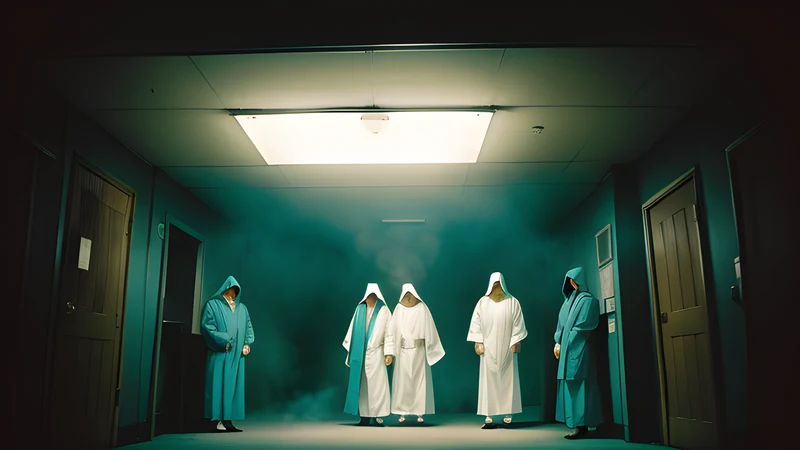
The setup is efficient. Deputy Daniel Carter, played by Aaron Poole, finds a bloodied man staggering out of a field at night and takes him to the nearest hospital — Marsh County, a facility half-emptied and running on a skeleton staff after a fire, which is a tidy way of getting a small cast into a large building. Inside are a handful of nurses, a couple of patients, an old doctor named Richard Powell played by Kenneth Welsh, and Carter’s estranged wife Allison, a nurse played by Kathleen Munroe. Outside, silently, figures in white robes with a black triangle on the hood begin to arrange themselves around the building. Nobody can leave. Something in the hospital starts turning people into other things.
Everything you see is real
The effects are the argument, so start there. Gillespie and Kostanski came out of Astron-6, the Winnipeg collective responsible for Manborg and The Editor, and Kostanski’s background is in practical make-up work — he has since made Psycho Goreman. The creatures in The Void are built objects: latex, foam, cable-operated jaws, glistening things puppeteered by people crouching just out of frame. There is no digital creature work of any consequence in the film.
The reason that matters is not nostalgia. A physical creature has to be lit, and lighting a physical creature forces choices — you must decide what to hide, because you cannot render the rest later. So the camera stays close, the light stays low and the monsters are revealed in fragments, and the fragments are always convincing because they were genuinely in the room, casting genuine shadows, occupying genuine space next to a real actor whose eyeline is correct. Poole is reacting to a thing that exists. That is a performance advantage no amount of tennis-ball-on-a-stick will buy.
Kostanski and Gillespie also understand the specific grammar of the era they are quoting. The creatures are wet, asymmetrical and mostly tentacular; they move slowly, because a puppet that moves slowly reads as heavy and a puppet that moves fast reads as rubber. The desk has laid out the wider case for this discipline in practical gore and the artistry of the effects maestros, and The Void is the best modern proof of the argument — a film in which a 2016 audience recoils from techniques that were considered obsolete in 1993.
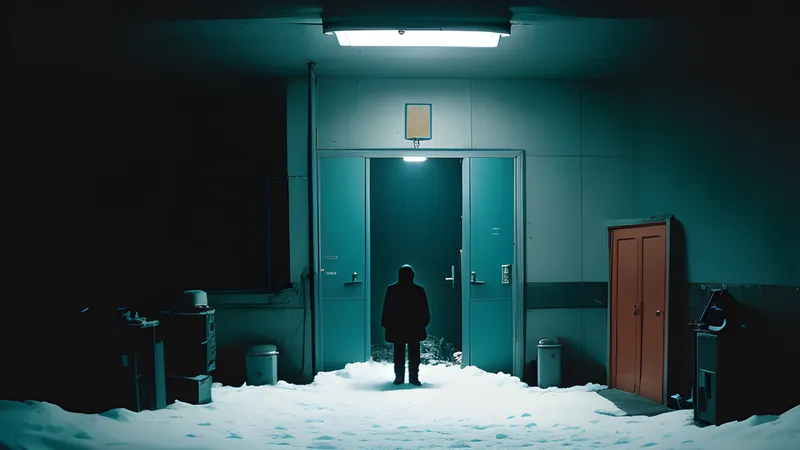
The lighting deserves its own note. The hospital is shot with hard, saturated sources — a corridor lit almost entirely by a single practical, an operating theatre in surgical white surrounded by black, and a recurring use of light that has visible colour temperature rather than a digital grade. The exteriors do the film’s best work: the robed figures are lit from behind and below by police lamps, standing in a field, doing nothing at all. They simply stand. It is the cheapest image in the film and easily the most frightening, because a person standing still in the middle distance costs nothing and cannot be improved upon.
The siege
Structurally this is a siege film, and the shape is borrowed with affection. A building, a small mixed group who do not like each other, a threat outside that will not act and a threat inside that will. Gillespie and Kostanski keep the geography clear, which is harder than it sounds and is the single most-failed test in low-budget horror. You always know where the basement is relative to the ward, and when a character runs, you understand what they are running toward.
The casting carries a collector’s signature. Art Hindle turns up as Sheriff Mitchell, and Hindle is a genuine artefact of exactly the cinema this film is quoting — he was in Philip Kaufman’s Invasion of the Body Snatchers in 1978 and in Cronenberg’s The Brood in 1979. Kenneth Welsh, meanwhile, was Windom Earle in Twin Peaks, and casting him as the hospital’s soft-spoken senior physician is a signal to anyone paying attention. Ellen Wong and Daniel Fathers fill out a cast that is doing capable work with fairly rudimentary material.
The real ancestor
The film is transparently descended from John Carpenter’s Prince of Darkness: the besieged building, the ring of silent figures outside who exist to prevent departure, the apocalyptic religion treated as physics, the mutating bodies. Carpenter’s film is smarter, and The Void knows it — the homage is a bow rather than a theft.
The second parent is Stuart Gordon and Brian Yuzna’s From Beyond, from which it takes the doctrine that cosmic horror should be sticky. Lovecraft’s own prose is famously abstract, and the desk has picked over the adaptation problem in cosmic dread and adapting the unadaptable Lovecraft. Gordon’s solution was to make the incomprehensible into wet flesh you could put in front of a camera, and Gillespie and Kostanski adopt it wholesale.
The third, and the one people underrate, is Fulci. The hospital-as-gateway, the sense that a building is sited over an aperture, the willingness to let narrative logic dissolve entirely once the aperture opens — that is The Beyond, and it is why the last twenty minutes of The Void stop making sense in a way that is deliberate rather than incompetent. Fulci taught the genre that a film could abandon coherence as a destination, and this is one of the few modern pictures with the nerve to try it.
The case against
The screenplay is the weak link and the film cannot hide it. The characters are functions — the estranged husband, the grieving wife, the pregnant girl, the vengeful father — and the dialogue does little to make them people. There is a subplot about a father and son hunting a man for reasons that arrive late and land thinly. Allison and Carter’s shared grief is the film’s emotional spine and it is delivered almost entirely in exposition; Munroe and Poole are good enough that you feel what the scenes were meant to do rather than what they do.
The film also runs out of money at the wrong moment. The final act needs to open onto something enormous, and the resources available produce a vision that is striking in still images and slightly threadbare in motion. A film that has spent ninety minutes proving that practical craft beats digital fakery ends at the exact point where practical craft cannot reach.
I would still recommend it without hesitation, and the reason is that the failures are the failures of ambition rather than laziness. Two men raised on the video shop decided to build the film they wanted to rent, with their hands, for less money than a single effects shot in a studio picture costs, and roughly eighty per cent of it works. The remaining twenty per cent fails while attempting something no sensible producer would have greenlit. That trade is worth making every time.
It streams and has had strong disc editions with proper effects documentaries, which are worth the time. Watch next: Prince of Darkness for the siege, From Beyond for the meat, Psycho Goreman for where Kostanski went next.
Spoilers below
Powell is the cult. Kenneth Welsh’s kindly old doctor is the man in the hood, and the robed figures in the field are his congregation, positioned to make sure nothing leaves the building until he has finished. His motive is the oldest one available and the film plays it straight: his daughter Maggie died, and he has spent the intervening years learning how to bring her back. The triangle on the hoods is the aperture — a door drawn as a shape.
What the hospital is sitting on is a hole in the world, and Powell’s method involves running human bodies through it. The transformations are the consequence: the nurse who peels her own face off in the first act is the demonstration, and everything that follows in the basement is the same operation at scale, bodies opened and rebuilt into things with too many limbs and no interest in stopping. Kostanski’s puppeteers earn their fee in the lower floors.
Maggie comes back, after a fashion, and the film’s cruellest beat is that Powell gets what he asked for and it is useless — the thing he raises is his daughter in the sense that a photograph is a person. Carter kills him, though killing him fixes nothing, because Powell was a man who found a door rather than a man who built one, and the door stays open regardless.
The ending is the swing. Carter and Allison go through, and the film’s last image is the two of them standing in another place entirely — a black landscape under a wrong sky, with an enormous dark pyramid on the horizon. No explanation. No return. The picture that opened as a siege thriller closes on a Lovecraftian tableau with no dialogue and no resolution, and the film simply stops.
That is the Fulci inheritance paid in full. The couple’s dead child, the grief that has run underneath every scene, the marriage that fell apart — all of it is answered by a shot of two small figures in front of a shape that does not care. Whether they are dead, transformed, or standing in the place their child went is left open, and the film’s refusal to say is the most confident decision in it. A more expensive production would have explained. This one built a pyramid, pointed a camera at it, and cut to black.
Related Content