The Video Nasty List, Forty Years On
How a police memo became the best-curated canon in British film history
Contents
Forty years after the Director of Public Prosecutions began circulating a list of films his office thought might be obscene, you can buy most of them in a slipcase with the words “VIDEO NASTY” embossed on the spine in a font designed to look like evidence tape. Arrow and 88 Films have built substantial businesses on this. The branding is the selling point. Somewhere in the archive of the British state there is a document that was meant to end these films, and it has instead spent four decades functioning as the most effective piece of film curation the country has ever produced.
I have written elsewhere about what the BBFC was really afraid of during the panic itself. This is the longer view: what the list did to the films after the shouting stopped, and whether the collector’s affection for it — mine included — survives contact with the paperwork.
The document had no legal force whatsoever
Start with the fact that gets left out of most accounts, because it reframes everything. The DPP list was guidance circulated to police forces, indicating which titles the DPP’s office believed might sustain a prosecution under the Obscene Publications Act 1959 — a law from the era of Lady Chatterley, drafted with books in mind, which asked whether an article tended to “deprave and corrupt” those likely to see it. Its whole authority rested on whether a chief constable chose to act.
It followed from a gap in the rules rather than any new appetite for censorship. The BBFC classified films for cinema exhibition. Videotape was a new commercial format, nobody had legislated for it, and so between roughly 1979 and 1983 a British distributor could put anything on VHS and a British newsagent could rent it to a twelve-year-old. That is the whole origin of the panic, and it was a real gap: no serious person argues that Cannibal Holocaust should have been available next to the Disney shelf with no certificate on it.
What the DPP produced in response was a moving target. Titles went on and came off. At its longest the list ran to 72 films, of which 39 were successfully prosecuted; the remainder were either acquitted, dropped, or shifted onto a secondary tier where they were liable to seizure without a prosecution following. A distributor had no way to know from one month to the next what was safe. Worse, obscenity was decided by local juries under local prosecutions, so the same tape could be obscene in one county and lawful in the next. The law was a lottery with the stock as the stake.
Parliament closed the gap with the Video Recordings Act 1984, brought in as a private member’s bill by Graham Bright with government backing. And here the story acquires its perfect punchline: in 2009 someone finally noticed that the 1984 Act had never been notified to the European Commission as required under the technical-standards directive, which meant it had been unenforceable for twenty-five years. Every prosecution brought under it during that period rested on a law with a procedural hole in it. Parliament quietly re-enacted the whole thing as the Video Recordings Act 2010 and moved on.
The list was partly assembled from packaging
The detail that most exercises collectors is that a meaningful number of these decisions were made about objects rather than films.
Abel Ferrara’s The Driller Killer (1979) is the clearest case. It is a grimy, half-improvised No Wave picture about a painter losing his mind in downtown Manhattan, closer to a Warhol Factory offcut than to a horror film, and it spends more screen time on rent arrears and a struggling band in the next flat than on the drill. What put it at the head of the panic was its advertising: a full-page image of a drill entering a man’s skull, run in the trade and consumer press with a confidence that a British newspaper editor found irresistible. The cover sold the film to renters and to the Daily Mail in the same week.
Then there is the case that should have ended the whole exercise on its own. Andrzej Żuławski’s Possession (1981) went on the list. This is a film that premiered in competition at Cannes, where Isabelle Adjani won Best Actress for it; a Polish auteur’s shrieking, Berlin-set allegory about the end of his own marriage, with a Carlo Rambaldi creature in it and some of the most committed screen acting of the decade. It was seized as obscene in Britain. A functioning process would have caught that in an afternoon.
The format made the films look guilty
There is a technical reason these titles played as more depraved than they were, and it belongs to the tape rather than to the direction.
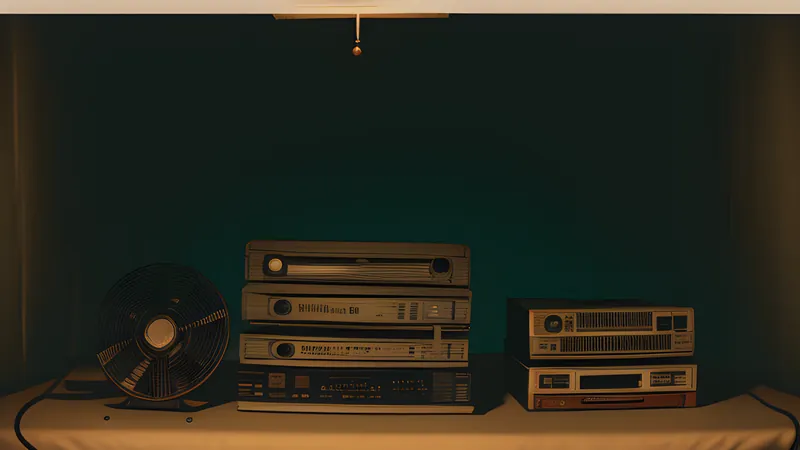
VHS was a bad format holding a low-budget film badly. Most of the nasties were shot on 16mm or cheap 35mm, then transferred to tape by rights-holders with no money, then duplicated at speed for the rental market, then copied again by shops and again by teenagers. Every generation lost resolution, crushed the blacks and smeared the colour. The result was that a mediocre gore effect — a latex appliance that reads as latex in a cinema — became an unreadable red mass on a fourth-generation tape playing on a fourteen-inch portable. The image degraded into something the viewer’s imagination had to complete, and imagination is always nastier than a prosthetic.
The censors were watching the same degraded tapes. A police officer assessing Zombie Flesh Eaters in 1983 saw a murky, juddering, tracking-error-riddled artefact that genuinely looked like contraband, because everything on that format looked like contraband. Restore the same film to 4K from the negative, as Arrow has, and Fulci’s compositions turn out to be careful, his Caribbean locations sunlit and handsome, and the notorious splinter sequence obviously a constructed effect. The panic was reacting in part to bad video engineering. This is also why the current video-shop aesthetic revival keeps reaching for the artefacts — the grain, the tracking lines, the wobble — as though they were authorial choices. They were compression damage, and they were doing more work than most of the directors.
What forty years did to the reputations
Here is the mechanism that makes the list interesting as an act of curation, however accidental. Prohibition performed three services for these films, and no marketing budget could have bought any of them.
It gave them a group identity. Before 1983 these were unrelated films from four countries with nothing in common beyond a distributor’s willingness to release them. Afterwards they were a set, with a membership roll and a numbered order. Sets get collected. A shelf with sixty-eight of seventy-two on it is an unbearable thing to own, and the DPP invented that itch.
It certified transgression. A teenager in 1985 had the state’s own assurance that these tapes were dangerous. That is a guarantee of quality no poster can make, and it travelled through school playgrounds with total efficiency.
It preserved them. Films of this budget normally vanish — the negative rots, the rights fragment, nobody reissues them. The nasties acquired a permanent constituency that kept demand alive through the VHS trade, the bootleg years, the DVD boom and now 4K restorations of films that were shot for less than the cost of the restoration. Sam Raimi’s The Evil Dead was Palace Pictures’ great video success because of the notoriety, and its afterlife funded a career.
The BBFC, meanwhile, changed its mind about nearly all of it. James Ferman’s interventionist board gave way to Robin Duval’s in 1999, and the wall came down fast: The Exorcist finally got a video certificate that year after Ferman had spent a decade withholding one, The Last House on the Left passed uncut in 2008, and today the overwhelming majority of the seventy-two sit on shelves with 18 certificates and no cuts. I traced how that reversal happened in the censor’s scissors. Cannibal Holocaust remains the notable exception, and the reason is instructive: the cuts the board still requires concern the real killing of real animals on camera, which engages the Cinematograph Films (Animals) Act 1937 — an actual documented harm to an actual creature, which is a different category of objection from the one the panic was making.
The case against my own affection
The collector’s version of this history has hardened into a comfortable story: idiot moralists, brave distributors, misunderstood art, vindication. I have told it that way myself, and it needs pushing back on in three places.
Most of the films are bad. Time has not revealed hidden merit in them and it has had forty years to try. The list contains perhaps a dozen genuinely accomplished pictures, a further dozen with real craft or interest in them, and a long tail of cheap, boring, competently-photographed tedium whose sole distinction is the DPP’s attention. The Italian cannibal cycle in particular contains material that no amount of formal analysis redeems, and defending it as a bloc means defending things I would rather not have watched.
The gap was real. The pre-1984 situation was untenable, and the people who wanted something done were correct. What they got was a bad instrument, applied incompetently, by people who had frequently not seen the films. My quarrel is with the instrument and the competence. Someone defending the pre-1984 shelf itself — a thirteen-year-old renting SS Experiment Camp on his mother’s card — has a much harder case to make, and the collector’s story tends to skip past it in a hurry.
And the nostalgia has become a product. When Arrow prints “VIDEO NASTY” on a spine, the transgression being sold is forty years dead and entirely safe. The teenager in 1985 was taking a small real risk. The customer in 2023 is buying a restored disc with a commentary track and an essay booklet, which is a pleasure I share and should not confuse with danger. Prano Bailey-Bond understood this exactly in Censor (2021), which is about a woman for whom the panic was never an aesthetic.
What survives
Watch the seventy-two and the durable lesson concerns what prohibition does to its object. A state that sets out to bury a group of films will reliably build them a monument, because banning something is a form of attention, and attention was the one thing these titles could never have bought for themselves. The DPP gave seventy-two obscure titles a permanent address in British film culture. If you want the dozen that justify the trip, they are in the ten that earned the panic. The rest are a monument to how badly a moral panic reads a shelf.
Related Content