The Vast of Night: A Whole Alien Mystery in Two Voices
Andrew Patterson's debut turns a single New Mexico night into radio drama with pictures
Contents
There is a moment early in The Vast of Night when the film stops trusting your eyes entirely. A woman on a switchboard is listening to a strange sound on the line, and Andrew Patterson holds on her face while the frame goes black around her, the picture draining away until there is nothing left but the audio and the flicker of her concentration. It is a debut director telling you, in his first quarter of an hour, that he knows exactly what his film is made of. Sound. Talk. Two young people describing something they cannot see.
Released in 2019 and picked up by Amazon, Patterson’s first feature was made for a reported budget in the low hundreds of thousands, shot over a handful of weeks in Whitney, Texas, standing in for the fictional town of Cayuga, New Mexico. The whole thing runs about ninety minutes. It concerns a single evening in the late 1950s, when most of the town has gone to the high-school gym for a basketball game and two teenagers who work the graveyard shift stumble onto a radio frequency that should not exist. That is the film. A sound, and two people chasing it.
The frame within the frame
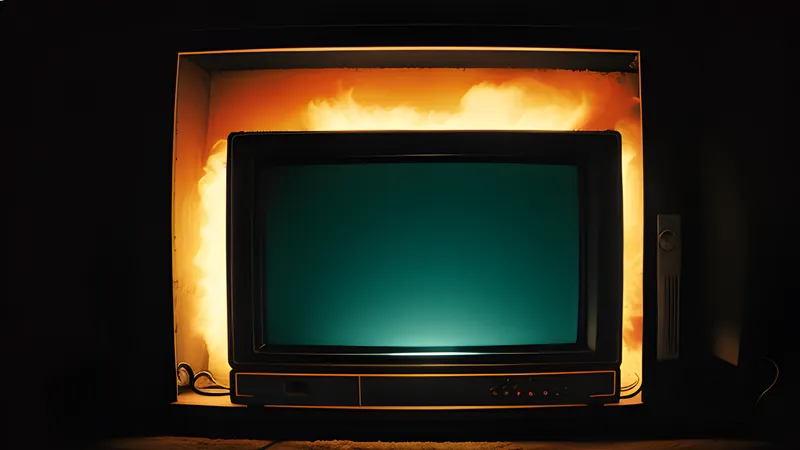
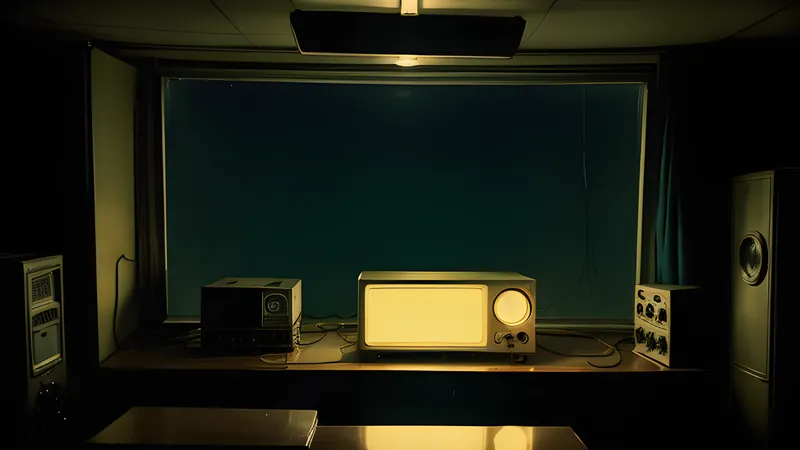
Patterson wraps the story in a piece of misdirection that some viewers find precious and I find load-bearing. We open on a boxy old television set, and a title card announces an episode of Paradox Theater, an anthology programme with an obvious debt to The Twilight Zone. Every so often the film retreats back into that black-and-white cathode glow, reminding you that what you are watching is a broadcast, a story told for the airwaves. It is a framing device that does real work. This is a movie about transmission, about voices reaching across distance and landing in a stranger’s ear, and it keeps folding that idea back into its own form.
The two voices belong to Fay Crocker (Sierra McCormick), sixteen and running the town telephone exchange, and Everett Sloan (Jake Horowitz), a little older, a fast-mouthed disc jockey at the local station WOTW. That call sign is a wink at The War of the Worlds, and Patterson wants you to catch it. Everett talks the way boys talk when they have decided radio is their ticket out. Fay talks the way clever girls talk when nobody has yet told them their curiosity is worth anything. When the sound turns up, first on Fay’s switchboard and then bleeding onto Everett’s broadcast, the two of them set about solving it in real time, on air, taking calls from listeners who might know more than they do.
Why the long takes matter
The film’s most discussed sequence is a single unbroken shot that leaves the characters entirely and races across the whole town at night, low to the ground, skimming the empty streets, ducking through the gym where the game is in full swing, and out the other side to the radio station. It is a bravura piece of camerawork, and on a first watch it reads as showing off. On a second it reads as thesis. The town is asleep at its game while something enormous is happening at its edges, and the camera is the only thing awake enough to connect the two rooms where the mystery is unfolding. Patterson is dramatising attention itself.
Elsewhere he does the braver thing and stops moving the camera at all. There is a long telephone conversation, and a longer monologue delivered down a microphone by a caller with a story to tell, during which Patterson repeatedly cuts to black and lets the voice carry the entire scene. A lesser film would cut away to illustrative flashback, would show you the thing being described. Patterson makes you build it yourself out of a stranger’s voice, which is precisely how the best radio drama has always worked, and precisely how a rumour becomes a belief. The restraint is the special effect.
This is where the craft rewards a patient viewer. The performances have to be flawless for the stillness to hold, and McCormick and Horowitz are. Horowitz gives Everett a motor-mouthed confidence that is half armour, and McCormick lets Fay’s face do the listening for the entire audience. Watch how often the film’s tension lives in the gap between what a voice is saying and what her expression is doing while she hears it.
The period texture is doing quiet work too. Patterson and his team reconstruct the analogue machinery of the 1950s with a fetishist’s care, the tape reels and the plug boards and the tube radios warming up, and the film keeps letting us watch the machines run. Fay demonstrates a new-fangled reel-to-reel recorder in an early scene with the delight of someone handling the future, and the moment doubles as a thesis: this is a world where sound could suddenly be captured, stored and played back, and that new power is exactly what lets two teenagers hold the evidence of something impossible in their hands. The technology dates the story to the last decade when a recording could still feel like magic, and Patterson leans on that innocence. He is nostalgic for an age of listening, and he built a machine to make you feel the loss of it.
The real ancestor of this thing
Every collector’s instinct in me wants to place The Vast of Night on the right shelf, and it is a crowded, honourable one. The obvious grandparent is radio itself, the Mercury Theatre panic of 1938, the idea that a broadcast could reach into a kitchen and make the ordinary feel besieged. Its television grandparent is The Twilight Zone, which the framing device all but signs. But its truest siblings are the recent micro-budget science-fiction films that understood you can buy an entire cosmos with a good script and a few committed faces.
I keep pairing it with Coherence, James Ward Byrkit’s dinner-party film that also generates dread almost entirely from people talking in a confined space while something vast happens outside the window. It shares DNA with The Man from Earth, which stakes a whole science-fiction premise on a single room and the pull of a story well told. And it belongs beside the location-driven wonder of Monsters and the sibling filmmakers behind The Endless, all of them proof that the American independent scene rebuilt cosmic awe from the ground up when the studios had priced it out. What unites them is a faith that suggestion outperforms spectacle when the budget forces the choice.
Where does The Vast of Night rank in that company? Higher than its modest reach might suggest. It is the most formally confident of the lot, the one most in love with its own machinery, and that self-delight is the only thing you could hold against it. Some viewers bounce off the theatricality of the dialogue, the way everyone speaks in polished paragraphs. I read that as a period register, the cadence of an era that still trusted talk, and it never broke the spell for me.
Spoilers below
The pleasure of the film is how long it withholds. The frequency turns out to be interference of an unearthly kind, and the film delivers its exposition through two extraordinary set pieces. The first is a phone call from a former military man, Billy, who claims he worked on a covert programme assembling something recovered from the sky, and that the sound is the same one he heard then. Patterson plays almost the entire call over a black screen. It is the single boldest choice in the picture, and it works because the voice is doing everything a face could not.
The second is a visit to a housebound old woman, Mabel Blanche, who tells Fay and Everett that the sky has been taking people from Cayuga for years, that her own son was among them. Her monologue is the emotional core, and it reframes the whole night. The mystery stops being a puzzle and becomes a grief.
The ending commits. Fay and Everett drive out to the site where the signal is strongest, and the film finally gives us the thing it has withheld: a craft, a light, an abduction. Fay is taken. It is a genuinely eerie image, all the more so for arriving after ninety minutes of pure suggestion, and Patterson has the discipline to keep it brief and strange rather than triumphant. The film then folds back into the television frame one last time, the Paradox Theater set fading to a dead channel, and the effect is a small ache. We have been told a ghost story about the radio age, about the last era when a voice on a wire could still feel like a visitation.
The verdict is that this is one of the finest science-fiction debuts of its decade, a film that turns its own poverty of means into a philosophy of storytelling and comes out the far side richer than pictures that cost a hundred times as much. It is a movie about listening, made for people who still know how. If it sends you anywhere next, make it Coherence for the same trick of vast events in small rooms, and then The Endless for where this strain of American low-budget science fiction went once it grew braver about the light at the end of the drive.
Related Content