The Vanishing (Spoorloos): The Ending That Ruined Sleep
George Sluizer's 1988 abduction thriller hands you the killer early and makes the not-knowing unbearable
Contents
There is a small class of films that people warn each other about the way they warn about a cliff edge. Spoorloos — released internationally as The Vanishing — is at the front of it. George Sluizer’s 1988 Dutch-French thriller, adapted by Tim Krabbé from his own novella The Golden Egg, spends most of its running time as a patient study of loss and obsession, and then closes on an image so bleak that people who saw it once in the late eighties will still tell you they never quite got over it. It is a horror film that contains almost no horror-film furniture. No mask, no score stabbing at you, no monster. Just a service station in the sun, a man who will not stop looking, and a chemistry teacher with a hobby.
The killer is not a mystery
Most abduction thrillers run on the engine of who. Sluizer disposes of that engine in the first act. A young Dutch couple, Rex and Saskia, are driving through France on holiday. They stop at a busy motorway service station near Nîmes. Saskia walks in to buy drinks and does not come back. She is simply gone, in broad daylight, in a crowded place — which is a far worse thing than a shadowed alley, because it removes every comforting story you could tell yourself about how to stay safe.
And then, unusually, the film introduces us to the man who took her. Raymond Lemorne, played by Bernard-Pierre Donnadieu, is a bespectacled family man, a lecturer, a homeowner with a wife and daughters and a summer house. We watch him rehearse. We watch him time himself, practise his patter, test his chloroform on himself, fail and try again with the fussy diligence of a man perfecting a soufflé. Krabbé and Sluizer make the monstrous thing about Raymond his ordinariness, his method, the way he approaches an act of annihilation as an intellectual exercise in whether he is capable of it.
This is the choice that makes the film. By handing us the who and the how early, the picture converts its tension into something purer and more unbearable: the dread of knowledge. We are ahead of Rex, and we cannot warn him. The clinical, unhurried evil of Raymond belongs to the same rare cabinet as the surgeon in Eyes Without a Face, another European film where the true horror is a respectable professional treating human beings as material for a procedure.
Two men, three years, one question
The film’s real subject is obsession, split across two mirrored men. Rex, played by Gene Bervoets, cannot let Saskia go. Three years pass. He acquires a new partner, and still he papers the walls with appeals, still he chases every crank lead, until his need to know what happened has hollowed out any possibility of a life. Raymond, watching from a distance, recognises a kindred fixation. He too is a man consumed by a question he cannot leave alone — in his case, whether he is truly the person capable of the worst thing he can imagine.
The two obsessions eventually reach for each other. Raymond makes contact and offers Rex the one thing he has been unable to buy, beg or reason his way to for three years: the truth about what became of Saskia. The offer comes with a condition that the film has been quietly loading since its first frame. Krabbé’s structure is the machine here, an interlock so tight that by the time the two men sit in a car together you understand there is only one way this can end, and you understand it in your stomach before your mind will say it.
Sluizer directs all of this in flat, sunlit, almost documentary daylight. The absence of horror lighting is the strategy. Nothing about the frame tells you to be afraid, which means the fear has nowhere to hide and no genre convention to be safely filed under. It is the same trick Kiyoshi Kurosawa would later run in Cure, where an ordinary, overcast world becomes the most frightening backdrop imaginable precisely because it withholds every cue that would let you relax into knowing you are watching a scary movie.
The remake that flinched
Here is the fact that turned The Vanishing into a permanent case study for critics: five years later, in 1993, George Sluizer directed the Hollywood remake of his own film. Same director, same source, a strong cast — Jeff Bridges, Kiefer Sutherland, Sandra Bullock, Nancy Travis — and a studio behind it that could not bear the original’s ending. So they replaced it. They swapped the void for a rescue, a heroic reversal, a resolution that lets the audience walk out unbruised.
It is one of the cleanest natural experiments in the history of the form: the identical story, told twice by the identical filmmaker, with only the final movement changed. The 1988 version is a landmark. The 1993 version is a byword for how a happy ending can retroactively drain the meaning from everything that led to it. I used exactly this pairing as the anchor example in why every horror remake softens the ending, because nothing else in the canon isolates the variable so perfectly. Watch them back to back and you can measure, almost to the gram, what a film loses when it decides its audience must be protected.
The service station and the golden egg
Krabbé titled his novella The Golden Egg after a recurring dream Saskia describes early on: she is floating alone inside a golden egg through endless dark space, and there is a second egg out there with someone else inside it, and if the two eggs ever collide, both people go free. It is one of the most quietly devastating images the film keeps in reserve, because the story that follows is the collision — Saskia’s egg and Rex’s, drawn together across three years by the void between them. The film plants the dream, lets it recede, and only reveals its full weight in retrospect, which is the mark of a script that trusts its own structure.
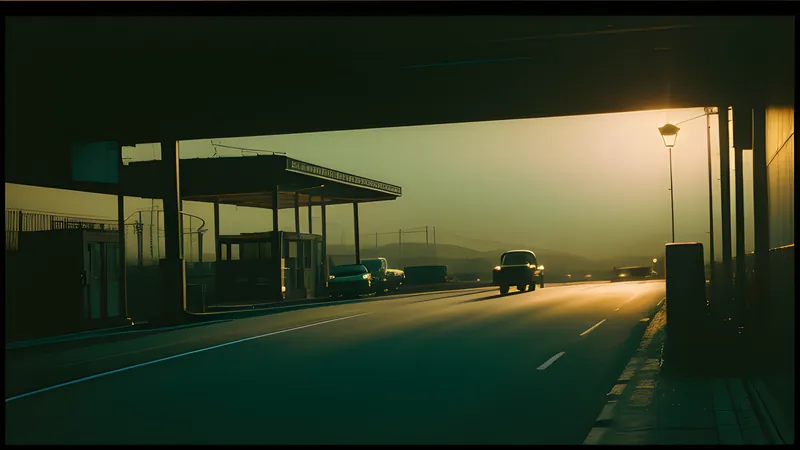
That patience extends to the geography. The Nîmes service station is filmed as the most ordinary place on earth: petrol pumps, a shop, families stretching their legs. Sluizer keeps returning to it, mapping its dull layout until it becomes a haunted site through sheer repetition, a spot where the worst thing imaginable happened in front of dozens of people who noticed nothing. The film’s confidence in banality — its faith that an unremarkable forecourt in the sun can be more frightening than any crypt — is the same instinct that drives the best of the J-horror wave, where dread pools in stairwells and damp flats rather than dungeons.
Why it works
The Vanishing is durable because its terror is not supernatural and therefore cannot be dismissed. The cliff edge it walks you to is a real one — the ordinary, unbearable fact that a person can step out of your life mid-sentence and leave no trace, and that the search for an answer can become a second disappearance, this time of the searcher. Donnadieu’s Raymond is one of cinema’s great quiet villains precisely because he is never theatrical; he is polite, tired, faintly self-deprecating, a man you would ask for directions.
Where to watch: the 1988 Spoorloos is the one you want, available through the Criterion Collection and worth every effort to find; take care not to stumble into the 1993 remake by accident, as the streaming metadata often confuses the two. The verdict is that this is the coldest great thriller Europe produced in the eighties, a film whose restraint is a form of ruthlessness, and it earns its reputation as the ending that ruined sleep. If you finish it wanting more of the same continental unease, Repulsion will take you deeper into it — Polanski’s flat, another sunlit European nightmare where an ordinary interior turns predatory.
Spoilers below
The condition Raymond attaches to his offer is that Rex must experience precisely what Saskia experienced. To know, he must undergo it himself. Raymond gives him a cup of drugged coffee and tells him that when he drinks it, he will learn the answer. Rex, three years past the point where safety means anything to him, drinks.
He wakes in total darkness, in a confined space, and as he lights a match the film delivers its final, annihilating information: he is inside a coffin, buried alive underground, exactly as Saskia was. The last shot is a newspaper report and Raymond back at his summer house with his family, unpunished, at peace — a monster who conducted his experiment, obtained his data, and went home. The horror lies in the specific, claustrophobic, oxygen-counting knowledge of the death, granted to Rex as the price of his obsession, and to us as the price of ours.
That the 1993 remake reached into this and pulled out a last-minute rescue, letting its hero dig his way to daylight and defeat the killer, is the single most instructive act of cowardice in modern genre cinema. The original understands that the buried coffin is the point — that some films exist to deny you the exit, and that denying you the exit is the only honest way to render a certain kind of loss. Sit with it against the flinch of the remake and you will never again mistake a softened ending for a kindness. For the fuller argument, why every horror remake softens the ending starts exactly here.
Related Content