The Uninvited (1944): The Ghost Story Hollywood Took Seriously
The Hollywood haunting where the ghost is real, the grief is deeper, and the scares are meant
Contents
For most of the 1930s, Hollywood could not bring itself to believe in its own ghosts. The haunted-house picture was a comedy engine, the spooks a hoax to be unmasked in the last reel, some crook in a bedsheet after the inheritance. The Uninvited changed that. Here, in 1944, at a major studio, the ghost is real, the film says so plainly, and it asks to be taken at its word. That decision — to let a Hollywood haunting actually haunt — makes it the ancestor of every serious screen ghost story that followed.
A house that is too cheap
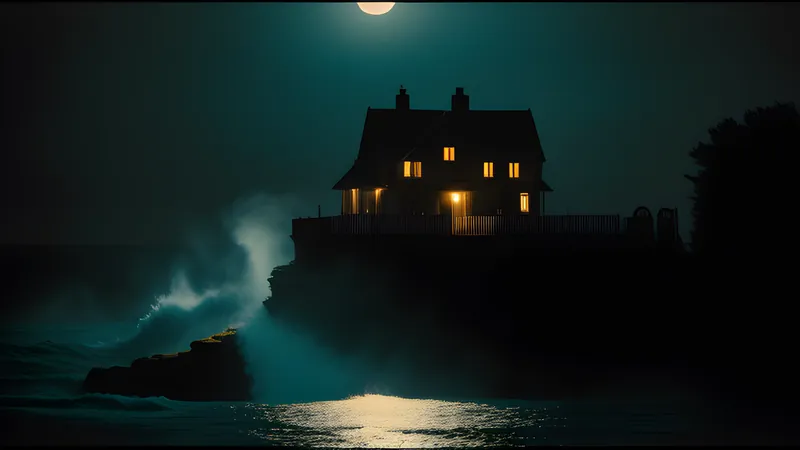
The premise is disarmingly gentle. Roderick Fitzgerald, a composer and music critic, and his sister Pamela, on holiday in Cornwall, stumble on a beautiful abandoned house on a clifftop and buy it on impulse for a price so low it should have set alarms ringing. Windward House has been empty for years, and the local family that sold it — an old commander and his granddaughter Stella — reacts strangely to the sale, the grandfather forbidding the girl to go near the place she was born.
Ray Milland plays Roderick with an easy light-comic charm, and for its first stretch the film is almost a romance, all sea air and banter and a brother and sister setting up house. Milland was a year away from his Oscar-winning turn as an alcoholic in The Lost Weekend, and he brings that same lived-in ease here, so the horror lands on a man we have come to like rather than a stock hero. Ruth Hussey gives Pamela a level-headed intelligence that anchors the film; she is the one who names what they are living with before her brother will. Then the hauntings begin, and the film’s tonal control reveals itself. It does not lurch into horror. It lets the dread seep in, one small wrongness at a time.
The manifestations are beautifully chosen. A room that is always cold, no matter the fire. The scent of mimosa where no flowers grow. A dog that will not climb the stairs. And, at night, the sound of a woman weeping somewhere in the house, a grief with no source. Long before anyone sees anything, the film has made the house unbearable through sensation alone — temperature, smell, sound — which is a far subtler toolkit than the era’s usual rattling chains. There is a detail I have always loved: the mimosa scent belonged to Carmel, so the smell works as a clue, the dead woman announcing herself the only way she can. The film plants its evidence in the reader’s nose. Dorothy Macardle’s source novel, published in Britain as Uneasy Freehold, took its hauntings seriously on the page, and the adaptation had the nerve to keep that faith rather than smuggling in the customary rational let-out.
The apparition Hollywood dared to show
What sets The Uninvited apart from its cautious predecessors is that it eventually shows you the ghost, and means it. A luminous, drifting apparition manifests on the staircase, an early instance of a Hollywood film committing to a visible spectre presented as genuine rather than a magic-lantern trick. The effect is simple and, in context, audacious. The studio’s own advertising fretted over whether audiences would accept a real ghost; the film’s conviction carried it.
Under the fright is a genuinely knotty mystery, and it is here that The Uninvited shows its intelligence. Two women died connected to this house — Stella’s mother Mary Meredith, remembered by all as a saint, and Carmel, a Spanish model who lived with the family — and the haunting is bound up in their story. The film gradually complicates the received history of Windward House, so that the real question becomes which of the two dead women is the malign presence and which the protective one. The scares are in service of a puzzle about the past, and the puzzle is in service of grief.
There is also a strand the 1944 censors could only allow to whisper. Cornelia Otis Skinner plays Miss Holloway, who runs a nearby sanatorium and who nursed a consuming, unmistakably romantic devotion to the dead Mary Meredith, keeping her portrait like a shrine. The film cannot say the word, and it does not need to; Holloway’s obsession is one of classic Hollywood’s more legible queer-coded portraits, and it drives the plot’s darkest turns. The ghost story, as so often, turns out to be about love that could not speak itself.
Why the dread still lands
The craft is why it endures. Lewis Allen, directing his first feature, stages the house with real spatial confidence, the staircase and the sealed studio room becoming charged geography you learn to fear. Charles Lang’s cinematography drapes Windward in moonlight and sea-mist and lets darkness pool in the corners, so the eye keeps hunting the shadows for a shape. The restraint is the strategy. For most of the film you are frightened by what you cannot see, and the eventual apparition works precisely because the film spent an hour teaching you to dread the air itself.
And then there is the music, which carries an odd footnote in cultural history. Victor Young’s score for the film includes a theme that was later given lyrics and became the standard Stella by Starlight, named for the film’s Stella — one of the loveliest songs in the American repertoire, born inside a ghost picture. The melody’s yearning quality is not incidental; the whole film aches, and the score aches with it. That a piece of music written to underscore a haunting should outlive the film as one of the century’s great love songs is a fitting accident, because The Uninvited is finally a love story with ghosts in it.
What The Uninvited understood, decades early, is that a ghost story works best when the haunting and the heartbreak are the same thing. The presence in the house wants something, mourns something, protects something, and the terror and the sorrow arrive together. That is the template. Get that right and a ghost stops being a jump-scare and becomes an argument about the past.
The ghosts it fathered
Set it in the collector’s lineage and The Uninvited is the well-behaved grandparent of the serious screen ghost story. Its direct descendants take its central bet — that a haunting can be genuine, and can be about grief — and refine it. Robert Wise’s The Haunting keeps the seeping, unseen dread and pushes it further, refusing to show the ghost at all. Jack Clayton’s The Innocents keeps the ambiguity and the repression, leaving you unsure whether the spectres are real or projected. Both are unthinkable without the ground The Uninvited broke first.
Nearer our own time, the film that most honours its method is The Changeling, another story of a grieving man in a too-large house piecing together the injustice a ghost cannot rest without avenging; watch the two together and the shared DNA is plain. For the cold, sensory approach to a haunting stripped to sound and temperature, Session 9 proves the tactic still terrifies with nothing supernatural shown at all.
The verdict argues itself. The Uninvited is the film that gave the Hollywood ghost story its dignity, treating a haunting as a real event with a real grief behind it and trusting an audience to be moved as well as frightened. It is warmer and funnier than its reputation, unafraid of a laugh in its first act, which only makes the cold that follows bite harder. If you love the serious ghost picture, this is where the modern version of it begins.
Spoilers below
The mystery inverts the received history of the house. Mary Meredith, remembered locally as an angel, was in truth cold and cruel, and it is Carmel — the Spanish model long slandered as the interloper — who was Stella’s real mother. The malevolent presence haunting Windward and menacing Stella is Mary, and the weeping, protective spirit is Carmel, trying across the barrier of death to shield her daughter from the woman who wronged them both. The saint is the monster; the scapegoat is the guardian angel.
Miss Holloway is the film’s living villain, her worship of the dead Mary curdling into a scheme that nearly costs Stella her life at the clifftop, an attempt to complete in the present the harm Mary began. The resolution turns on Roderick and Pamela reconstructing the truth and confronting the two ghosts directly, so that the film’s climax is an act of setting a false story right. Mary is finally banished, Carmel’s spirit is freed, and Stella is released from the fate that hung over her from birth. The haunting ends with a correction rather than an exorcism of noise and light — the record put straight, the wronged woman believed at last, the grief allowed to close. It is the most humane possible ending for a ghost story, and it is why the film still feels ahead of its time.
Related Content