The Turin Horse: Tarr's Final, Elemental Film
Six days, thirty shots, and two people boiling potatoes at the end of the world
Contents
There is a story about Friedrich Nietzsche that every philosophy undergraduate has heard. In Turin, in January 1889, he came out onto the street and saw a cabman thrashing a horse that refused to move. He threw his arms around the animal’s neck, and something in him broke. He spent the last decade of his life in the care of his mother and then his sister, mostly silent. Béla Tarr’s last film opens with a narrator telling you exactly this, in a flat voice over black, and then delivers the line that the whole picture hangs from: of the horse, we know nothing.
The Turin Horse (2011) is Tarr’s answer to that gap in the record. It is 146 minutes long, shot in black and white by Fred Kelemen, co-directed with Tarr’s long-time editor and partner Ágnes Hranitzky, and written with László Krasznahorkai, the novelist whose sentences have been running underneath Tarr’s images since the 1980s. It is composed of roughly thirty shots. Tarr announced before its premiere that he was finished with filmmaking, and he has largely kept his word. It won the Silver Bear Grand Jury Prize at Berlin in 2011.
I came to Tarr the way most people my age did, backwards and on discs — a rented copy of Werckmeister Harmonies in my early twenties, then the seven-hour crawl through Sátántangó over two evenings because nobody within reach was ever going to screen it. The Turin Horse was the first Tarr I encountered close to its release, and it functions as a summation. Everything he had been circling for thirty years is here with the upholstery stripped off.
What you are actually watching
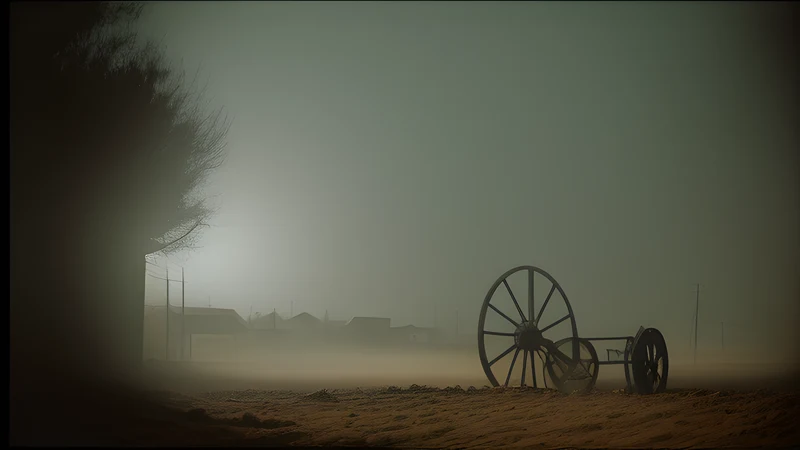
A farmer, Ohlsdorfer (János Derzsi), lives with his daughter (Erika Bók) in a stone house on a plain where the wind never stops. He has one useless arm. They have a horse and a cart, a well, a stove, and a bottle of pálinka. The film covers six days, marked by intertitles. Each day the daughter fetches water, helps her father dress, and boils two potatoes. They eat them with their hands, standing or sitting, in near silence. The horse, which they need in order to be anything other than stranded, has stopped wanting to work.
That is the material. The dramatic engine of the film is a horse’s refusal and a domestic routine repeated until you know it in your body: the coat, the well, the stove, the potato, the window. Two visitors arrive across the six days and disturb the pattern briefly. The wind continues.
Erika Bók is the connective tissue of Tarr’s late work. She was the child Estike in Sátántangó, and if you have seen that film you will never quite recover from what she does in it. Here she is grown, wordless for long stretches, hauling a bucket through a gale. Casting her is the closest Tarr comes to sentiment.
Why the long take works here, specifically
The lazy defence of slow cinema is that duration equals depth. It does not, and Tarr’s own imitators prove it. What makes the shots in The Turin Horse function is that they are almost never static and almost never about waiting. Kelemen’s camera drifts, circles the room, picks up a body and hands it to another body. A shot begins on the daughter at the window and ends, four minutes later, on her father’s face across the table, having travelled a small architecture of a house you now know as well as your own flat.
The mechanics are worth naming, because this is a craft argument rather than a temperament. Tarr shoots the routine in real duration so that the deviations become events. When the potato-eating has happened three times identically, a fourth iteration with one element altered lands like a jump scare in a film that would never stoop to one. He is spending your patience deliberately in order to buy a currency he can then devalue. That is a structural technique, and it is the same one Kiyoshi Kurosawa uses in a completely different register — see dread without a jump scare for the horror-side version of the identical trick.
Then there is Mihály Víg’s score, which is barely a score. A short organ-and-strings figure repeats, rises slightly, subsides. It arrives on top of the wind, and the wind is the real sound design: a continuous roar under everything, produced on set with enormous machines, so persistent that when the film ends the silence in the room feels like a physical event. Anyone interested in how noise floors do the emotional work in genre film should read this alongside the long take as an instrument of dread, because Tarr is running the same equipment for different ends.
The real ancestor
Everyone reaches for Tarkovsky, and the influence is honest enough. The better cross-reference is Robert Bresson, and specifically Au hasard Balthazar (1966), the film in which a donkey passes through human cruelty and human indifference and remains a donkey. Tarr’s horse and Bresson’s donkey are doing the same job: they occupy the frame as a creature that cannot narrate its own suffering, which forces you to do the narrating. Bresson’s rigour — the deliberate flattening of performance, the refusal of the actorly gesture — is all over Derzsi and Bók’s faces. If you want the version of Bresson’s method applied to a genre skeleton, A Man Escaped is the prison-break film that turns procedure into prayer, and it is the clearest bridge between his method and Tarr’s.
The other ancestor is Carl Theodor Dreyer, whose sense that a room can be a cosmology runs straight into Tarr’s stone house. Vampyr has nothing to do with peasant farming, and its logic — a world governed by rules the film declines to explain — is the same operating system.
The case against
I will make it honestly, because the film invites it. The Turin Horse is programmatic. Tarr had a thesis about human beings running down, and he built a machine to deliver it that cannot be argued with, because nothing in the film is permitted to contradict the thesis. Sátántangó has drunks, gossip, farce, a dance sequence that goes on for a small eternity and is genuinely funny. The Turin Horse has been sanded down until only the argument remains. The daughter has no interior life the film is willing to show you; she is a function.
There is also a fair complaint that the visitor’s long speech, delivered by Mihály Kormos, states out loud what the images have already established without help. It is the one moment where Krasznahorkai’s prose overrides Tarr’s pictures, and it briefly turns a film into a lecture.
Neither objection sinks it. They do explain why people who love Werckmeister Harmonies — which has a whale, a riot, and a plot — sometimes find this one airless. If you are starting with Tarr, start there, or with the whale and the mob, and come to the farmhouse when you have the stamina.
Where to find it, and what to watch next
It circulates on boutique physical media and drifts through arthouse streaming platforms; the black-and-white photography deserves a decent screen and genuinely suffers on a phone. Watch it late, alone, with the sound up enough that the wind sits in the room.
Afterwards: the slow cinema of dread maps how this vocabulary crossed into horror, and Come and See is the other Eastern European film that treats the camera as an instrument of endurance. For the argument about whether any of this is a virtue, elevated horror and the backlash against the slow burn is the row worth having.
The verdict: this is the most complete statement of a method that changed what a long take could be asked to do, and it earns its severity through craft rather than assertion. It is also a film that will bore a substantial number of intelligent people rigid, and Tarr knew that perfectly well. He made it anyway and then stopped. There is something almost polite about that.
Spoilers below
The six days are a subtraction problem. Tarr removes one thing at a time and lets you watch the arithmetic.
Day one: the horse will not pull the cart, and this is filmed in the extraordinary opening shot, several minutes of animal and cart and driver in a gale, before anything resembling a scene begins. Day two: the horse will not eat. A visitor, Bernhard, walks in to buy pálinka and delivers a monologue about how the world has been degraded and acquired by the powerful, and about how everything has been touched and therefore debased. He leaves. Day three: a group of travellers arrives at the well, drinks, is driven off by Ohlsdorfer with an axe handle, and one of them leaves behind a book, which the daughter reads aloud in a halting, unpractised voice. It is some kind of liturgical or anti-liturgical text about desecrated holy places.
Day four is the turn. The daughter goes to the well and finds it dry. They pack the cart, take the horse, and leave, walking over the ridge with everything they own. The camera stays. They come back over the ridge a few minutes later, and the film never explains why. That refusal is the single best decision in the picture. Any explanation would have made it smaller.
Day five: the woodworm in the timbers, whose steady noise has been present since the beginning, falls silent. The lamps will not stay lit. The stove will not draw. Day six: the light itself is going. Father and daughter sit at the table in near-blackness with two raw potatoes in front of them. He tells her to eat. She does not. The image goes dark on his hands and the food he cannot make her take, and the score stops, and the wind stops, and that is the end of Béla Tarr’s career.
Read the horse’s refusal as the first move in the same sequence and the design snaps into focus. The animal declines to work, then declines to eat, then the water goes, then the fire, then the light. A creature at the bottom of the hierarchy makes a decision, and the decision propagates upward until it consumes the people who thought they owned it. Nietzsche put his arms around the horse and lost his mind. Tarr’s proposal is that the horse was simply first to understand the situation, and everything after that is just the household catching up.
Related Content