The Toxic Avenger: Troma's Grubby Superhero Satire
Before every studio owned a caped franchise, a New Jersey mop boy fell in a vat of waste and became the first ironic superhero
Contents
There is a case to be made that the most prophetic superhero film of the 1980s was not made by a studio, cost almost nothing, and features a mutant hero beating a man to death with his own severed arm in the first reel. The Toxic Avenger, directed by Troma founders Lloyd Kaufman and Michael Herz, arrived in 1984 as a piece of deliberately repellent low-budget schlock, and it accidentally invented the ironic superhero a full generation before the multiplex made irony the house style of the genre. Watch it now, after fifteen years of self-aware caped franchises, and its grubby little joke looks less like a joke and more like a forecast.
Troma has always been easy to dismiss, and often earns it. But dismissing The Toxic Avenger means missing the one time the studio’s gleering nihilism found a subject worthy of it, and produced a mascot durable enough to spawn sequels, a stage musical, a children’s cartoon and, decades later, a straight-faced Hollywood remake. That is a strange afterlife for a film this cheerfully disgusting, and the strangeness is the point.
Tromaville, the toxic-waste capital
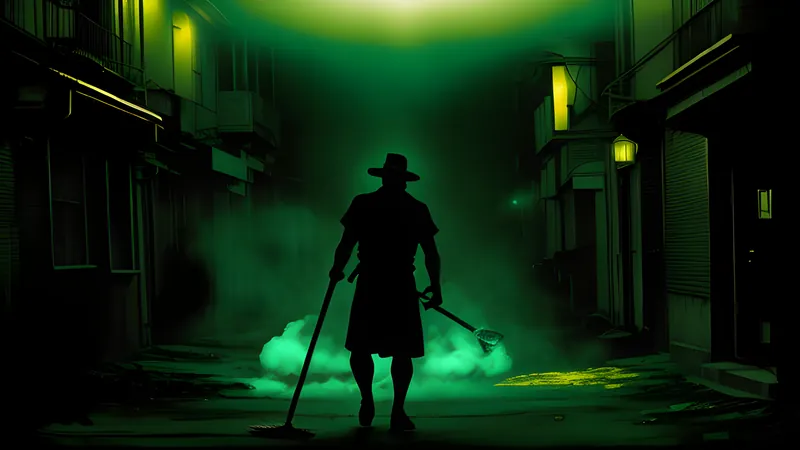
Melvin Ferd is the ninety-eight-pound weakling of the Tromaville Health Club, a mop boy in a tutu tormented by a gang of preening, murderous fitness fanatics. Their idea of fun is running down pedestrians for points. When a cruel prank goes wrong, Melvin flees in humiliation and dives out of a window straight into a drum of toxic waste, and the chemicals do to him what radioactive spiders and gamma rays do in more respectable comics: they remake him. He rises as Toxie, a hulking, melted, superhumanly strong avenger with a mop for a weapon and a monstrous face, and he sets about cleaning up the corrupt, criminal, cartoonishly rotten town of Tromaville.
The film’s structure is pure superhero origin — the weakling, the accident, the transformation, the secret, the love interest, the crusade — executed with gore effects that revel in their own cheapness and a comic tone that swings between slapstick and genuine cruelty. Melvin finds a blind girlfriend, Sara, who cannot see his hideousness, a gag that the film plays for sweetness surprisingly often. He becomes a local legend, then a target of the very authorities who should thank him. The beats are all present and correct. The film just performs them in a register of exploding heads and children’s-cartoon morality, and the collision is the comedy.
Why it works: sincerity under the sludge
The reason The Toxic Avenger outlived a thousand grimmer, gorier Troma titles is that underneath the severed limbs it is weirdly, genuinely earnest. Toxie wants to be good. The film means it. His romance with Sara is played straight enough to land, and his crusade against Tromaville’s crooked mayor and its casual everyday sadism carries a real, if crude, populist anger — this is a Reagan-era fable about a poisoned working-class town saved by the freak everyone spat on.
Kaufman and Herz also understood something about tone that most exploitation directors never grasp: that gore is funnier when the film commits to its own logic without winking too hard. The violence in Toxie is grotesque and gleeful, but the moral universe around it is childishly clear — bullies are punished, the meek inherit the mop — and that clash between infantile ethics and adult carnage is where the satire lives. It is a superhero film for people who found superheroes ridiculous, made with just enough affection to become the thing it mocked.
The practical effects deserve their own line of praise. Made for a pittance, the melted-flesh make-up and the splatter gags have a handmade, latex-and-corn-syrup tactility that no amount of digital budget can buy. You can feel the seams, and the seams are half the charm.
There is craft in the pacing, too, easy to miss under the grime. Kaufman edits the film like a live-action cartoon, cutting fast through gags before any one of them can curdle, so that the tastelessness keeps moving and never quite settles into something you can be offended by at leisure. A slower film with this content would be unbearable. This one is over the line and onto the next joke before your disgust catches up, and that momentum is a genuine directorial choice, not an accident of a threadbare budget. Troma made dozens of films that mistook shock for entertainment. This is the one that remembered to keep the audience laughing while it recoiled.
The company it keeps
The Toxic Avenger sits at the centre of a small constellation of eighties splatter comedies that used gross-out horror as a delivery system for social satire. Larry Cohen’s The Stuff is the sharpest of them, aiming its consumerist parody at the American appetite itself, and it shares with Toxie the belief that the truest horror of the decade was corporate rot dressed up as wholesomeness. Stuart Gordon’s Re-Animator, released the following year, is the genre’s high-water mark for balancing genuine wit against genuine gore — the film Toxie is reaching toward when its aim is best.
For the pure New York-and-New-Jersey grime of it, Street Trash is the essential companion piece, another melting-body Reagan-era fable that treats urban decay as literal liquefaction. And for the giddy peak of splatter-as-comedy, Peter Jackson’s Dead Alive pushed the form so far past excess that it looped back into art, which is a compliment nobody would pay Toxie and yet the family resemblance is unmistakable.
Which version, and a warning
Seek the unrated cut. The Toxic Avenger exists in multiple versions, and the trimmed ones neuter the very excess that gives the film its identity — a censored Troma film is a contradiction in terms. Troma’s own restorations are readily available and preserve the muck as intended.
A word of caution to the curious: this is a film that will lose a good chunk of any audience in its first ten minutes, and it means to. The opening violence is nasty, the humour is juvenile, and the whole thing is built to be too much for polite company. If that sounds like a warning label, it is also the recommendation. The film has no interest in the viewers it repels. Kaufman has spent a career insisting that Troma’s audience is smarter than its detractors assume, and The Toxic Avenger is his best evidence: a film that looks like it is insulting you while quietly flattering your ability to spot the satire under the slime.
The verdict
The Toxic Avenger is crude, cheap, frequently indefensible, and one of the most quietly influential exploitation films of its decade. It took the superhero origin story, dunked it in industrial waste, and discovered a satire of American self-image that the mainstream would not catch up to for twenty years. Toxie remains Troma’s one genuine folk hero because the film, for all its leering ugliness, actually believes in him. That sincerity is the secret ingredient, and it is why a melted mop boy from Tromaville is still standing when far slicker heroes have been forgotten. Come for the exploding heads. Stay for the surprisingly big heart under the sludge.
Spoilers below
Everything above is safe. The plot’s turns and the ending are below.
Toxie’s crusade escalates from petty crooks to the rotten heart of Tromaville itself: the corrupt Mayor Belgoody, a grotesque cartoon of civic greed who runs the town as a personal racket and regards the toxic avenger as a threat to business. The film’s cleverest structural move is that the authorities turn on Toxie precisely because he is effective — he cleans up the crime the mayor profits from, so the mayor brands him a menace and orders him destroyed. The freak who saves the town is declared its greatest danger by the men who poisoned it.
The romance with Sara pays off as the film’s sincere centre. She loves Toxie without ever seeing his monstrous face, and the film treats that blindness as clarity: she perceives the goodness the sighted townsfolk cannot see past the melted flesh. When the mayor’s forces finally corner Toxie, the ordinary citizens of Tromaville, who owe him their safety, gather to protect him, a mob turned protective rather than murderous. The meek, in the film’s childlike morality, close ranks around their monster.
The climax delivers the mayor his due in the most Troma fashion imaginable, with Toxie dispatching the villain in a burst of gore that the film frames as pure justice, cheered on by the crowd. The last image is the hero embraced by the town and the girl, a monster accepted at last, the origin story completed with a happy ending it earns precisely because it is so grotesque. The joke, and it is a real one, is that The Toxic Avenger delivers the wholesome superhero fantasy — the outcast redeemed, the community saved, love conquering appearance — more sincerely than most of the polished films that would later make the genre respectable. It just makes you wade through a lot of latex viscera to get there, and it is entirely unashamed of the toll.
Related Content