The Thirteenth Floor: The Other 1999 Simulation Film
Released nine weeks after The Matrix, adapted from a novel Fassbinder got to first, and forgotten by everyone since
Contents
The Thirteenth Floor opened in the United States at the end of May 1999. The Matrix had opened on 31 March. eXistenZ had opened in April. By the time Josef Rusnak’s film reached a screen, the audience had been asked twice already that spring whether the world was real, had received a leather-coated answer with a good soundtrack, and had gone home satisfied. The film took about $18 million against a budget of roughly $16 million and disappeared.
Which is a shame, because it is the only one of the three that is actually interested in the people inside the machine, and it is the one with the oldest and most distinguished pedigree in the room.
The book everyone keeps adapting
The source is Daniel F. Galouye’s Simulacron-3, published in 1964 and also sold as Counterfeit World — a paperback that worked out, three decades before the phrase “simulation hypothesis” existed, that if you can build a world containing conscious inhabitants then you have also built an argument about your own address. Galouye’s move is the one every subsequent version inherits: the simulated people are not props. They have inner lives, they wake up, and they can be talked to.
Rainer Werner Fassbinder adapted it first, in 1973, as the two-part German television film Welt am Draht — World on a Wire, a chilly, mirror-obsessed, three-and-a-half-hour masterpiece made for broadcast and then effectively lost until its restoration in 2010. Rusnak, a German director working in Roland Emmerich’s Los Angeles production company, went back to the same novel a quarter-century later. So The Thirteenth Floor is the third telling of a story that had already been told definitively by one of the great European directors, arriving in the same season as a Warner Bros. juggernaut chasing the identical premise. It never had a chance.
What it actually is
Douglas Hall (Craig Bierko) works for a Los Angeles technology firm that has built something extraordinary on the thirteenth floor of its building: a fully populated simulation of Los Angeles in 1937, running with period detail down to the newsprint, inhabited by units who believe they are people living their lives. Employees “jack in” by lying down in a machine and waking up in the body of a 1937 counterpart, free to walk the streets, drink in the bars, and talk to residents who have no idea what they are.
Hannon Fuller (Armin Mueller-Stahl), the firm’s founder and Hall’s mentor, has been spending a great deal of time down there. He discovers something, writes it down, and is stabbed to death in an alley the same night. Hall wakes with blood on his shirt and no memory of the evening. A detective (Dennis Haysbert) starts building a case against him. A woman claiming to be Fuller’s daughter (Gretchen Mol) appears from nowhere with an inheritance and a strong interest in shutting the project down. And the only way for Hall to find out what his mentor knew is to go down to 1937 himself and look for a message left in a world that does not know it is a message board.
Vincent D’Onofrio, doubling as a company employee and that employee’s 1937 counterpart, does the film’s most interesting acting — two men made of the same code, one of whom has been handed a soul and a bartender’s apron.
Why the 1937 works
Here is the craft argument, and it is the reason to see the film.
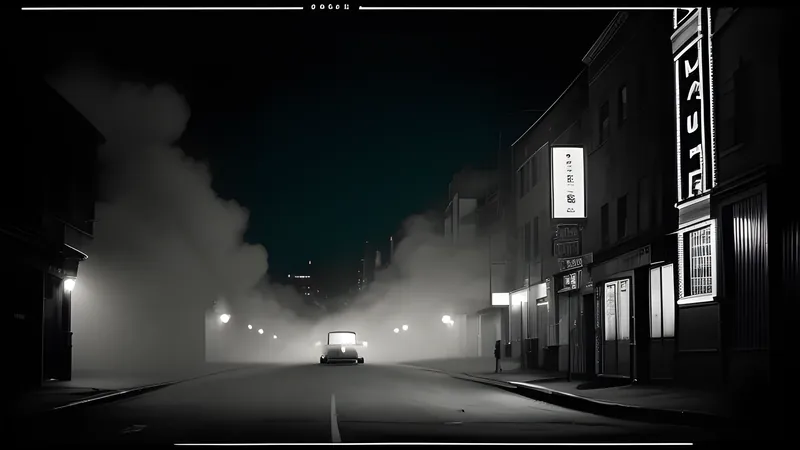
The simulated Los Angeles is shot as period noir — the wet streets, the venetian-blind shadows, the tailoring, the sedans — and Rusnak plays it entirely straight. There is no winking, no digital shimmer, no visual cue that says this is fake. The 1937 sequences look exactly like a well-made forties crime picture, because a well-made forties crime picture is precisely what a 1990s engineer building a nostalgic simulation would construct. The fidelity of the pastiche is the world-building.
That decision pays a specific dividend, and it is one The Matrix deliberately declined to collect. The Wachowskis gave their simulation a green tint and a rain of glyphs, so you always know which world you are in — a clarity that serves an action film beautifully. Rusnak withholds every marker. The 1990s scenes and the 1937 scenes are lit and composed with the same seriousness, so the audience has no reliable way to tell a simulated frame from a real one, and consequently begins doing what the characters do: watching for a seam. The film’s paranoia is generated by its production design rather than announced by its dialogue.
It also lands the emotional register that its 1999 rivals skipped. When Hall walks into a 1937 bar and talks to a bartender who has a wife, opinions and a bad back, the film sits in the discomfort of it. Neo shoots the simulated policemen. Rusnak’s film has a scene in which a simulated man asks a visitor, sincerely, what is on the other side of the mountains, and the visitor has to decide whether to answer him. That is Galouye’s actual subject, and this is the only adaptation in English that reaches for it.
The image everyone remembers is the film’s boldest formal gesture: a street that simply stops, its world unravelling into a bare green wireframe grid stretching to a black horizon — the map at the point where nobody bothered to build any further. It cost almost nothing and it is worth more than most of the decade’s effects work, because it is an idea rather than a spectacle. Every simulation has an edge, and the edge is where the budget ran out.
The ancestor
Fassbinder is the obvious parent and the film knows it. Rusnak keeps the novel’s cardinal images — the mirrors, the corridors, the sense of a corporation calmly discussing the ethics of a population it owns — and drops the three-hour Brechtian chill in favour of a murder plot. That trade is defensible. It is also why World on a Wire remains the superior film: Fassbinder understood that the horror is administrative, and staged it in conference rooms.
The stranger ancestor is film noir itself, which the film uses structurally rather than decoratively. Noir’s governing paranoia — that you are being framed, that the fix is in, that the ordinary world is a set dressed by someone with an interest in your conviction — turns out to be the exact grammar of a simulation story. A man wakes with blood on him and cannot account for the night; the classic version of that scene ends with a corrupt lieutenant, and this version ends somewhere considerably worse. The corporate-paranoia lineage runs on into films like Cypher, where an identity is again the disputed property of a company, and out into the surveillance tradition traced in nine sci-fi films that saw the surveillance age coming.
The case against
Craig Bierko is the problem. He is a perfectly competent leading man and he is asked to carry a film about ontological terror with a performance pitched at television-thriller intensity; the abyss opens and he furrows. Gretchen Mol’s character is written as a plot function with a wardrobe. The score is doing a great deal of shoving. And the last twenty minutes, having reached a genuinely vertiginous position, reach for romantic resolution with an eagerness that suggests a producer in the room.
There is also a structural cost to the murder plot. Fassbinder’s version could afford to be about the idea; Rusnak’s has to keep a detective moving through scenes, and every minute spent on the frame-up is a minute not spent in the bar in 1937 where the film is alive.
The verdict, spoiler-free
The Thirteenth Floor is a good film that lost a year to a great one, and it deserves the second look it has slowly been getting. Its 1937 is one of the most persuasive built worlds of the nineties, its central conceit is handled with more human curiosity than its famous rival managed, and one shot of a green wireframe horizon has outlived the entire film around it. It has aged into a Saturday-afternoon pleasure with a bad conscience underneath.
Watch it, then watch World on a Wire to see the same novel handled by a director who was not obliged to give anyone a chase. Both circulate on disc; Fassbinder’s restoration is the one worth owning.
Spoilers below
The message Fuller leaves in 1937 is a letter, deposited with a bartender named Ashton — D’Onofrio’s simulated counterpart — and the reason Fuller was killed is that he had worked out the thing the film has been steering toward from its first frame. The 1990s Los Angeles that Hall lives in is itself a simulation. There is a level above. Somebody up there has been jacking down into Hall’s world and wearing his body, and the murders are being committed by a visitor using Hall as a suit.
The wireframe drive is how Hall confirms it, and Rusnak stages it as pure procedure: Hall gets in a car, drives out of the city, keeps going past the last road he recognises, and reaches the place where his world stops being rendered. No monster, no revelation scene — just a man looking at a green grid where the mountains should be. It is the best sequence in the film precisely because it is undramatic. The universe does not confront him. It simply fails to continue.
The visitor is David, the husband of the woman Hall knows as Jane Fuller — a man from the level above who has been coming down to Hall’s 1990s to do things he cannot do at home, exactly as Hall’s colleagues go down to 1937 for the same reason. The chain is the film’s real thesis, and it is a bleak one. Every level exploits the one beneath it in identical ways, and nobody’s motives improve with elevation.
Where the film loses its nerve is the ending. Jane loves Hall, David dies while wearing Hall’s body, and the consciousness of Hall — a simulated man — is uploaded into David’s vacated real body in the world above, where he wakes beside Jane in a sunlit 2024 with a view and a happy ending. The escape rewards the counterfeit man with promotion to the real, which sentimentally satisfies and philosophically collapses the entire argument the previous ninety minutes made about levels being morally identical.
Then Rusnak, to his credit, twists the knife on the way out. The final shot cuts to black in a way that reads unmistakably as a monitor being switched off — the top level shutting down, the “real” world revealed as one more screen. Galouye’s joke, delivered thirty-five years late, in a film nobody went to see, nine weeks after somebody else took the money.
Related Content