The Third Man: The Zither, the Sewers, and the Best Entrance in Film
Carol Reed and Graham Greene turned occupied Vienna into a maze, and made an audience wait an hour for a smile
Contents
There is a moment, roughly two-thirds of the way through Carol Reed’s 1949 The Third Man, that every book about cinema eventually reaches for. A man has been standing in a darkened Vienna doorway, unseen. A neighbour’s window opens, light spills across the street, and the beam catches a face — amused, unbothered, caught doing exactly what it was doing. Orson Welles’s Harry Lime has been dead for the entire film up to this point, mourned, discussed, investigated. And here he is, alive, smirking, discovered by an accident of light. It is the most famous entrance in the medium, and it works because Reed made the audience wait an hour for it, building a man out of other people’s stories before letting him arrive to contradict them all.
The Third Man was written by Graham Greene, who developed it as a story first and a screenplay second, and produced under the joint auspices of Alexander Korda and David O. Selznick. It is a British film about American innocence loose in a shattered European city, and it is one of the supreme achievements of the noir tradition — a crime story in which the crime is almost incidental to the atmosphere of moral exhaustion it takes place in. Vienna in 1949 was a real ruin, divided into four zones by the occupying Allied powers, and Reed shot in the actual rubble, giving the film a documentary weight underneath its expressionist style.
The setup, spoiler-clean
Holly Martins (Joseph Cotten), an American writer of cheap pulp Westerns, arrives in postwar Vienna at the invitation of his old friend Harry Lime, who has promised him a job. He arrives to learn that Lime is dead, killed by a car outside his own building, and that the funeral is happening that very afternoon. Martins, broke and grieving and constitutionally unable to leave a story alone, starts asking questions, and the questions do not add up. Witnesses contradict each other about how many men carried the body from the road. Two men are accounted for. Somebody keeps mentioning a third.
Around Martins circle a British military policeman, Major Calloway (Trevor Howard), who has a low opinion of Lime and of Martins’s snooping, and Anna (Alida Valli), an actress who loved Lime and whose papers are not in order in a city where papers decide whether you are free. Martins, half in love with Anna and wholly out of his depth, keeps pulling at the discrepancy of the third man on the assumption that the truth will vindicate his friend. Everything above the line is safe. The film’s engine is the gap between the Harry Lime that Martins remembers and the one the city knew, and I will keep the shape of that revelation below.
Why it works: a city tilted off its axis
The first thing anyone remembers about The Third Man, after the entrance, is the sound. Reed heard a zither player named Anton Karas performing in a Viennese wine tavern and hired him to score the entire film solo, on that single stringed instrument. The result is one of the strangest and most effective scores in cinema: jaunty, plucked, almost comic, playing over scenes of betrayal and death. The mismatch between the sprightly music and the grim events is deliberate and destabilising, a musical shrug that says this ruined city has seen too much to take any one tragedy seriously. The “Harry Lime Theme” became a worldwide hit, which is its own small joke about how catchy despair can be.
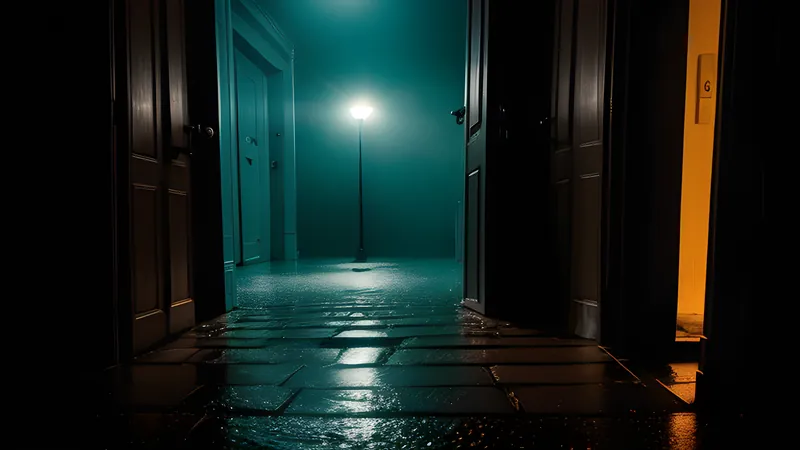
The second thing is the image. Robert Krasker won an Academy Award for the cinematography, and it is a textbook of expressionist technique bent to a realist location. The camera tilts — the canted, off-kilter angles are so pervasive that a director reportedly joked Reed would need his bed cut down at the corners to sleep straight. Wet cobblestones throw back the light of a single lamp; enormous shadows stretch up the faces of bombed buildings; figures flee down streets that seem to lean in on them. Reed shot much of it at night, hosing down the roads to catch the reflections, and the visual language tells you before any plot point does that this is a world knocked off true, where nothing stands quite upright.
The third is the performance economy. Welles is on screen for a strikingly short time, yet dominates the film, because Reed spends the whole first hour building the myth of Lime through the testimony of people who loved and feared him. By the time Welles appears, the character is already enormous, and Welles has only to confirm and complicate him. The famous speech he delivers on the Prater Ferris wheel — the one about Switzerland, five centuries of peace, and the cuckoo clock — was Welles’s own contribution to the script, and it distils Lime’s whole amoral charm into a few sentences of breezy cynicism. It is the case for evil made by a man too charming to argue with, and the film is honest enough to let it land.
The collector’s cross-reference
The Third Man is a foundational noir, and its DNA runs through the whole postwar crime tradition, but the most instructive companion is Chinatown. Both films send a confident investigator into a corruption larger than his moral vocabulary; both end on the defeat of decency rather than its triumph; both understand that the true subject of noir is the discovery that the machine cannot be beaten by one good man’s persistence. Reed’s Vienna and Polanski’s Los Angeles are the same city under different weather — places where the crime is a symptom of a rot that predates the detective and will outlast him.
The other line worth tracing runs forward to the Cold War spy thrillers that borrowed the film’s divided-city geography and its sense of ideology as a fog that hides individual guilt. And for the sheer craft of the withheld entrance, the technique of building a character in absentia before revealing him, you can watch its influence in everything from the delayed arrivals of Sergio Leone to the way modern thrillers hoard their villains. When the Coens keep the audience one step ahead of their characters in Blood Simple, they are working a different corner of the same inheritance: the noir conviction that what you do not yet know is more powerful than what you have already seen.
The verdict, above the line
The Third Man is one of the greatest films ever made in Britain and one of the finest crime pictures made anywhere. Everything in it — the zither, the tilted frames, the ruined city, the entrance, the closing shot — has been so thoroughly absorbed into the language of cinema that a first-time viewer may feel they have seen it before, which is only proof of how completely it won. To argue why its ending is perfect, and why it may be the most quietly devastating final shot in the medium, I have to spoil it. Everything above is safe. Below the line, the maze closes.
Spoilers below
The truth Martins keeps circling is that Harry Lime is not dead. The funeral was a fake, staged with a substitute body to let Lime disappear, and the discrepancy about the third man who helped carry the corpse is the loose thread that unravels the whole deception. Lime faked his own death because the authorities were closing in on the racket that made his fortune in a city where the black market was the only functioning economy: stolen penicillin, diluted for profit and sold on.
Calloway makes Martins face what that racket actually meant. The watered-down penicillin, sold to hospitals, was administered to sick and injured children, and it did not cure them — it killed them or left them maimed, because the dose was worthless. Reed and Greene ground the abstraction in a single unbearable scene, showing Martins the ward of ruined children, and the effect on Martins, and on the audience, is to demolish the charming rogue Lime has been in memory. This is the film’s cruel structural masterstroke: it spends an hour making us, like Martins, love the idea of Harry Lime, and then it shows us the price other people paid for his charm. The Ferris wheel speech, so seductive in the moment, curdles the instant you know what the man saying it did for money.
The confrontation drives Lime, finally, into the Vienna sewers — a vast, echoing underworld beneath the divided city, filmed by Krasker as a nightmare of water, shadow and stone. Martins, who came to Vienna to defend his friend, ends up hunting him through the drains and, at the last, killing him, an act Lime seems almost to invite with a look. The man who could talk his way past any moral objection has nothing left to say.
Then comes the ending Reed fought for and Greene, who had imagined something warmer, came to accept was better. After Lime’s second and real funeral, Martins waits on a long, straight, tree-lined avenue for Anna, who has every reason to despise him for his part in Lime’s death and no reason to forgive the man who loved the wrong things about the wrong man. Reed holds the shot — one of the longest and most patient in classic cinema — as Anna walks the entire length of the road toward the camera and past Martins without a glance, without a word, leaving him to light a cigarette in the emptiness. Karas’s zither plays on, jaunty as ever, indifferent. It is a closing image of total, earned desolation, and its refusal to grant Martins even the small mercy of a look is what lifts the film out of melodrama and into greatness.
My verdict: The Third Man is essential viewing, a film whose reputation has if anything undersold how strange and modern it feels — the sound design alone is decades ahead of its moment, and the ending remains a rebuke to every crime film that flinches at the last second. Watch it, then put on Chinatown for its twin study of corruption that cannot be defeated, and the Coens’ Blood Simple for the American inheritors of its cold, patient dread. Then go stand in a doorway and think about what a single beam of light can do to a story.
Related Content