The Spook Who Sat by the Door: The Militant Blaxploitation Firebrand
Ivan Dixon filmed Sam Greenlee's novel about a CIA man who trains an army, and the film vanished from cinemas almost immediately
Contents
Every cycle has a film that the system tried to lose. Ivan Dixon’s The Spook Who Sat by the Door opened in 1973, did well enough in its first engagements to suggest it had an audience, and then came out of cinemas with a speed that nobody has ever satisfactorily explained on the record. Prints became difficult to find. The film effectively left circulation for three decades. Sam Greenlee, who wrote the novel and co-wrote the screenplay, spent the rest of his life saying that the FBI had leaned on the distributor, and that the negative survived only because it had been stored under a decoy title.
I want to be careful here, because this is the part of the story that gets told loosest. The documented facts are these: the film was withdrawn quickly, it stayed out of circulation for decades, it was restored and released on DVD in 2004, and in 2012 the Library of Congress selected it for the National Film Registry. The pressure-campaign account comes principally from Greenlee and Dixon themselves and has been repeated widely. Whatever the mechanism, a film that was in profitable release stopped being in release, and it is a matter of record that American law enforcement in 1973 was actively engaged in disrupting Black political organisation.
Watch it now and the vanishing needs very little explanation. This is a film that ends with a working instruction manual.
The premise is a trap the audience walks into
Dan Freeman, played by Lawrence Cook, is recruited into the CIA as part of a programme to integrate the agency — a programme the film establishes, in a superbly acid opening movement, as a piece of political theatre engineered by a senator who wants the Black vote. The recruits are meant to fail. One is meant to survive, to be photographed, and to be given a desk somewhere visible. Freeman is the one who survives.
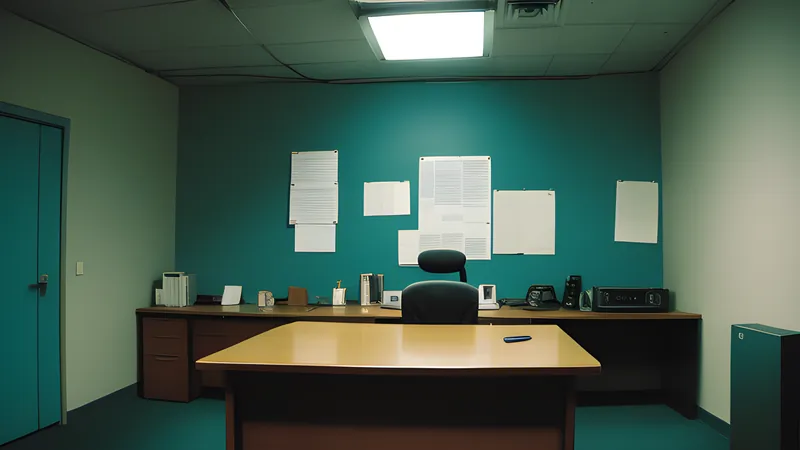
He is placed in a job with no responsibility, in an office beside the door, where visitors can see him on their way in. The title is doing several jobs simultaneously: “spook” as spy, “spook” as the slur, and “sat by the door” as the exact geometry of tokenism. Freeman does the job for five years. He is docile, unthreatening and endlessly patient. He is also, throughout, memorising everything the agency will teach him: guerrilla warfare, cell structure, propaganda, weapons, the entire toolkit of insurgency that the United States was at that moment exporting around the world.
Then he resigns, goes home to Chicago, takes a job as a social worker, and begins recruiting a street gang.
The structure of that first act is the film’s masterstroke, and it is a piece of screenwriting worth studying. Freeman’s passivity reads as humiliation for close to an hour. The audience watches a capable man being condescended to and swallowing it, and the film lets that go on long enough to be genuinely uncomfortable. The retrospective reveal is that every minute of the humiliation was tuition. Greenlee has built a story in which the tokenism itself is the security failure.
Greenlee, Dixon and how it got made
Sam Greenlee had worked for the United States Information Agency abroad, which gives the novel’s account of official Washington its unpleasant plausibility. He wrote the book in the sixties; American publishers turned it down, reportedly repeatedly, and it was published in Britain in 1969 before finding a US edition. That is a useful fact to sit with. The novel was too much for New York publishing before it was too much for anybody else.
Ivan Dixon directed. He was known primarily as an actor — Kinchloe in Hogan’s Heroes, and before that the lead in Michael Roemer’s extraordinary Nothing But a Man (1964), one of the best American films of its decade and a picture that should be far better known than it is. Dixon moved into directing largely in television, and Spook is by some distance his most significant work behind the camera.
The production had to fight for locations. Chicago, where the book is set, was reportedly unhelpful, and substantial shooting moved to Gary, Indiana, where Richard Hatcher — one of the first Black mayors of a significant American city — was willing to have it. The score is by Herbie Hancock, working in his Mwandishi-into-Head Hunters period, and it is spare, electric and menacing rather than funky.
The craft: why the deadpan works
The film is not stylistically flashy and that is its weapon. Dixon shoots it plain — flat television-trained coverage, natural light, unemphatic cutting — and the plainness makes the content land as procedure.
Watch the training sequences. Freeman teaches the Cobras cell structure, drilling into them that no member may know more than a handful of others, so that no arrest can unravel the network. He teaches them to appear harmless. He teaches them that a riot is a diversion and a supply raid is the objective. Dixon films all of it in the register of an instructional video, and the effect is chilling in a way that a stylised treatment could never achieve. The film treats revolution as logistics and explains them calmly, with diagrams.
Lawrence Cook’s performance is the other engine. He plays Freeman almost entirely without affect. There is no rage in the man, no speeches, no catharsis — just a controlled, permanent, low-temperature intent. The character has done all his feeling before the film started. Cook makes emptiness read as discipline, and it is one of the great underseen American screen performances.
The forgotten ancestor here is Gillo Pontecorvo’s The Battle of Algiers (1966), and the debt is architectural. Pontecorvo’s film is also a procedural about cell structure, also shot with documentary flatness, also refuses to give its insurgents interiority so that the audience must engage with the method rather than the man. Greenlee and Dixon have transplanted that grammar to the American Midwest. Anyone who admires one and has not seen the other has a gap to fill.
Where it sits in the cycle
It is filed under blaxploitation and the label fits badly, which is part of why it fell through the floor.
The commercial cycle had a settled formula by 1973. A hero, an antagonist, a soul score, a community threatened by narcotics, a resolution delivered by personal violence. The pleasure on offer is competence and revenge, and the political content is an atmosphere. Spook has the surface — an urban setting, a Black lead, a crime-adjacent plot, a jazz score — and underneath it has an argument that regards the entire formula as a sedative. Greenlee’s Freeman would look at Youngblood Priest in Super Fly and see a man doing the state’s work for it.
That mismatch is exactly what made it unmarketable. Exhibitors in 1973 knew how to sell a picture with a hero in a coat. This one gives an audience no one to be. Freeman is unlovable by construction — he lies to everyone in the film, including the people he is fighting for — and Cook plays him with the charisma dial set at zero. There is no soundtrack single. There is no love story that survives. There is a curriculum.
The other films in the wave were absorbed, sequelised, sampled and eventually remade. This one was removed, and then spent thirty years as a rumour circulating on degraded bootlegs among people who had heard it existed. Its restoration and its 2012 Registry selection are a small, late correction, and the gap between those two dates is the whole review.
The case against
The film is technically rough. The budget shows constantly, several supporting performances are amateur, and the pacing in the middle third slackens badly while the film explains itself. Dixon’s plainness is a virtue in the training scenes and a liability in the domestic ones.
The politics are also, deliberately, brutal in ways the film does not fully examine. Freeman’s programme requires casualties, including Black ones, and the film raises the question and then moves past it faster than the material deserves. The women in the story are treated as instruments — of Freeman’s cover, or his critique — and Greenlee’s contempt for the Black professional class occasionally curdles into something less interesting than analysis.
And it must be said that its reputation now runs ahead of its execution. This is a film people revere for what it dared and what happened to it, which is fair, and those two things are not the same as it being well made throughout. It is a great screenplay and an important document inside a scrappy picture.
Spoilers below
Freeman’s Cobras go operational. The film’s final act is an urban insurgency in Chicago that spreads, and the sequence is staged with the same procedural coolness as the training: raids on armouries, a national guard deployment that plays into the strategy, a media apparatus that cannot read what it is looking at.
The film’s most quietly devastating beat is Freeman’s friend Dawson, a Black police officer, who works out what Freeman is doing. The confrontation between them is the argument the whole film has been building to: the man who chose to work inside the institution against the man who spent five years hollowing it out. Dixon gives that scene the full weight it needs, and Greenlee refuses to make Dawson a fool.
The ending is a fuse rather than a resolution. The uprising has spread beyond Chicago. Freeman is still working. The film declines to tell you whether it succeeds, because the point is that the method exists and has been demonstrated.
That is why it disappeared, and there is no mystery in it. Nothing else in this cycle asked its audience to consider tactics. Sweet Sweetback’s Baadasssss Song is a howl of defiance; Shaft hires militants as muscle and never asks what they want. Spook provides a syllabus.
The verdict: the most dangerous film the wave produced and the one the wave’s mythology least resembles. Rough, uneven, and containing an idea so precisely worked out that half a century has done nothing to defuse it. Lawrence Cook’s blank stare is the most eloquent thing on this shelf.
Where next: Black Caesar for the rage without the programme; Across 110th Street for the despair that arrives when no programme exists; and the blaxploitation canon for the map. Since the restoration it circulates properly on disc and streams; Greenlee’s novel is in print and is sharper still.
Related Content