The Spanish Horror Canon (Fantaterror)
Ten films from the boom that a dictatorship's censors somehow allowed, and that died within two years of the dictator
Contents
The Spanish horror boom has a name that sounds like an insult and was largely used as one: fantaterror. It ran for roughly eight years, from the late 1960s to the mid-1970s, produced somewhere north of a hundred films, and it happened inside a Catholic dictatorship with a censorship board that read every script. Working out how is most of the fun.
The short answer is tourism and hard currency. Manuel Fraga Iribarne’s ministry loosened the rules in the early 1960s to attract co-production money, and horror turned out to be the genre foreign buyers wanted. The censors treated it as frivolous — monsters in castles, nothing to do with Spain — and passed things they would have destroyed in a contemporary drama. Producers exploited the gap with the doble versión: shoot the scene clothed for the domestic print, shoot it again nude for the export negative. Two films, one schedule. The board saw only one of them.
What came out of that arrangement is a genuinely distinctive body of work — Catholic imagery turned against itself, ruined monasteries doing what Hammer’s studio castles could not, and a run of monsters descended from local history rather than from Universal. These ten are chronological.
The founding text
The Awful Dr. Orlof (1962). Jess Franco’s film is where the tradition starts, and its director’s surname being the same as the head of state is a coincidence Spanish critics never stopped enjoying. A surgeon abducts women to restore his daughter’s burnt face, assisted by a blind killer called Morpho; the debt to Georges Franju’s Eyes Without a Face is open and the execution is entirely Franco’s own — fog, a gliding camera, an eroticism the board apparently failed to notice. It was a co-production with France, which is how the nudity travelled. Franco went on to make roughly two hundred films; my starting ten is the way in, and the career piece explains the working method.
The House That Screamed (1969). Narciso Ibáñez Serrador’s boarding-school film is the most technically accomplished thing in this canon by a wide margin, and it was Spain’s most expensive production of its year. Lilli Palmer runs an institution for difficult girls with a system of informers and punishments; her son watches from the shadows. Serrador had learned pace on television, and he stages the school as a machine for producing obedience, with the horror arriving as its logical output. Shot two years before Suspiria, and every bit as good on the subject of a school as a prison.
The wolf man and the Templars
The Werewolf Versus the Vampire Woman (1971). León Klimovsky’s film is the best entry point to Paul Naschy, the former weightlifter born Jacinto Molina who wrote his own scripts and played Waldemar Daninsky, Spain’s wolf man, a dozen times across four decades. Two students hunting a medieval countess’s tomb wake something worse; Daninsky is cursed, sympathetic, and doomed on a schedule. Klimovsky shoots the vampire’s approach across a misty field in slow motion, a device he essentially invented here and which the whole cycle then borrowed. Naschy’s Daninsky is Spain’s only original monster of the era, and the sincerity is what carries him.
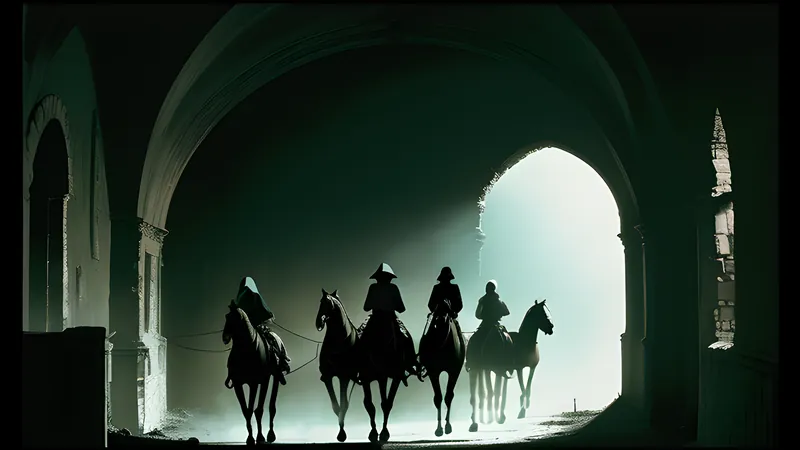
Tombs of the Blind Dead (1972). Amando de Ossorio’s Templars are the cycle’s great creation. Knights executed for heresy, eyes pecked out by crows, buried in a ruined monastery and rising to hunt by sound alone — hooded, skeletal, riding in slow motion to a chant. The blindness is the mechanic: characters must stand still and silent while the dead pass, which turns every set piece into an exercise in held breath. Ossorio made three more (Return of the Evil Dead, The Ghost Galleon, Night of the Seagulls) and shot them all in real ruins, because Spain had ruins and no money for sets. Watch the first and the fourth.
Hunchback of the Morgue (1973). Javier Aguirre’s film is Naschy’s most extreme, and the one where his commitment tips into something genuinely disturbing. Gotho works at a morgue, loves a dying woman, and falls in with a scientist who promises to bring her back. Naschy plays him with a raw, unembarrassed pathos, and then the film puts him in a catacomb full of live rats and asks him to fight them with a torch — footage that would end a production today. It is crude and sincere and it lands, largely because Naschy never once winks.
The transgressive middle
The Blood Spattered Bride (1972). Vicente Aranda’s Carmilla adaptation is the most politically loaded film in the canon and the least like the rest of it. A new bride at her husband’s country estate meets a woman buried on the beach, and the picture reads Le Fanu’s vampire as a straightforward account of a marriage as ownership. Aranda was a serious director working in genre for access, and the images — a woman dug out of the sand wearing a diving mask, a dagger in a wedding bouquet — are as strange as anything in European horror. Detailed in The Blood Spattered Bride: The Spanish Carmilla.
Cannibal Man (1972). Eloy de la Iglesia’s La semana del asesino is a slaughterhouse worker’s diary, set in a Madrid shantytown under the shadow of a new tower block where a rich young man watches through binoculars. The first killing is almost accidental; the rest are housekeeping. De la Iglesia was gay, communist and openly contemptuous of the regime, and the film’s real horror is class — the meat, the smell, the neighbours who cannot afford to notice. It was cut heavily and banned in Britain for years. The title is a lie: nobody eats anybody.
A Bell from Hell (1973). Claudio Guerín’s only significant film, and a genuine tragedy attaches to it: the director fell from the bell tower and died on the last day of shooting, with Juan Antonio Bardem finishing the picture. What survives is the cycle’s cruellest black comedy — a young man released from an asylum, an aunt and three cousins who put him there for his inheritance, and a revenge plan involving an abattoir. It is beautifully composed, appallingly funny, and the ending is unforgettable for reasons no synopsis should touch.
The endgame
Let Sleeping Corpses Lie (1974). Jorge Grau’s Spanish-Italian co-production was shot in the Peak District and Manchester, which gives it a damp English texture nothing else here has. An agricultural machine emitting ultrasonic radiation to kill insects reanimates the recently dead; a policeman decides the long-haired stranger must be responsible. Grau’s ecological premise arrived four years before Romero returned to the subject, and the sound design — that insect whine under every scene — is the reason the film still crawls. See Let Sleeping Corpses Lie: The Eco-Zombie Euro-Shocker.
Who Can Kill a Child? (1976). Ibáñez Serrador’s second and final horror feature is the masterpiece the cycle ends on. An English couple sail to a Mediterranean island and find only children, playing, smiling, and entirely willing. Serrador opens with several minutes of documentary footage of children killed in twentieth-century wars, which reframes everything after it as an answer rather than a threat. He shoots the whole film in hard Mediterranean sunlight, and it is more frightening than any darkness in this canon. Released months after Franco’s death. Full piece: Who Can Kill a Child?: The Sunlit Horror of the Innocent.
Why the ruins do the work
The craft observation that explains the cycle is about location. Hammer built its castles at Bray on a budget and lit them warmly; Italian gothic used baroque interiors and gels. Spanish horror had access to genuine medieval ruin — monasteries, Templar commanderies, abandoned villages — and no money to light them, so it shot in available or barely supplemented light, often at dusk, often on long lenses that flatten depth.
The result is a texture the rest of Europe could not fake. The Templars ride through Berzocana’s real ruined monastery; the walls have the wrong kind of damage, weather rather than set dressing, and the eye reads that instantly even when the viewer cannot say why. Add the cycle’s other signature — a zoom lens used as punctuation, snapping in on a face because a dolly track cost money — and you have a house style built entirely out of constraints.
The second mechanic is Catholicism. Every monster in this canon is a theological problem: heretic knights, a resurrected sorcerer, a curse that requires a specific silver instrument wielded by someone who loves you. The regime’s censors read that as reverence. It reads now as a country working through what its own church had been party to, in the only language the board would pass.
The doble versión left its own fingerprint on the finished work, and it is worth watching for. Because the nude take was a separate setup rather than a longer version of the same one, export prints often cut to a shot with subtly different lighting, a different lens, sometimes a body double who is visibly another person. Continuity collapses for three seconds and then resumes. Collectors treat these seams as damage. They are the only surviving physical evidence of how a Spanish crew got a film past a censorship board and out of the country in the same fortnight. Severin’s restorations increasingly present both versions, and running them side by side is a short course in what the regime would and would not look at.
The exported cuts also explain the cycle’s reputation problem. Foreign audiences met these films in whichever version their distributor bought, dubbed badly, retitled to imply a sequel to something else — Naschy’s first Daninsky picture reached America as Frankenstein’s Bloody Terror, a title referring to a character who is not in it. Two generations judged the tradition on prints its makers never approved.
Where it went, and where to watch
The boom died fast. Franco’s death in November 1975 opened the destape, and the softcore comedy took the audience within two years; the new “S” classification in 1977 gave producers a licence to sell sex directly, which removed the reason to smuggle it inside a horror plot. Naschy kept working, largely alone, well into the 2000s.
The tradition came back in the 1990s and 2000s with different tools and the same fixations — Catholic guilt, the buried past, children who know too much. The Devil’s Backbone, The Orphanage and [REC] are all downstream of this canon whether or not they claim it. Start with Who Can Kill a Child? and Tombs of the Blind Dead. Blue Underground, Severin and Arrow have restored most of the essentials, and the ruins have never looked better than they do now.
Related Content