The Spaghetti Western's Debt to the Samurai Film
How a stolen Kurosawa plot travelled from feudal Japan to the Almerian desert and back to Hollywood again
Contents
In 1964 Sergio Leone made a low-budget Western in Spain called Per un pugno di dollari, sold it across Europe under a stack of Anglicised pseudonyms, and turned a television actor named Clint Eastwood into the most famous squint in cinema. He also, quite plainly, stole it. A Fistful of Dollars is Akira Kurosawa’s Yojimbo (1961) transposed almost scene for scene from a lawless Japanese town to a lawless Mexican border town, the ronin’s sword swapped for the drifter’s revolver. Kurosawa noticed. Toho, his studio, sued, and they won — Kurosawa reportedly told Leone that it was a fine film, but it was his film, and he collected a percentage and the Japanese distribution rights for his trouble. He is said to have made more from A Fistful of Dollars than he made from Yojimbo itself.
The theft is the interesting part, because the genre it founded was built on the honest admission that Westerns and samurai films were always the same story wearing different hats. The debt runs deeper than one lifted plot, and it runs in both directions.
The plot that would not stay in one country
Start with the loop, because it is genuinely dizzying. Kurosawa, by his own account, adored the American Western and John Ford above all. Yojimbo is a samurai picture assembled from Western bones — a stranger with no name rides into a town split between two criminal gangs and plays them against each other until both are destroyed — and critics have long noticed how much its cynical structure resembles Dashiell Hammett’s hardboiled novel Red Harvest. So the raw material was already American pulp when Kurosawa dressed it in kimono.
Leone then dressed it back in a poncho and a gunbelt and shot it in the Tabernas desert of Almería, and the circuit closed. American story to Japanese film to Italian film shot in Spain, and finally home again: in 1996 Walter Hill made Last Man Standing, an official, licensed remake of Yojimbo set among Prohibition bootleggers, with Bruce Willis as the drifter. Four countries, three eras, one plot, and nobody could quite say who owned it because everyone had borrowed it from someone else.
This was not a fluke of a single film. A year before A Fistful of Dollars, John Sturges had already turned Kurosawa’s Seven Samurai (1954) into The Magnificent Seven (1960), moving the beleaguered village and its hired defenders to the Mexican frontier. The traffic between the two genres was constant and mutual by the early sixties, and Leone simply pressed the pedal harder than anyone else.
The masterless man
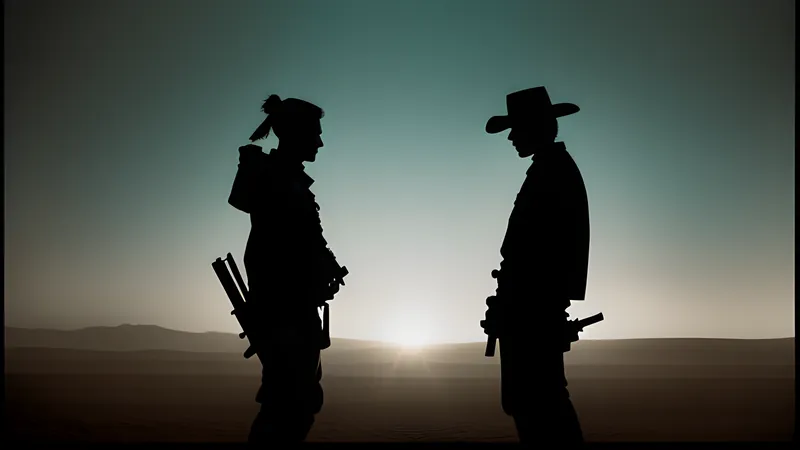
What actually crosses over is a character, and he is the reason the swap works so cleanly. The ronin — the samurai with no lord — and the gunslinger with no name are the same figure: a man of lethal competence and no fixed place, moving through a society that has broken down enough to need him and is too corrupt to keep him. Toshirō Mifune’s scratching, shrugging ronin in Yojimbo and Eastwood’s laconic Man with No Name are cut from one template. Both are for hire and loyal to nobody. Both watch a town tear itself apart and decide, for reasons closer to disgust than virtue, to hurry the process along.
The masterless man solves a problem both genres share. The feudal Japan of the late Edo period and the American frontier are both settings where old authority has collapsed and new authority has not arrived — a lawless interval that requires, and cannot domesticate, a violent competent outsider. That is why the sword and the six-gun are interchangeable props. The weapon changes; the social vacuum it fills does not. Kurosawa’s Sanjuro (1962), the Yojimbo sequel, and Leone’s own Dollars trilogy are all elaborations on the same lonely figure walking away from a town he has cleaned out and cannot live in.
Leone kept the type and pushed it toward myth. Where Mifune’s ronin is scruffy and human, forever scratching at fleas, Eastwood’s gunman is stylised almost to abstraction — the cigarillo, the flat stare, the poncho — a walking icon rather than a man. That stylisation is Leone’s real contribution, and it is what let the character outlive its source and seed everything from Eastwood’s later Westerns to the neon minimalism of Nicolas Winding Refn’s Drive, whose near-silent driver is a direct descendant of the man with no name.
Two directors, two grammars of violence
Where the films diverge is in the look, and comparing the two grammars is where a viewer learns the most.
Kurosawa’s violence is built on stillness and weather. He shoots his duels with a near-documentary patience, then detonates them: long held compositions, wind driving dust through the frame, the combatants motionless until the single explosive movement that ends it. He loved the telephoto lens and the multi-camera setup for action, and he loved weather as a character — the mud in Seven Samurai, the dust-storm town of Yojimbo. The tension lives in the wait; the killing is over in a breath.
Leone learned that lesson and slowed the wait until it screamed. His signature is the extreme close-up — an eye filling the screen, sweat on an upper lip — cut against vast empty vistas, the whole gunfight compressed into a montage of stares while Ennio Morricone’s score wails and twangs over it. Kurosawa’s silence-before-violence becomes Leone’s operatic ritual, minutes of held faces before a fraction of a second of gunfire. Both directors understood the same essential truth, that the anticipation of violence is more cinematic than the act, and both starve the audience of the release for as long as they dare. Leone simply made the starvation into a style.
The Italian Western that followed took the template in wilder directions. Sergio Corbucci’s Django (1966) drags a coffin through the mud and pushes the violence toward the grotesque; his The Great Silence (1968) sets the whole thing in snow and ends with a nihilism no Hollywood Western would have dared. The genre kept the Kurosawa skeleton — the drifter, the two factions, the town not worth saving — and layered on a specifically European cruelty and irony. It sits alongside the giallo as the two great disreputable Italian genres of the sixties, and the same national appetite for stylised bloodshed runs through both, from Leone’s desert to the black-gloved killers of Mario Bava and the roving camera of Argento’s Deep Red.
The sound of the theft
Morricone deserves his own section, because the Italian Western would be half itself without him. Kurosawa scored his samurai films with a spare, percussive tension that stays clear of the image and lets the wind and the silence do the work. Ennio Morricone did the reverse. He made the music a co-lead, a howling, whistling, guitar-cracked presence that tells you how to feel about a man before the man has drawn. The cracked whip, the ocarina, the wordless soprano wail on The Good, the Bad and the Ugly — these are as much the genre signature as the poncho, and they are a purely Italian graft onto a Japanese frame. When someone says a scene feels “like a spaghetti Western”, nine times in ten they mean it sounds like one, and that sound is the one thing in the entire lineage that was borrowed from nobody.
Why the debt still matters
It would be easy to file all this under trivia — the lawsuit, the remakes, the party fact that Godzilla and John Wayne are cousins by way of Kyoto. The debt matters because it tells you something durable about how genres actually work. They are not sealed national traditions. They are portable machines for staging a particular anxiety, and the anxiety travels better than the costume. Strip Yojimbo and A Fistful of Dollars down to the frame and you have the same machine: a competent stranger, a broken town, two rotten powers, a reckoning. Kimono or poncho is set dressing.
That portability is why the influence did not stop at the Western. George Lucas took the bickering-peasants-and-a-hidden-princess structure of Kurosawa’s The Hidden Fortress (1958) and built Star Wars (1977) partly out of it, right down to telling the story through two low-status characters. The jidaigeki, the Western, the space opera — three genres, one grammar, endlessly re-costumed. Leone’s genius was to notice the seam and stitch across it in the open, to make a Western that admitted it was a samurai film that had admitted it was a hardboiled novel.
If you want to watch the debt directly, run them back to back. Yojimbo (1961) first, for Mifune and the dust and the scratching ronin; then A Fistful of Dollars (1964) for the same story reborn in Almería; then, for the far end of the line, The Great Silence (1968) or Drive to see how far the masterless man has walked from where he started. Watch how little you have to change to turn a sword into a gun. The costume is negotiable. The lonely competent man in the middle of a rotten town is forever.
Related Content