The Signal (2014): The Desert Lab and the Legs
William Eubank's second feature spends its whole budget on one image and nearly gets away with it
Contents
There are two films called The Signal that a genre viewer might reasonably be looking for, and the internet has spent a decade merging them. The 2007 one is a three-director anthology about a broadcast that turns a city homicidal. The 2014 one is William Eubank’s, and it is the one with the desert, the hazmat suit and Laurence Fishburne speaking very slowly to a young man strapped to a gurney. This is about the second.
Eubank’s film opens as a road movie, and the opening is the part everyone underrates. Three MIT students — Nic (Brenton Thwaites), his girlfriend Haley (Olivia Cooke) and their friend Jonah (Beau Knapp) — are driving Haley across the country to California, where she is transferring and where the relationship will presumably end. Nic has a degenerative condition that is taking his legs; he was a runner once, he is on crutches now, and he has responded by becoming unbearable to the person who loves him. Cooke and Thwaites play the specific cruelty of a couple who are being kind to each other in public and are already gone in private. That is not filler before the science fiction. It is the reason the science fiction lands.
The plot device is a hacker called NOMAD who has breached MIT’s systems and is taunting Nic and Jonah personally. They trace him to coordinates in the Nevada desert, detour to a derelict shack, and film themselves going in with handheld cameras like idiots. Then the film blacks out, and Nic wakes up in a white room, and Fishburne is sitting there in an airtight suit asking him to describe what he saw.
The Sundance NEXT economics
The Signal premiered at Sundance in 2014, in the NEXT strand — the section reserved for films whose budgets are visible from space. It was Eubank’s second feature after Love (2011), a space-station picture financed by the band Angels & Airwaves and largely built in his parents’ back garden, which tells you the essential thing about him: he is a cinematographer first, and he thinks about money in terms of what a lens and a light can be made to imply.
That discipline shows everywhere. The facility is corridors, white walls, a wheelchair, a strip of light. The desert is desert. The film has perhaps four genuine effects sequences and it hoards them like a man rationing water, which is exactly the strategy Gareth Edwards used on Monsters and Christopher Caldwell and Zeek Earl later used on Prospect. Spend nothing for eighty minutes, then spend everything at once on a single image the audience cannot unsee.
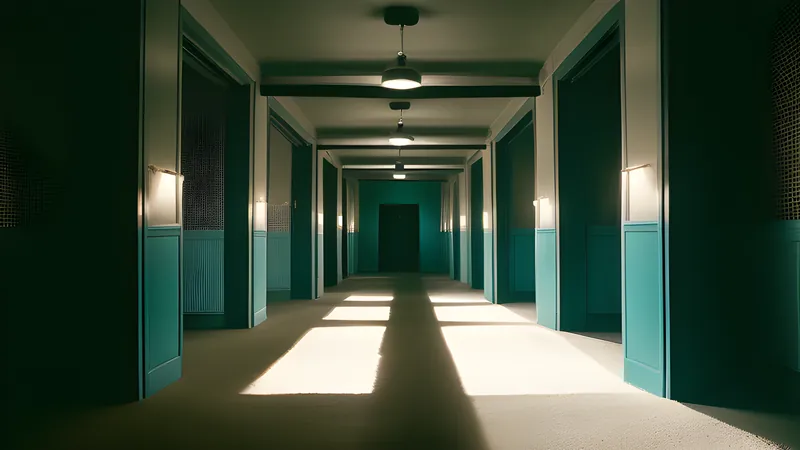
The craft decision worth naming is the film’s use of white. Eubank and cinematographer David Lanzenberg shoot the facility as an overexposed void — corridors that blow out at the far end, doorways that read as rectangles of pure light, a place with no discernible edges. It is a cheap effect and a clever one, because a room with no visible boundary cannot be measured, and a viewer who cannot measure a space cannot work out how to escape it. The film’s entire mood of helplessness comes out of an aperture setting.
Against that, the desert exteriors are shot in hard, dry, high-contrast daylight with the horizon sitting flat and low in frame. Eubank keeps putting his characters against enormous empty sky. It reads at first as scale-for-free, the standard low-budget trick of letting landscape do the production design. Watch it a second time and the choice is doing something else entirely.
Fishburne, and the pleasure of a calm interrogator
Fishburne plays Dr Wallace Damon, and he plays him at about a third of the speed of everyone else in the film. He asks questions in a flat, courteous register, waits, then asks again. He never raises his voice. He offers no information and no reassurance. It is a performance built almost entirely out of pauses, and it is the best reason to watch the film.
The role belongs to a specific and durable genre lineage: the pleasant man in the white room who knows what happened to you and will not say. That figure runs from The Prisoner’s rotating Number Twos through Kiefer Sutherland in Dark City to Vincenzo Natali’s Cypher, where the interrogation itself is the trap. Fishburne understands that the character’s power is procedural. He is frightening because he has forms to fill in.
The problem — and The Signal has a real one — is that a puzzle box only holds together if the puzzle is being played fairly, and Eubank is not always playing fair. Information is withheld from Nic in ways that make sense, and withheld from us in ways that make less. Characters behave illegibly for a reel or so, and the illegibility turns out to be the film hiding its hand rather than the people hiding theirs. The found-footage flourishes of the first act — those handheld cameras at the shack, the night-vision green — are dropped the moment they stop being convenient, and the film never acknowledges the switch. A device that establishes a rule and then quietly abandons it teaches the audience to stop trusting the grammar, which is a bad lesson to teach ninety minutes before an ending that depends entirely on grammar.
The script, by Eubank with his brother Carlyle and David Frigerio, is at its sharpest when it stops explaining. There is a stretch in the middle where Nic and Damon simply circle each other — a question, a silence, a non-answer — and the film generates more unease from two men in a room than most alien-abduction pictures manage with a fleet of saucers. Eubank knows what he has in Fishburne and hands him the frame.
The honest case against
The Signal is a film with an ending in search of ninety minutes. Eubank had one enormous idea and built a corridor to walk you down towards it, and the corridor is under-furnished. The middle hour asks Thwaites to carry long stretches of confusion, and Thwaites is a limited enough actor that confusion is mostly what registers. Cooke, who was concurrently doing far more difficult work on television, is put in a bed and left there. Knapp gets the film’s most interesting arc and the least screen time to play it.
There is also a tonal wobble. Eubank cannot decide whether he is making a Sundance drama about a young man losing his body or a genre film about an institution taking it, and the two halves have different metabolisms. When the film commits to the second — and there is a sequence of physical exertion in the final act that is genuinely thrilling, staged with a patience most action directors have lost — it is superb. When it hovers between them, it stalls.
But the last shot is the last shot. I have seen The Signal three times now and the ending has never stopped working, because it does the thing that the great recontextualising endings do: it re-files everything you have already been shown. Every flat horizon in the second act is suddenly doing a job you did not know it had. That is honest filmmaking, and it retroactively pays for a lot of the wandering.
The real ancestor
Everyone reaches for Cube and Dark City, and they are in the family. The truer ancestor is Planet of the Apes (1968) — a film whose entire structure exists to deliver one final image that redefines the ground the characters have been standing on, and which spends its running time carefully showing you the evidence you will not read correctly until the last minute. Rod Serling understood that trick as a writer of half-hour television; Eubank is running it at feature length on a fraction of the budget.
The other family resemblance is to Josef Rusnak’s The Thirteenth Floor, another film that spends its running time teaching you to look at the wrong thing. If The Signal sends you anywhere, send yourself there, and then to James Ward Byrkit’s Coherence, which came out the same year, cost less, and does more with a dinner table than most studios manage with a fleet.
The Signal streams and rents easily and always has. Watch it for Fishburne’s pauses, for Lanzenberg’s white, and for a final ninety seconds that a much better-funded film would have been too sensible to attempt.
Spoilers below
From here on, everything.
The legs. Nic wakes in the facility to find that the deteriorating body he has spent the film resenting has been replaced from the knee down with something articulated, powerful and not his. Eubank stages the discovery with restraint — a sheet, a look, a long hold — and the film’s whole emotional architecture snaps into focus at once. Nic has spent the road trip pushing Haley away because he cannot bear to be seen losing his body. The facility gives him the body back, and it costs him his species.
That is a genuinely elegant piece of construction, and it is why the film survives its middle. The horror and the wish-fulfilment are the same event. When he finally runs — and Eubank shoots the run with the camera low and level, letting the ground blur, no slow motion, no music swell for far longer than you expect — it is the most conflicted triumph in recent science fiction. He is doing the thing he has grieved for, using equipment installed in him without consent.
Then the sky. Nic reaches the edge of the desert, hits something, and the horizon reveals itself as a boundary. The camera pulls, the enclosure resolves, and the flat empty sky Eubank has been photographing for two acts turns out to have been the inside of a container. He leaps. The final image — the structure, the scale, the sudden absence of any human reference point — is the money shot the whole film was saving for, and it is worth every underlit corridor.
The mechanics do not entirely survive scrutiny. Damon’s evasions read as an alien researcher managing a specimen, which is a fine reading, but the film also wants his slowness to have been kindness, and both cannot be fully true. Jonah’s fate is skipped over. Haley’s function collapses into an object to be carried. The last five minutes are so good that they expose how much of the preceding hour was scaffolding — and I would still take one image this ambitious over ninety competent minutes of anything else Sundance sold that year.
Related Content