The Shining: The Hotel That Rearranges Itself
Kubrick's haunted house works because its geography is a lie
Contents
Watch The Shining enough times and you stop being frightened by the twins or the elevator of blood and start being frightened by the building itself, which does not add up. The Overlook Hotel has a window in the manager’s office that looks out onto daylight, except that the office is buried in the centre of the building where no exterior wall could be. Corridors connect to rooms that cannot exist beside them. A store cupboard has no exit, until it does. Stanley Kubrick built a haunted house whose real haunting is architectural: the place will not hold still, and once you notice, you cannot unnotice, and the ground goes out from under the whole film.
Kubrick adapted Stephen King’s 1977 novel with the writer Diane Johnson and threw out most of what makes a King book comforting — the warm interiority, the redemptive fatherhood, the explained supernatural. King has spent forty years complaining about the result, and he is not wrong that Kubrick’s film is colder and crueller than his book. He is wrong that this is a failing. What Kubrick made is the most rigorous haunted-house film ever shot, precisely because he treats the haunting as a problem of space rather than of ghosts.
The camera that glides where it shouldn’t
The film’s signature is the Steadicam, then a very new tool, operated by its inventor Garrett Brown. Kubrick uses it to follow young Danny Torrance as he pedals his plastic tricycle through the Overlook’s endless corridors, and the effect is one of the great uses of a camera in horror. The lens floats a few feet off the floor at a child’s height, smooth and relentless, turning corner after corner after corner, and the smoothness is exactly what disturbs. A handheld camera would give us a person’s fear. The Steadicam gives us something worse — the calm, gliding attention of the hotel itself, watching the boy, knowing the way. The rhythmic clatter of wheels over floorboards and then the sudden hush over carpet becomes a sound-design metronome for dread.
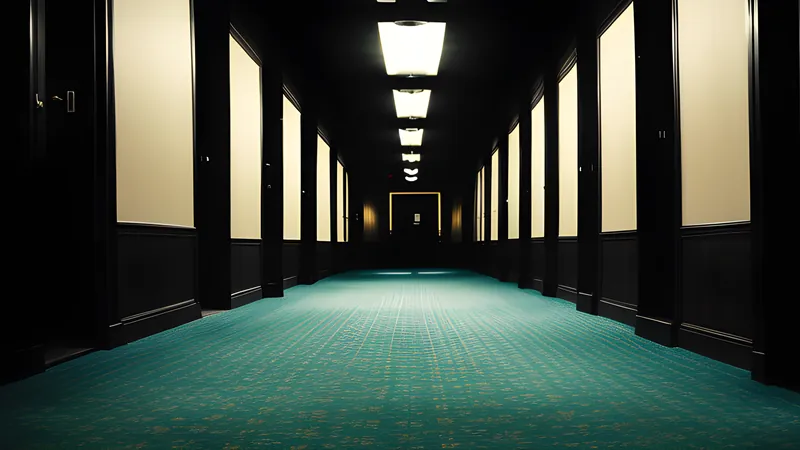
Kubrick shoots the interiors, designed by Roy Walker on soundstages in England, with a flat, bright, symmetrical clarity that is the opposite of every haunted-house cliché. There are no cobwebs, no gloom, no shadows to hide monsters in. The Overlook is well-lit, freshly decorated, gaudy with its Native American motifs and its gold ballroom, and the horror leaks out of that brightness. When the twin Grady girls appear at the end of a corridor in matching blue dresses, they are fully, evenly lit, standing in the open, which is far more upsetting than any shadowed reveal. Kubrick understood that a thing you can see clearly and still cannot explain is worse than a thing hidden. John Alcott’s photography floods the corridors with an even, sourceless brightness, and the fluorescent glare of the enormous kitchen and the cold gold of the ballroom feel less like a hotel than like a memory of one, over-lit and slightly unreal. The Overlook always looks a fraction too big for the people inside it, which is Kubrick preparing the ground for the impossible geography without ever announcing it.
Nicholson, gone before he arrives
Jack Nicholson’s performance as Jack Torrance is the most argued-over element, and the common charge — that he is unhinged from the first scene, so there is no arc, no descent into madness — misses what Kubrick is doing. Nicholson plays a man who is already lost when we meet him, a failed writer and dry alcoholic seething with resentment he can barely mask behind a salesman’s grin. The hotel does not corrupt an innocent. It finds a door already ajar and pushes. Nicholson’s eyebrows and that stretched, wolfish smile telegraph the rot from the job interview onward, which is the point: the tragedy has already happened, and we are watching it be confirmed.
Shelley Duvall’s Wendy has been unfairly maligned for decades, partly because Kubrick reportedly treated her brutally on set to extract the raw, frayed terror that fills the second half. Watch her again and the performance is remarkable — a woman doing emotional triage in real time, managing a violent man and a frightened child in an isolated building with the phone lines down, her face a live wire of exhaustion and calculation. She is the only person in the film behaving rationally, and the film punishes her for it. Scatman Crothers’s Dick Hallorann, the cook who shares Danny’s psychic gift, provides the one note of warmth and the film’s cruellest joke about the uselessness of the cavalry. Danny Lloyd, meanwhile, gives one of the strangest child performances in horror, his invented friend Tony speaking through a crooked finger in a rasping voice, the boy himself preternaturally still. Kubrick reportedly shielded the young actor from the knowledge that he was making a horror film at all, and that innocence reads on screen as an eerie calm, a child moving through catastrophe without quite registering it.
Where it comes from, and what it fathered
The ancestor of The Shining is Robert Wise’s The Haunting from 1963, and the debt is structural. Wise’s Hill House is described by a character as “born bad,” a building with insane geometry, walls slightly off-true, doors that swing shut on their own, and the horror is generated by the house’s wrongness rather than by any visible spectre. Kubrick took that idea — the malevolent architecture, the sense that the building is the antagonist — and gave it a budget and a Steadicam. Both films famously withhold the ghost and let the space do the haunting. Where Wise keeps almost everything off-screen, Kubrick shows you the impossible directly and dares you to make it cohere.
The children of The Shining are legion, but the truest heir is Hereditary, which shares Kubrick’s obsession with framing a family home as a controlled, doll’s-house space where the people are being arranged by an unseen hand. Ari Aster’s locked-off symmetrical wides are Kubrick’s grammar exactly. And the specific idea of a domestic monster — the father as the thing in the house, the family’s own violence given supernatural permission — flows straight into The Babadook, where the haunting is a parent’s rage made flesh and impossible to evict. Kubrick’s Overlook and that film’s book-monster are the same insight: the scariest house is the one where the danger already lives with you.
The verdict
The Shining is the film that has generated its own cottage industry of interpretation — the documentary Room 237 catalogues readings involving faked moon landings, Native American genocide, the Holocaust, and the minotaur myth — and the fact that it sustains all of them without confirming any is the surest sign of its construction. Kubrick built a text with too many doors, deliberate continuity impossibilities and buried symmetries that reward and defeat analysis in equal measure. Some find this maddening. I find it the whole achievement: a horror film that makes the act of trying to map it part of the fear.
Watch it for the Steadicam and for the building that will not behave. Then go back to The Haunting to see the blueprint of the malevolent house, and forward to Hereditary to see the doll’s-house dread rebuilt for a new century. The famous final image, and what it does to the whole timeline, is below the line.
Spoilers below
The ending is where Kubrick’s cold machine reveals that it was never going to let anyone escape, and where the film’s real trick with time shows itself.
Jack, fully claimed by the hotel, pursues Wendy and Danny with an axe through the building, splitting the bathroom door with the ad-libbed grin and the Johnny Carson greeting that has outlived everyone involved. Danny escapes into the enormous hedge maze, and in the film’s most elegant sequence he doubles back in his own footprints in the snow so that Jack, following the tracks, loses him and freezes to death in the maze his son has out-thought. It is a rare instance of the child defeating the haunted house on its own terms of space and geometry, using the labyrinth against the man the labyrinth belongs to. Hallorann, who travelled across the country to help, is killed almost the moment he arrives, a blunt joke about rescue.
Then the camera moves, slow and inexorable, down a corridor of the Overlook toward a wall of framed photographs, and settles on one from a ball dated the fourth of July, 1921. At the centre of the crowd, grinning, in period dress, is Jack Torrance. The hotel has always had him. The photograph rewrites everything we have watched: the film we thought was a descent into madness may have been the story of a man returning to a place he has always belonged, absorbed into the building’s permanent population. It is the same architectural horror as the impossible windows, extended into time — the Overlook does not only rearrange its rooms, it rearranges history, and there was never a moment when Jack was outside it. The image gives no explanation and needs none. The hotel has simply filed him, the way it files everything, and the smooth glide of the camera toward that photograph is the coldest, most confident final gesture in the genre.
Related Content