The Ritual: The Norse God in the Swedish Woods
Four middle-aged men, a shortcut through the trees, and one of the great creature designs
Contents
Four English men in their forties stand in a Swedish forest arguing about a map. One of them has a knee injury. One of them wants to get back to the car. All of them are wearing the exact wrong coat. It is, for about twenty minutes, the most accurate depiction of a British walking holiday ever committed to film, and then something eviscerates an elk and hangs it in a tree twelve feet off the ground.
The Ritual arrived on Netflix in early 2018, after a London Film Festival premiere in October 2017, and it did the thing that happens to a certain kind of British genre film now: no cinema run to speak of, an algorithmic afterlife, and a reputation built entirely by people telling each other about the monster.
The monster deserves the reputation. What surprises on a rewatch is how little the film needs it.
Four blokes and a shortcut
The prologue is the film’s real engine, and it’s over in five minutes. Five friends in a pub, planning a lads’ holiday, half-heartedly. Two of them — Luke (Rafe Spall) and Rob (Paul Reid) — stop at an off-licence on the way home and walk into a robbery in progress. Luke hides behind a shelf. Rob tries to talk to them and is killed with a bottle while Luke watches from cover and does nothing.
Six months later, the surviving four take the trip in Rob’s memory: Luke, plus Hutch (Robert James-Collier), Dom (Sam Troughton) and Phil (Arsher Ali). The Kungsleden trail in northern Sweden. Dom wrecks his knee. Hutch, the sensible one, proposes a shortcut through the forest.
That’s it. Everything the film does afterwards is a variation on a man who hid behind a shelf being shown, repeatedly, what he is.
The four performances are the thing that makes it hold together, and they’re better than the film’s reputation suggests. Spall carries the guilt without ever asking for sympathy. Troughton’s Dom is a superb piece of writing — whining, injured, and correct about almost everything, which makes him unbearable. Ali gets the film’s most interesting arc and the least screen time to do it in. James-Collier plays decency, which is the hardest thing on the list.
The dialogue is properly written. These men communicate by insult, and the insults have a decade of history in them. When the film turns, the recriminations are the same jokes with the affection removed.
The craft: what Bruckner does with a forest
The forest is the film’s second-best special effect, and Bruckner shoots it with a specific idea.
Andrew Shulkind’s photography keeps the canopy low and the horizon absent. There’s almost no wide landscape in The Ritual after the first act — no establishing vista, no map shot, nothing that tells you where the forest ends. The frame is always closed by trunks. That’s a deliberate refusal of the folk-horror default, which is usually the open field, the standing stone, the sky. Bruckner’s woods are claustrophobic in a way woods rarely photograph as, because he never lets you see out.
Then the geometry starts lying. The film’s best sustained sequence involves the men walking and arriving somewhere they’ve already been, and Bruckner stages it without a single flourish — no whip pan, no how can this be close-up. They just come back out where they went in. The horror is administrative: the compass is fine, the map is fine, the walking was fine.
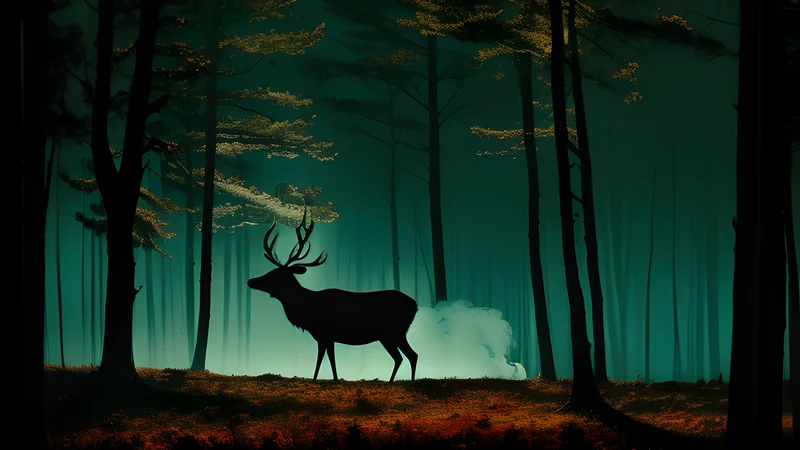
The elk is the film’s thesis statement. A large animal, gutted, suspended high in branches by something that had no reason to display it. It’s a wonderful piece of design because it communicates scale, strength and intent in one image and answers nothing.
And Ben Lovett’s score deserves its own paragraph. It’s a drone-heavy, low-string thing that mostly declines to cue you. The film’s scares generally arrive under a withdrawal of music rather than a sting — Lovett takes the bed away and leaves you with wind in birch, which is far worse.
The creature itself is the payoff of everything I’ve argued about the creature restraint principle. For an hour you get a shape, a limb, a silhouette between trunks that reads as a tree until it moves. Keith Thompson’s design is genuinely original — nothing in it is borrowed from the standard bestiary — and Bruckner’s discipline in withholding it is why the reveal survives.
The real ancestor
Everyone says The Blair Witch Project, because of the woods and the effigies and the men going in circles, and the resemblance is real. Everyone says Deliverance, because of the male friendship and the terrible weekend, and that’s closer.
The true ancestor is The Wicker Man — folk horror’s founding text — in one specific respect: the community is entirely rational. The villagers in the film’s second half are farming a god. They have an arrangement. They have terms, and the terms are ancient, and they’ll explain them to you politely while you’re tied to a chair. That’s Summerisle’s logic, moved north and stripped of Hardy’s satire.
Underneath both is the pagan-survival strand I’ve traced from Wicker Man to Midsommar, and The Ritual sits at an interesting point on it — released a year before Ari Aster’s film, doing the same Scandinavian pagan material with far less irony and a great deal more mud.
The British ancestor, though, is The Descent. Neil Marshall’s film is the same architecture with the genders swapped: a group with a shared grief and a buried betrayal, a wilderness expedition undertaken as therapy, a monster that turns out to be the second-worst thing in the film. Both are about a survivor whose real crime is something that happened before the trip started.
Adam Nevill’s 2011 novel, which is very good, has a wilder second half than the film — the adaptation, by Joe Barton, trims a great deal and improves the shape.
The case against
The third act loses the film.
For sixty minutes The Ritual is a masterclass in withholding. Then the men reach the settlement, and the film hands you a cult, a mythology, an exposition scene, an attic full of relics, and a specific parentage for the creature. Every question the forest raised gets an answer, and the answers are smaller than the questions.
The pattern is textbook — precisely the failure I flagged in The Taking of Deborah Logan — a first hour that terrifies through undecidability and a final act that itemises. Bruckner is a better director than the third act suggests; he’d go on to The Night House, which holds its nerve much longer.
The cultists themselves are underwritten. They’re a mechanism for delivering information. And the dream-logic device the film uses to visualise Luke’s guilt — the off-licence rebuilt in the forest — is inspired the first time and mechanical by the third.
Dom, Hutch and Phil are also dispatched in an order that follows screenplay convention rather than the film’s own logic.
Why it still gets pressed on people
Because of that hour, and because of the last twenty minutes, which recover.
The Ritual is a film about the specific cowardice of an ordinary man and the specific cruelty of the friends who know. It’s also a film in which a Norse deity the size of a house pursues four blokes from Croydon through a birch forest. That it holds both without embarrassment is a real achievement.
It’s on Netflix. Watch it with the lights off and the volume up for the score, and try to spot the creature before the film shows you. You won’t.
Spoilers below
The forest, first. The men find a gutted elk, a wooden house with a headless effigy in the loft, and they all dream — each one has his private failure staged for him. Dom is impaled through the chest by something and left standing. Hutch is taken and hung in a tree, gutted like the elk. Phil is found in the village, naked, kneeling, worshipping.
The village is the reveal. A community of Norse-descended people who keep a god in the woods and feed it. They explain, without malice, that the deity is a jötunn — the film names it as an offspring of Loki, a bastard child — and that in exchange for worship and sacrifice it gives them impossibly long life. The withered figures in the upper rooms of the houses are the elderly congregation, kept alive far past the point where that’s a kindness.
The bargain has two options for outsiders. Worship, and join the ancients upstairs. Refuse, and be hung in a tree. Phil takes the first. Luke takes the second, and is strung up alongside Hutch’s body.
The creature, when it finally arrives whole, is the best design in a decade of horror: a vast antlered thing whose body is composed of something like a headless human torso, arms hanging, walking on legs that bend the wrong way. It reads as a hallucination and is entirely practical and physical in most of its shots.
Luke gets down. He kills the old woman, burns the house, takes an axe and runs — and the film’s last movement is a straight chase, a man sprinting through a forest at dawn with a god behind him.
And here’s why the ending works. The creature is faster, stronger, and cannot be fought. Luke doesn’t fight it. He gets to the treeline — the edge of its territory — turns around, and looks at it. Refuses to kneel. And it stops, because it cannot cross, and it howls at him, and he screams back.
That’s the whole film discharged in one shot. A man who hid behind a shelf while his friend was murdered stands in the open, in front of the largest thing he will ever see, and declines to hide. The god loses because Luke has finally stopped running from the wrong thing.
He walks out into the sunlight, filthy and screaming, and the film ends. No village, no rescue, no epilogue. He simply survives, having finally paid something.
Related Content