The Remake as Cultural Translation
The unit you have to translate is the anxiety, and almost everybody translates the plot instead
Contents
Martin Scorsese won Best Picture in 2007 for a film that is, on paper, a scene-by-scene lift of a Hong Kong policier made four years earlier. The Departed takes the central conceit of Infernal Affairs — a cop inside the triads, a triad inside the police, both hunting a mole who is the other one — and reproduces its structure with unusual fidelity. It also changes almost everything that matters, and the changes are the reason it works. Andrew Lau and Alan Mak made a film about a colony that had recently changed hands, where the fear underneath every scene is that identity might be an administrative fact rather than a personal one. William Monahan’s screenplay throws that away and finds a local rhyme for it: Boston Irish-Catholic tribalism, the class ceiling, the specific horror of informing on your own. The plot survived because the anxiety was rebuilt from scratch.
That is the whole argument. A remake is a translation problem, and the unit of translation is the anxiety rather than the incident. Get the anxiety right and you can move every plot beat; get it wrong and a perfect reproduction of the plot will sit on screen like a stuffed animal. Almost every failed remake fails at exactly this point, and it fails for a reason more interesting than laziness.
The thing that does not travel
Take the J-horror wave, which produced the most instructive run of translation disasters in the medium’s history because the industry ran the same experiment a dozen times in five years.
Hideo Nakata’s Ringu (1998) works on a piece of cultural grammar that arrives in a Japanese audience pre-installed. The onryō is a vengeful ghost created by a wrong, and the wrong is what animates it. It cannot be reasoned with, exorcised or defeated, because it is a debt rather than a monster. The only thing you can do with a debt is transfer it, which is why the tape’s mechanism — pass it on and live, keep it and die — lands as moral horror rather than as a puzzle. I go at that machinery in the well, the tape and the slowest dread in horror.
Gore Verbinski’s The Ring (2002) is a well-made studio picture that keeps the tape and loses the debt. It gives the curse a backstory, a rule set and an investigation, which converts an obligation into a mystery, and a mystery has a solution. Every American version of the wave did some variant of this. The originals end on inevitability; the remakes hand the audience a mechanism to fight. I catalogue the pattern in what the American remakes lost and dig into the ambiguity that gets flattened in why Asian horror remakes flatten the ambiguity.
The translation error is specific and it happened because nobody involved noticed there was one. The producers looked at Ringu and saw a great hook: a videotape that kills you in seven days. That hook is the plot. The anxiety was elsewhere, in a culture’s relationship with the wronged dead, and it was invisible to buyers precisely because it was the water the original was swimming in.
Architecture is culture, and it is in every shot
Here is the craft version of the same point, and it is the most concrete evidence I can offer that translation happens at the level of the frame rather than the script.
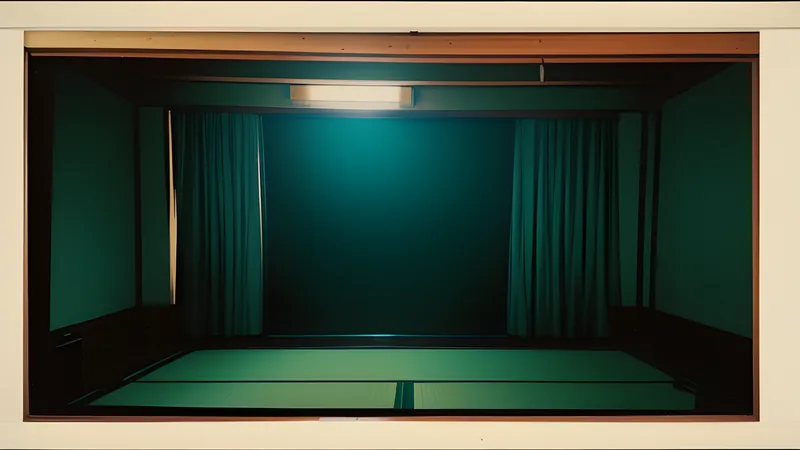
J-horror’s ghosts work partly because of Japanese domestic space. A traditional interior is permeable: sliding fusuma panels, thin walls, rooms that become other rooms, an internal geography with almost nothing you can lock. That architecture generates a specific kind of dread — the thing is already inside, there was never a threshold, and the composition can hold a doorway in the middle distance and let something slowly resolve in it. Kiyoshi Kurosawa built an entire career on that shot, which I go through in dread without a jump scare, and Takashi Shimizu’s Ju-On films are essentially a house diagram, as I argue in the architecture of dread.
Now transplant that ghost to an American suburban house. You have deadbolts, drywall, a basement, a garage, a hierarchy of secured and unsecured space. The whole grammar of intrusion changes: an American haunted house is a fortress being breached, which means the film wants doors, locks and a perimeter. The ghost has to be given new rules because the set has different physics. That is what the remakes were reacting to when they added mechanisms, and it is why the fix was never as simple as hiring a better screenwriter. They imported a creature designed for one kind of room into another kind of room and then wrote frantically to make it fit.
Shimizu himself proves the point from the other side. He remade his own Ju-On as The Grudge in 2004 for Sam Raimi’s Ghost House, shot it in Japan with American leads, and produced a hybrid that keeps the architecture and imports the audience surrogate instead. It is the most coherent film of the entire wave’s American phase, and the reason is that the director declined to move the house.
The re-cut is a remake with the credits of the original
There is a cheaper version of this operation that deserves naming, because it did more damage than any official remake ever managed. Before studios bought rights, they bought prints and edited them.
Gojira opened in Japan in 1954, nine years after Hiroshima and Nagasaki and months after the Daigo Fukuryū Maru fishing crew were irradiated by an American test at Bikini Atoll. Ishirō Honda’s film is explicitly about that — the monster is woken by nuclear testing, the imagery of the ruined city is a memory rather than a spectacle, and the scientist who can kill it would rather die than let the weapon exist. Two years later an American distributor recut it as Godzilla, King of the Monsters!, dubbed it, and inserted Raymond Burr as an American reporter narrating events from angles Honda never shot. The atomic argument was substantially trimmed. What arrived in the West was a monster picture with an anxiety-shaped hole where the film had been.
That is translation performed with scissors, and for forty years it was the normal way a non-English genre film reached an English-speaking audience — a mechanism I get into properly in the subtitled horror film and the anglophone blind spot. The re-cut and the remake are the same instinct at different budgets. Both look at a foreign film, see a hook, and throw away the water it was swimming in.
When the translation is done properly
The successes cluster around one behaviour: somebody identified what the original was afraid of and then asked what the new audience is afraid of instead.
Sergio Leone took Kurosawa’s Yojimbo (1961) and made A Fistful of Dollars (1964), moving a masterless samurai playing two clans against each other into a border town playing two families against each other. Toho sued and won, which tells you the plot travelled intact. What Leone changed was the register — Kurosawa’s film is a comedy about a professional; Leone’s is a myth about a man with no history at all — and the Western absorbed it so completely that the borrowing became a genre. The Magnificent Seven (1960) had already done the same operation on Seven Samurai (1954), converting a film about class and duty into a film about vocation.
Philip Kaufman’s Invasion of the Body Snatchers (1978) is the sharpest example in horror because it translates across time rather than geography. Don Siegel’s 1956 film is about conformity in a small town; Kaufman moved it to San Francisco twenty-two years later and made it about the exhaustion of a city where everyone is already performing a self, then stripped out the studio-imposed framing that had softened the original’s ending. I go through that in the remake that out-dreads the original.
Michael Haneke’s American Funny Games (2007) is the purest case of all, because Haneke remade his own 1997 film shot for shot and changed only the audience. The Austrian original was an attack on a European bourgeoisie who mostly did not go to see it. The English-language version aimed the same gun at the people who actually buy tickets to watch families be tortured. Identical film, different target, and the translation is entirely in the choice of viewer.
Luca Guadagnino did something comparable to Argento, replacing the 1977 original’s delirious colour with a cold Berlin of political guilt — a swap I unpick in the remake that chose dread over dazzle. Werner Herzog took Murnau’s 1922 Nosferatu, which was itself an unlicensed translation of Stoker that Stoker’s estate sued out of existence, and translated it again into melancholy, which I get into in Herzog’s melancholy remake.
The case against my own thesis
The theory has a hole and I should put my finger in it.
If translation is the job, then a remake that changes nothing should fail, and one that changes the culture wholesale should succeed. Neither holds reliably. George Sluizer remade his own Spoorloos (1988) as The Vanishing (1993) with an American cast, a bigger budget and a new ending, and the result is the most notorious self-inflicted wound in the form — he translated the culture and destroyed the film, because the thing he changed was the one thing the original was. Meanwhile Matt Reeves’s Let Me In (2010) is a careful, largely faithful transposition of Let the Right One In that keeps the snow, the estate and the loneliness, and it is a perfectly decent film that simply lives in the shadow of one that got there first.
So the rule is narrower than “translate the culture”. The rule is: identify the load-bearing element, then move everything else. Sluizer’s error was translating the load-bearing element. The J-horror remakes’ error was failing to notice which element that was. Scorsese’s success was knowing that the plot of Infernal Affairs was scaffolding and the fear of a divided self was the building, which is why The Departed can throw out the Hong Kong ending and still be the same film underneath — and why the Korean industry, which produced its own answer to the same source in New World, found a third anxiety again.
What this asks of the viewer
The reason to care is that it changes what a remake is for. A remake is the only form in cinema that runs a controlled experiment: same plot, different culture, and the delta is a readout of what each audience is frightened of. Watch Infernal Affairs and The Departed back to back and you learn something about both Hong Kong in 2002 and Boston in 2006 that neither film could have told you alone.
Which is also why the softened remake is such a waste. When a studio takes a foreign original and sands it down for a domestic audience, as they nearly always do to the last reel for the reasons I set out in why every horror remake softens the ending, it discards the readout. The film stops telling you what the new audience fears and starts telling you only what the marketing department believes they will tolerate. Those are different data, and one of them is worth watching.
Related Content