The Reflecting Skin: The Prairie Gothic Nobody Saw
Philip Ridley's 1990 debut turned golden wheat fields into a childhood nightmare
Contents
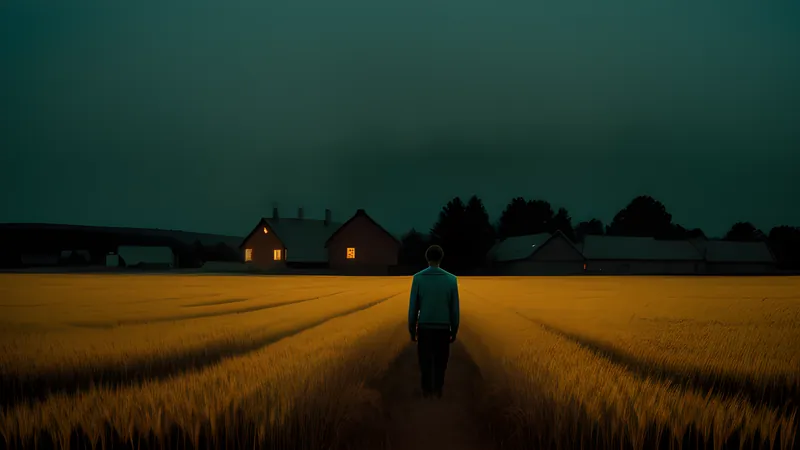
Some films are cursed by being too beautiful for their own subject. Philip Ridley’s The Reflecting Skin, made in 1990 as the debut feature of a man better known then as a painter and playwright, is one of them. It is set in the American Midwest in the 1950s, in a country of golden wheat that runs flat to the horizon under a sky of enormous blue, and it is one of the most punishing films about childhood ever put on screen. The prettiness is the trap. Ridley photographs a genuinely horrible story in the palette of a nostalgia advert, and the collision is the point.
Almost nobody saw it on release. It played festivals, picked up a scatter of admirers, and vanished into the cult margins where it has quietly festered ever since, passed between the kind of viewers who trade titles like contraband. It deserves a wider hearing now, partly because a very young Viggo Mortensen anchors half of it, and partly because it is a near-perfect example of a mode that barely has a name: the prairie gothic, the horror of wide-open American space rather than the usual old-house dark.
A boy, a widow, and a wrong idea
The engine of the film is a child’s misreading of the adult world, which Ridley treats as a horror premise in its own right. Seth Dove, played by the young Jeremy Cooper, is a boy left largely alone in a landscape of secrets. His father runs a filling station and carries the weight of an old accusation. His mother is a raw nerve. And into Seth’s imagination walks Dolphin Blue, played by Lindsay Duncan, the widow who lives nearby in black mourning clothes, pale and remote and grieving.
Seth decides she is a vampire. He has half-heard an idea, half-invented the rest, and once the notion takes hold he reads every subsequent event through it. When bad things start happening to the children around him, his vampire theory swells to explain them, and the film lets us sit inside a child’s logic as it hardens into conviction. Ridley understands something true and frightening about children: that they build cosmologies out of fragments and then act on them, and that a wrong idea held with total sincerity can do real damage.
Mortensen, in one of his earliest leading roles, plays Cameron as a man already half-hollowed by what he has seen, and the flat prairie stillness of the performance is what keeps the film’s stylisation grounded. He gives the escalating strangeness a human floor to push against. Without an actor that still and that sad at the centre of it, the saturated imagery and the mounting cruelty could tip into camp; with him, the film keeps its terrible sincerity.
His older brother Cameron, played by Mortensen, comes home from military service in the Pacific, where the atomic tests have left their mark on him in ways the film keeps quietly present. Cameron and Dolphin Blue draw together, and Seth watches his brother fall for the woman he has decided is a monster. The dread of the film lives in that gap between what Seth believes and what the adults are actually doing, and Ridley refuses to close it cleanly.
Why the beauty is the horror
The reason The Reflecting Skin lodges in the memory is its craft, and specifically the decision to shoot ugliness in the most gorgeous terms available. The cinematography by Dick Pope saturates everything: the wheat is molten gold, the house sits like a single black tooth on the plain, the sky presses down enormous and indifferent. Ridley the painter composes each frame as a canvas, and the loveliness never softens the content. It sharpens it.
This is the mechanism worth studying. When horror arrives inside beauty, the audience has no tonal cue to brace against, so the cruelty lands undefended. A dark and grimy film about a suffering child announces its own bleakness and lets you prepare. Ridley denies you that. He keeps the surface radiant while the events curdle, and the mismatch produces a specific queasiness that grimmer films never reach. The clearest ancestor is Charles Laughton’s The Night of the Hunter, another film that films American childhood terror as a storybook and lets the fairy-tale frame make the menace worse. Ridley clearly learned from it, and The Reflecting Skin is the closest any film has come to inheriting that particular poison.
The other lineage it belongs to is the quiet American unease of the 1970s, where the horror comes from a place and a mood rather than a monster you can point at. Watch it beside Let’s Scare Jessica to Death and you can feel the same withheld dread, the same refusal to confirm whether the threat is supernatural or entirely in the human world. Ridley pushes it further into stylisation, but the DNA is shared.
The child in danger, and how the film handles it
There is a black car in the distance and children begin to disappear, and the film is unflinching about the fact that a predator is moving through this landscape. Ridley handles the material with more restraint than his reputation for provocation suggests, keeping the worst of it at the edge of frame and inside implication, which is where it does the most damage. The threat to the children is the real horror; Seth’s vampire fantasy is the child’s desperate attempt to make that unbearable reality into a story he can understand.
That is the film’s deepest idea. A vampire is, in a sense, a mercy — a shape a child can give to a danger that has no comprehensible shape at all. Seth would rather live in a world with monsters than in a world where children simply vanish for no reason and no one can stop it. His misreading is a form of self-protection, and the tragedy of the film is that it does not protect him, or anyone else, in the slightest. His theory is where his empathy goes to die.
Ridley sits this alongside images of decay that recur throughout: a preserved foetus in a jar, a swollen dead body, the famous exploding frog that opens the film and tells you exactly what register you are in. These are not gore for its own sake. They are a child’s-eye inventory of death, the objects through which a boy is trying to work out what dying means, and the film treats them with the seriousness a child would.
Where it sits, and where to find it
The Reflecting Skin has grown a devoted following in the decades since, championed by musicians and filmmakers who caught it late and could not shake it. It was long hard to see in a decent transfer, which only deepened the cult; a proper restoration exists now, and it is the way to watch it, because the whole effect depends on that saturated colour surviving intact. On a grey old copy the beauty dims and half the horror goes with it.
If you come to it from the folk-horror tradition, note that Ridley is doing something adjacent but distinct. Where a film like those in the folk-horror canon roots its dread in old belief and the land’s memory, Ridley roots his in a child’s imagination and the atomic-age anxiety humming under 1950s America. It is folk horror with the folklore invented on the spot by a lonely boy. That makes it stranger and, in some ways, sadder than its cousins.
Ridley went on to make The Passion of Darkly Noon and a long career in theatre, but this remains his purest statement. It is a film that almost nobody saw and almost nobody who saw it forgot.
Spoilers below
The cruelty of The Reflecting Skin is that Seth’s monster theory poisons the one good thing in his life. Convinced Dolphin Blue is draining his brother, Seth works to drive them apart, and his interference contributes to the tragedy that consumes Cameron and the widow. The vampire was never real; the harm the belief causes is entirely real. Ridley closes the loop with brutal precision — the child’s story kills the very people the child was trying to save from it.
The final image is one of the most devastating in cult cinema: Seth alone in the wheat, screaming, having lost everything and understood nothing, the golden field as indifferent and beautiful as it was in the first frame. There is no comfort, no lesson delivered, no adult arriving to explain. The film simply leaves the boy inside a grief too large for him, wearing the same radiant light that opened the picture.
What makes the ending unforgettable is that Ridley never lets the beauty apologise for the horror. The last shot is as gorgeous as the first, and that refusal to look away or to soften is the whole argument. Childhood in The Reflecting Skin is a place where a wrong idea, held with a child’s total faith, can burn a life to the ground, and the world stays lovely the entire time it happens.
Related Content