The Phantom Carriage: The Silent Swedish Ghost Story That Haunted Bergman
Victor Sjöström's 1921 New Year's Eve nightmare and the double exposures that still work
Contents
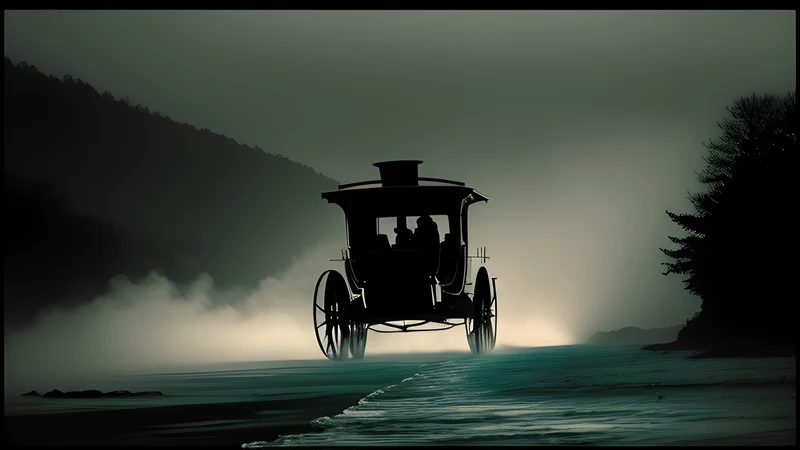
A cart rolls along the seabed. Under the water, on the sand, the driver hunched in a hooded cloak while the surface moves overhead, and he stops to haul up a drowned man. The shot is from 1921. It was achieved with multiple exposures on a hand-cranked camera by a cinematographer working out the mathematics as he went, and it is still, a century later, one of the most genuinely eerie images in cinema.
Körkarlen — released in English variously as The Phantom Carriage and The Stroke of Midnight — was directed by Victor Sjöström for Svensk Filmindustri, from Selma Lagerlöf’s 1912 novel. Lagerlöf had won the Nobel Prize in Literature three years before writing it, and had been commissioned by the Swedish National Society Against Tuberculosis to produce something that would frighten people into caring about public health. The film is an adaptation of a piece of commissioned propaganda, and it is a masterpiece. Both things are true and the tension between them is the most interesting thing about it.
The legend and the machine
The premise is folklore that Lagerlöf either found or built: the last person to die before the stroke of midnight on New Year’s Eve must drive Death’s carriage for the following year, collecting souls. It is a shift rota. The horror is bureaucratic and unending, and the current driver is desperate to hand it on.
David Holm, played by Sjöström himself, is a drunk who has destroyed his marriage, infected his family with tuberculosis, and spends the film’s present tense sneering at a dying Salvation Army sister who has wasted her health trying to save him. He dies in a graveyard brawl at midnight. The carriage comes for him, driven by an old drinking companion who has been at the reins for a year, and Holm is walked through his own life while his body lies in the frost.
Jaenzon’s exposures
Julius Jaenzon shot it, and his work here is the reason the film outlived its sermon.
The ghosts are done with multiple exposure — the negative run through the camera repeatedly, each pass laying a new image over the last, with the black areas of one exposure carrying the substance of the next. This was known technique by 1921. What was unheard of was doing it at the scale and duration Sjöström demanded, with the camera cranked by hand so that every pass had to match the last in speed, and with some shots requiring three or four separate exposures in precise register. A single misjudged crank ruins the negative and you shoot the scene again.
The results have a specific quality that CGI cannot replicate and has never really tried to. The carriage and its driver are translucent rather than transparent — you see the landscape through them, and you also see them, and the two images have equal photographic weight because both were struck on the same strip of film by the same lens. A modern composite has one layer that was there and one that was not, and some part of the eye always knows. Jaenzon’s ghosts were all there, in different passes, and they read as present in a way that a rendered spectre does not.
The seabed shot is the showpiece, and the drowned-man sequence is the moment the film stops being a temperance tract. It is doing what Murnau’s Nosferatu would do the following year and what Vampyr would do a decade later: locating dread in a landscape that is otherwise entirely mundane. Scandinavian silent horror kept arriving at this. Nothing is stylised. The sea is the sea, the shore is the shore, and something impossible is quietly working in it.
The structure nobody credits it for
The Phantom Carriage has flashbacks inside flashbacks. Holm’s story is told by the driver; within Holm’s story, another character recounts events; the film nests its narration three levels deep and expects a 1921 audience to follow, using nothing but intertitles and dissolve conventions that had barely settled.
It follows, because Sjöström is rigorous about it. Each level has its own tonal signature — the present is cold and blue-tinted, Holm’s past is warmer and more conventionally shot, the carriage material is the exposure work — and the film cuts between them on emotional logic rather than chronology. This is 1921. Citizen Kane is twenty years away and gets the credit for structural nesting because it had sound and a marketing department.
The other structural achievement is Sjöström’s performance. Holm is genuinely unpleasant — not a lovable rogue, a man who coughs on his children on purpose. Sjöström plays him without any of the silent-era mugging that makes so much of the period hard going, and he plays the redemption as something ugly and hard rather than as a reward. He had come out of the Swedish stage and directed himself, which was standard practice for him; he ran the film with a discipline that the era’s producers found expensive and its audiences never noticed.
There is a craft detail in the exposure work that repays attention on a second viewing. Sjöström keeps the living and the dead in separate planes of focus. The carriage material is soft, slightly diffused, sitting a fraction behind the sharp world; the solid characters are crisp. When Holm’s spirit steps out of his body, he changes plane, and the film has taught you what that softening means without a single intertitle explaining it. The whole supernatural grammar is carried by an optical property. Sound cinema would spend the next thirty years achieving the same effect with a reverb unit and a harp glissando, which is a considerable step backwards.
The inheritance
Ingmar Bergman is the reason a certain kind of cinephile knows this film. He watched it obsessively — by his own account at least once a year for much of his life — and he was explicit about its influence on how he shot death, memory and guilt. He then did the thing every director dreams of: in 1957 he cast the seventy-eight-year-old Sjöström as Isak Borg in Wild Strawberries, a film about an old man driven through his own past, and let the man who had made The Phantom Carriage play the passenger version of the same journey.
The other famous descendant is louder. Holm, in a rage, takes an axe to a door his wife has locked herself behind, hacking through the panel while she cowers. Stanley Kubrick knew the film, and the sequence in The Shining where Jack Torrance splinters a bathroom door is close enough that the debt has been remarked on for decades. Kubrick’s version has Nicholson’s ad-lib and a crash zoom. Sjöström’s has a man doing it in near silence, which is worse.
The essential context sits in the silent horror canon, and the film’s nearest Nordic sibling in tone is Häxan, made the following year, which shares the willingness to put the supernatural on screen with a straight face and a documentary’s posture. Where Caligari built its dread from painted geometry, Sjöström built his from arithmetic and weather.
Watch the Criterion edition, which restores the tinting and carries two scores. Matti Bye’s is the traditional choice and works beautifully. The alternative, by KTL — Stephen O’Malley of Sunn O))) with Peter Rehberg — is a wall of drone that turns the film into something close to unbearable, and is the more interesting experiment if you already know the picture.
Spoilers below
The redemption is the part that surprises people who came for the ghost story.
The driver of the carriage is Georges, Holm’s old drinking companion, who died at midnight the previous New Year’s Eve and has spent the year collecting the dead. He has come for Holm so that the shift can pass on. Sister Edit, the Salvation Army woman, is dying of the tuberculosis Holm gave her, and her one wish is to see him saved — she has loved him, hopelessly, for a year, and the film treats this as pathology rather than romance.
Holm is shown his wife, whom he has driven to the point of murder-suicide: she is preparing to poison their children and herself to end it. And the film performs its trick. Georges does not take him. Holm is returned to his body, and he sprints across the frost to stop her, and the sermon lands — the film was funded to make you afraid of tuberculosis and it makes you afraid of yourself instead.
What keeps the ending from being cheap is that Sjöström refuses to let it be clean. Edit dies anyway. Holm’s redemption saves his wife and children and does nothing for the woman who bought it. The carriage still needs a driver and someone, somewhere, has died at midnight to take the reins. The film ends on a prayer that the soul may be made ripe before it is harvested, which sounds like consolation and is actually a threat: the machinery has not stopped, it has simply moved on to the next name.
That is the sting. Holm gets his second chance because the film needed to make its public-health point. Everyone else in the story is still on the rota.
Related Content