The Perfume of the Lady in Black: The Roman Paranoia Giallo
Francesco Barilli's 1974 debut beat Polanski to his own ending by two years
Contents
Call this a giallo and you will spend ninety minutes waiting for something that never arrives. There are no black gloves. There is no razor, no faceless prowler, no inspector with a hat and a theory. Il profumo della signora in nero was sold into the giallo boom because in 1974 that was the shelf Italian distributors had available, and it has been miscatalogued ever since, which is a large part of why it took forty years to acquire the reputation it should have had immediately.
The film it is actually related to is Repulsion. Francesco Barilli’s debut is an apartment horror — a study of one woman’s flat becoming an organ of her own mind — and it is good enough to be discussed in that company without embarrassment.
The man who made it, once
Barilli came to directing from acting. He is in Bertolucci’s Before the Revolution in 1964, a decade before this, which places him squarely inside the Italian art cinema at the moment it was at its most self-confident. Then he made this, and then he made Hotel Fear in 1977, and then, essentially, that was the story. Two horror films from a man with an art-cinema pedigree, in an industry that had no idea what to do with either.
The pedigree is visible in every frame and it is what saves the film from its genre. Barilli has no interest in shocks and no gift for them. What he has is patience and a very good eye for the way a room can turn hostile without changing.
Mimsy Farmer, and the problem she solves
Silvia Hacherman is an industrial chemist. This is a small detail and it is the whole performance. Mimsy Farmer plays a woman whose profession is the measurement of things — precision, reagents, a laboratory where results are either reproducible or wrong — and then the film hands her an experience that cannot be measured, reproduced or reported. Every subsequent scene is Silvia applying a rigorous mind to material that will not hold still.
Farmer is exceptional here. She had come to Europe from American International Pictures and stayed, and Italian cinema used her repeatedly as the cool blonde with something coiled underneath — Dario Argento put her in Four Flies on Grey Velvet in 1971, and Armando Crispino got a lacerating turn out of her in Autopsy the year after this one. Her method is restraint that costs visible effort. You can watch Silvia deciding to be reasonable, and the decision is more frightening than a scream would be, because a person who has to choose composure has already lost it.
The mother is the film’s other presence, remembered rather than shown: a woman in black, an affair, a death Silvia witnessed as a child and has filed somewhere she cannot open. A small girl starts appearing in the flat, and the film is admirably unhurried about who she is.
The craft: mirrors that are not a metaphor
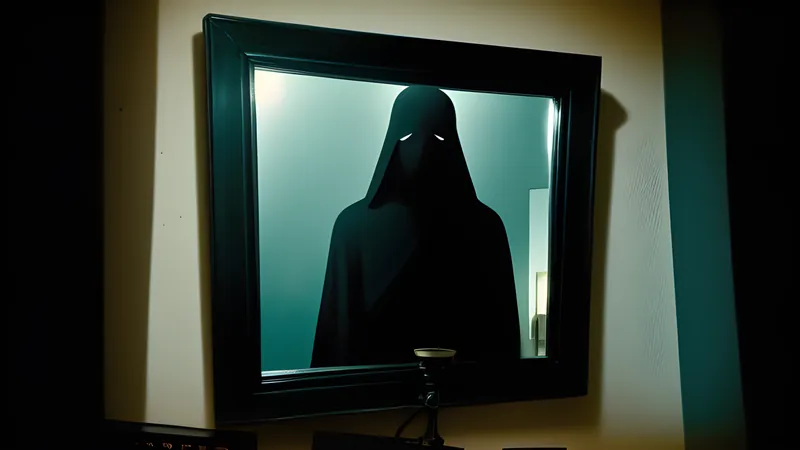
Barilli’s central formal device is the mirror, and he uses it with more discipline than the genre normally allows. Italian horror loves a mirror; it usually means the obvious thing, and the shot is over. Barilli instead builds the flat so that mirrors are architecture. You are never sure, in several scenes, whether you are looking at the room or its reflection, because Mario Masini’s camera declines to establish geography. The result is that the audience is doing the same work Silvia is doing — checking, verifying, failing to be certain — and the mirror stops being a symbol of a divided self and starts being a practical obstacle to knowing where you are.
There is an Alice motif threaded through the film, the looking-glass and the child, and it is handled with a light enough hand that it functions as a memory rather than an announcement. The clever part is what it implies about the mother: a woman who read her daughter a story about a girl who walks into a mirror and finds a world of adults behaving according to rules she was never told.
Nicola Piovani wrote the score, twenty-four years before he would win an Academy Award for Life Is Beautiful, and it is the film’s best-kept secret. He scores the flat rather than the fear — long, becalmed, almost pastoral passages that suggest a pleasant afternoon while the images suggest a woman coming apart. The music is on the neighbours’ side. Once you notice that, the film’s ending stops being a surprise and starts being something that has been sitting in the room from the first reel.
Rome, and the sound of a nice building
The location work is worth more attention than it gets. Barilli shoots a Rome of good addresses — high ceilings, long shuttered windows, stairwells with brass and stone, the kind of building that announces the tenants have arrived somewhere. There is almost no street life. The city that the Italian thriller normally uses for chases and crowds is here reduced to what you can see from a window, and the effect is that Silvia’s flat feels less like a home than like a well-appointed cell with a view of somewhere she used to go.
The sound design does something similar and does it beautifully. Barilli keeps the building audible: pipes, a lift, a door two floors down, footsteps in a hall. None of it is stingered, none of it is pointed at, and it accumulates into the specific dread of an apartment dweller, which is the knowledge that you are surrounded at all times by people you cannot see and can hear. Polanski understood this and used it hard. Barilli is gentler about it, and the gentleness is worse, because a horror film that flags its noises teaches you which ones to fear. This one just leaves the building running.
Look also at what he does with time of day. The flat is at its most frightening in good light. Barilli almost never reaches for darkness; the worst scenes here happen in a sunny room in the middle of the afternoon with the shutters open, which is a refusal of the whole genre’s default tool. It is a director saying that the trouble in this film is not hiding.
The Polanski question
Here is the thing that ought to have made this film’s reputation forty years ago. Roman Polanski’s apartment trilogy runs Repulsion in 1965, Rosemary’s Baby in 1968 and The Tenant in 1976. Barilli’s film sits in 1974, between the second and the third, and it arrives at the terminal position of that trilogy — the flat, the neighbours, the collective project, the terrible conviviality of it — two years before Polanski got there.
I am not accusing anyone of anything; ideas surface in more than one place, and both films are drawing on the same postwar European suspicion that the polite are organised. What I will say is that The Tenant is a canonical film with a Criterion-shaped afterlife, and Perfume played to a giallo audience who wanted a killer, and that the difference in their reputations is a fact about distribution rather than a fact about quality.
Barilli’s neighbours are the film’s masterstroke. They are charming. They invite her to things. They are concerned about her. Mario Scaccia’s Mr Rossetti in particular is played with a warmth that never cracks, and the film’s cruelty is that there is no moment where the mask slips, no scene of villains conferring. They mean it. That is worse.
The case against
The film is slow in a way that will lose people, and I do not think all of the slowness is earned — there is a stretch in the middle where Barilli is essentially waiting, and the mirror device, remarkable as it is, gets three or four repetitions past its useful life. The African material, introduced through an acquaintance who discusses ritual practice, is handled in the manner of 1974 and lands now as a lump of exotica doing plot work it should not be doing; the film needs an idea to be in the air and reaches for the least defensible source available.
And the psychology of the mother-trauma is schematic. Barilli is a better director of rooms than of childhoods, and the flashback material explains rather more than a film this good at ambiguity ought to explain.
Where to start
If you are coming to this from the thriller side, come the other way round: watch Footprints on the Moon, which is the other great Italian film of this exact moment about a woman losing her grip on her own record of events, and which Piovani also scored. Then this. Then the giallo canon for the shelf it was wrongly filed on.
Where to watch: restored and widely available now, which was not true for most of its life. Masini’s photography depends on being able to read very slight differences in a room’s light between one visit and the next — a print without that gradation turns the flat into a flat.
Spoilers below
The neighbours eat her.
I want to be precise about why that ending is one of the great endings in Italian horror rather than a shock reveal. Everything above the line is true: they are charming, they mean it, there is no mask. The final act does not reveal that the pleasant people were secretly monstrous. It reveals that being pleasant and being monstrous were never in tension, and that a circle of well-dressed, cultured Romans can move from concern to consumption without a change in tone, because the concern was the preparation.
The film has told you this repeatedly and you did not hear it, because Piovani’s score kept telling you the afternoon was fine. Go back and watch how the neighbours behave in the first act and you will find that not one of them does anything a good neighbour would not do. They check on her. They notice she has been unwell. They involve her. Barilli’s argument is that the machinery of a community caring for a vulnerable person and the machinery of a community selecting one is physically the same machinery, and that from inside it there is no test you can run to tell which one you are in. Silvia, who spends her working life running tests, cannot run this one.
The mother material resolves into the reason Silvia is available — isolated, unbelieved, already carrying a story nobody wants to hear — and the film is clear-eyed that the trauma did not attract the neighbours. It simply meant nobody would ask questions afterwards. The child in the mirror is Silvia, and the last thing the film does is close the looking-glass from the other side.
Polanski’s tenant gets a scream and a spectacle. Barilli’s chemist gets a dinner party. I know which one has kept me awake.
Related Content