The Others: The Twist Told Through a Child's Fear
Amenábar's fog-bound ghost story, twenty years on, still plays fair
Contents
There is a particular kind of horror film that gets better once you know the ending, and The Others (2001) is the cleanest example I can name. Alejandro Amenábar wrote it, directed it, and scored it himself, and the confidence of that single authorship shows in how patiently the film withholds. Watch it cold and it works as a slow, elegant haunting. Watch it a second time and every scene is doing something you missed — the film has been telling you the truth from the first reel, in a voice pitched just below the threshold you were listening at.
I want to talk about how it does that without spoiling the how for anyone who has not seen it, so I will keep the mechanism above the line and save the payoff for the end. What I can say up front is that Amenábar built the whole structure on a child’s fear of the dark, and treated that fear as literally true.
The house that keeps its curtains drawn
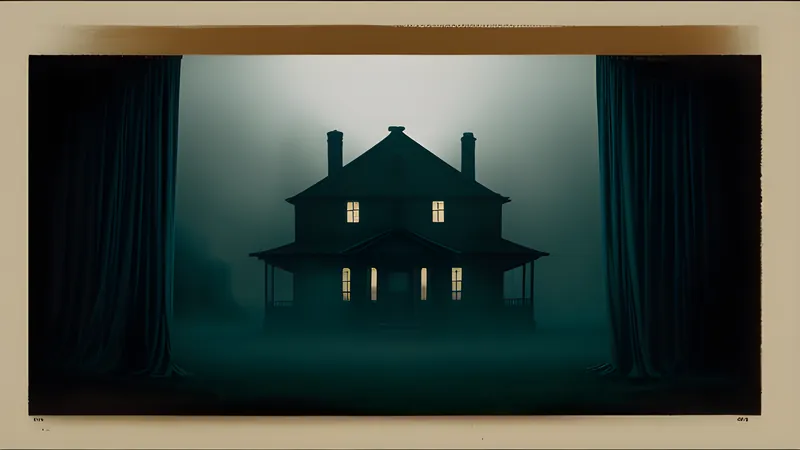
Jersey, in the Channel Islands, 1945. The war has just ended and the men have not all come home. Grace Stewart — Nicole Kidman, giving the best performance of her early career, brittle and devout and coming apart at the seams — keeps a vast country house with her two children, Anne and Nicholas. The children have a rare condition: they are photosensitive, and direct light can kill them. So the house runs on a rule. No door is opened until the one behind it is shut. No curtain is drawn while a child is in the room. The place exists in a permanent brown twilight, lit by lamps and candles and the grey Channel fog pressing at every window.
Three servants arrive to answer an advertisement Grace does not remember placing: the calm housekeeper Mrs Mills, the gardener Mr Tuttle, and a mute young maid, Lydia. They settle in with the ease of people who already know the house. And then the children begin to report that the house is not empty. Anne, the elder, insists there are others living alongside them — a boy called Victor, an old woman, footsteps and voices in rooms that should be sealed. Grace, rigidly Catholic and rigidly rational in the way only the very frightened are, refuses to believe her, and the refusal is the engine of the film.
The pleasure of the setup is how it weaponises Grace’s own logic. She has spent years teaching the children that the house is safe because the rules are obeyed. When the rules start breaking — curtains found open, a piano playing in a locked room — she cannot admit the cause without admitting that her entire ordered world is a fiction. Kidman plays a woman defending her sanity against her own daughter, and the film never lets you forget that the person most committed to the haunting not being real is the mother.
Why the restraint works
Amenábar came to The Others off the back of Open Your Eyes, the Spanish thriller Hollywood remade as Vanilla Sky, so he already understood how to build a story whose floor gives way. Here he does it with almost no gore and only a handful of true shocks. The horror is atmospheric, architectural, made of held breath and long corridors. It descends directly from a tradition that trusts the audience to be frightened by suggestion — the same lineage as The Innocents, where a governess and two children share a house with presences that may be real or may be projections of her own repression, and The Haunting, where Robert Wise frightens you with a door that bulges and never shows you the thing behind it.
The craft trick worth naming is the fog. Javier Aguirresarobe’s cinematography treats the exterior world as unreachable: whenever a character walks out of the house, they vanish into white within a few paces, and sound goes muffled and wrong. The film establishes early that the grounds are lost in mist, which reads at first as pure gothic mood. It is doing more than mood. The fog is a wall, and the film wants you to accept the wall as weather before you understand it as something else.
Then there is the séance. There is a scene involving an old woman and a table and a pen scratching across paper that reframes the entire chain of events, and it is staged with the best kind of horror restraint — the camera holds, the light is bad, and the information arrives sideways. It is a close cousin to the séance sequence in The Changeling, where a ghost communicates through a medium and the audience is left to assemble the meaning. Amenábar borrows the form and turns it inside out.
The performance underneath the plot
What keeps The Others from being a mere delivery system for its ending is Kidman. Grace is a genuinely difficult woman — controlling, punitive, quick to invoke God and quicker to punish Anne for the sin of imagination. She is grieving a husband who may or may not be coming back from a war that may or may not still be on. The children’s illness has trapped her in a life of drawn curtains and enforced silence, and Kidman lets you see the cost of it: the woman is exhausted by her own vigilance. Every ghost story is finally about someone who cannot let go, and Amenábar makes sure you feel Grace’s grip long before you understand what she is gripping.
The child actors matter here too. Alakina Mann’s Anne is defiant, watchful, the only person in the house willing to say what she sees; James Bentley’s Nicholas is younger and more suggestible, and the film uses his terror of the dark as its emotional ground note. A younger child afraid of what is in the room is the oldest horror there is, and Amenábar treats that fear with total seriousness. He does not condescend to it. He builds a whole film out of taking a child at their word.
Verdict
Twenty-odd years on, The Others has aged better than nearly all of the twist-driven horror films that clustered around the turn of the millennium, because its twist is not a cheat. Everything you need is on screen from the beginning, seeded in the rules of the house and the fear of a small boy. The rewatch is not a lesser experience of a spent trick — it is the film revealing that it was a different, sadder story all along. Amenábar made a haunted-house picture whose true subject is grief and the refusal to accept a loss, and he had the discipline to keep the machinery invisible until the last movement.
Where to watch: it turns up regularly on streaming platforms and is worth owning on disc for Aguirresarobe’s fog-bound photography, which compression tends to muddy. Go in knowing as little as possible if you somehow still can. If you already know the ending, watch it anyway, and watch the servants.
Spoilers below
Grace and the children are the dead ones. That is the whole architecture, and the film has been fair about it from the first frame. The “intruders” Anne keeps seeing are the living family who have moved into the house — the boy Victor, his parents, and the old woman conducting the séance, who is a medium hired by the new occupants to make contact with whatever is disturbing them. The séance scene plays the haunting from the other side: to the living, Grace and her children are the ghosts, and the pen scratching across the paper is their answer.
The photosensitivity is the tell that hides in plain sight. Amenábar gives the children a condition that keeps the house dark and the curtains drawn, and you accept it as a plot premise. It is really the film’s way of explaining, in advance, why these particular dead cannot bear the light and why the house exists in perpetual twilight. The fog that swallows anyone who walks the grounds is the edge of their world; there is nothing beyond the house for them to walk into.
The unbearable revelation, and the reason the film is finally a tragedy, is what Grace did. She smothered Anne and Nicholas in a breakdown after her husband failed to return from the war, then shot herself — and then woke, as the newly dead do in this cosmology, with no memory of the act, and simply carried on keeping house and enforcing the rules. The servants know; Mrs Mills and the others are older ghosts, buried on the grounds, gently managing a woman who has not yet understood that she is dead. Charles, the husband who briefly returns, is a soldier killed at the front, passing through on his way to wherever the dead go.
When Grace finally accepts the truth, the film lands its last, quiet devastation: the house is theirs, it was always theirs, and the living will leave because they cannot bear to share it. “This house is ours,” the children chant at the window, and it is both a claim and a life sentence. The horror is not that the house is haunted. The horror is that Grace killed her children out of love and fear and will now keep them, in the dark, forever, because she cannot do the one thing the whole film has been about — let go.
That is why the child’s fear of the dark had to be literally true. Nicholas was right to be afraid; he was simply afraid of the wrong thing. Amenábar took the most ordinary childhood terror and made it the load-bearing wall of a ghost story about a mother who could not stop protecting the children she had already lost.
Related Content