The Night Porter: Cavani's Taboo Power Study
Vienna, 1957, and the two people who found each other again in the wrong hotel
Contents
Liliana Cavani’s The Night Porter came out in 1974 and the argument about it started immediately and has never really stopped. Dirk Bogarde plays Max, a former SS officer working nights on the desk of a Vienna hotel in 1957. Charlotte Rampling plays Lucia, who was a prisoner in the camp where Max was an officer, and who walks into his lobby as the wife of an American conductor. They recognise each other. What they do about it is the film.
The received summary — Nazi and survivor resume a sadomasochistic affair — is accurate and useless. It describes the plot and misses the picture entirely, and it is the summary that got The Night Porter condemned as pornography by people who mostly had not seen it, and later adopted as a style reference by people who had seen only the still.
What the film is doing
Cavani wrote it with Italo Moscati, and the premise came out of documentary work she had done in the 1960s on the war and its survivors — interviews with women who had come through the camps, some of whom returned to the sites afterwards for reasons they could not articulate to an interviewer. That origin matters, because the film is about the survivors of an atrocity being unable to occupy the roles the postwar world has assigned them.
Max in 1957 belongs to a small circle of ex-SS men who meet in Vienna, hold mock tribunals on each other, and systematically destroy documents and witnesses so they can be, in their own vocabulary, cured. That word is the film’s coldest joke. The group’s therapy is the elimination of evidence. Max is the one who has not been cured, because his evidence walked into his hotel.
Lucia’s position is the film’s genuinely dangerous idea, and Cavani builds it with care. Lucia has been rebuilt as a respectable woman on the arm of a respectable man, and the respectability is a costume that fits nobody. The film puts it plainly enough: the two of them are the only people alive who know what happened in that room, and there is nowhere else to take it.
Bogarde and Rampling
Bogarde’s Max is one of the great performances of the decade and it works by subtraction. He plays a man who has taken all the personality out of himself and stored it somewhere — soft voice, small movements, exquisite manners, a face that gives nothing. When he is behind the desk he is invisible, which is exactly what a night porter should be, and Bogarde makes the invisibility feel like a survival strategy that has eaten its user. He had made The Servant and Death in Venice by this point and was fluent in exactly this register: charm as a lid.
Rampling is doing something harder. Lucia is required to be simultaneously a woman in her thirties in a Vienna hotel and a girl in a camp, and Rampling plays both without a shift in technique, so the flashbacks feel less like the past than like a room the character never left. Her stillness is the film’s engine. She spends much of the picture watching Bogarde and letting you fail to read her.
The scene everyone knows is the cabaret: Lucia in the camp, performing for the officers in braces and an SS cap, singing Marlene Dietrich. It is the image that got printed on every poster and paperback for thirty years, and out of context it looks like the fetish object the film was accused of manufacturing. In context it is the opposite. Cavani stages it as a transaction under duress with an audience of murderers, and the horror is in the composition — the girl performing, the men enjoying it, the film declining to enjoy it with them.
The mechanics
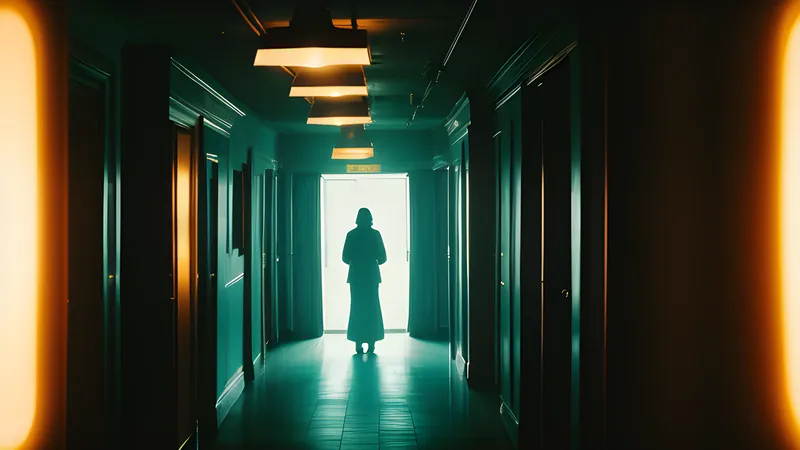
Alfio Contini photographed it, and the visual scheme is the argument. Vienna in 1957 is filmed in low light, browns and dull golds, heavy furniture, corridors, closed doors. The camp flashbacks are filmed in a bleached, high-contrast blue-white. Neither looks like memory. The past is the sharper of the two, and the present is the one that keeps dissolving, which reverses the convention and tells you which era these people are actually living in.
Cavani’s other structural decision is the refusal of explanation. There is no scene where anyone accounts for their behaviour, no psychiatrist, no speech. The film hands you two people and their conduct and stops there. That withholding is what makes it endure and what makes it insufferable to a certain kind of viewer, because a picture about the Holocaust that declines to moralise reads to many people as a picture that approves. Cavani took that risk knowingly, and the ambiguity is load-bearing — the moment you explain Lucia, you have taken the film’s subject away from her.
The hotel is the third performance. Cavani shoots the building as a machine for hiding in: the night shift, the service corridors, the bell, the register. Max’s job is to be the man who sees everyone arrive and never comments. It is the same job he had before, and the film knows it.
The ancestor
The standard comparison is The Damned (1969), Visconti’s operatic Nazi decadence, and it is the wrong one — Visconti is doing tragedy at full volume, and Cavani is doing chamber work. The film shares a season with Pasolini’s Salò, which arrived a year later, and with the whole ugly cycle of Italian Nazi-exploitation pictures that The Night Porter is routinely blamed for starting. That charge is worth taking seriously and I will come back to it.
The truer ancestor is Last Tango in Paris (1972). Bertolucci’s film is the same structure: two people who meet by chance, agree to know nothing about each other, and construct a sealed erotic world inside a rented room while the ordinary world carries on outside the door. Both films are about the room as a refusal of society. Cavani’s addition is history — her two people are returning to a private world that was built for them by the state, and the door was locked from the outside the first time.
The other useful ancestor is Hiroshima mon amour (1959). Resnais and Duras put a woman in a hotel room in a foreign city with a man, and let the war she survived come back at her in fragments that will not stay in the past tense. The flashback grammar of The Night Porter is inherited directly from that film. Cavani’s contribution is to remove the consolation of speech: Duras’s woman talks for two hours; Cavani’s says almost nothing.
For the wider question of how cinema keeps returning to this iconography, see Why Nazi occult horror never dies, and for the film that sits at the opposite pole — a war picture with no ambiguity and no eroticism whatsoever — Come and See: Klimov’s unbearable war nightmare.
The case against
The charge that will not go away is that the film aestheticises the camps, and it is not frivolous. The flashbacks are beautifully lit. Rampling is beautifully lit. The cabaret sequence has been reproduced as fashion imagery for half a century, and images escape their films. Whatever Cavani’s intention, The Night Porter supplied the visual grammar for a whole shelf of Italian Nazi-exploitation product — the Salon Kitty end of the market — that has no ideas at all and takes its poster from her.
The second charge concerns Lucia’s agency. Cavani’s refusal to explain means the film can be read as suggesting the victim wanted it, and a great many people have read it that way. The defence is that the film is about a woman for whom every available role is a lie, and that only a picture willing to sit inside her contradiction can film her honestly. Whether that defence holds is a genuine argument rather than a settled one. Pauline Kael thought the film was worthless. She was wrong, and she was not wrong about nothing.
There is also a straightforward craft complaint: the middle sags, the ex-SS circle is written thinly, and the political mechanics that drive the last act are the least interesting thing in the picture.
The verdict
The Night Porter is a serious film that has spent fifty years being punished for the poster, and it is far colder, sadder and more intelligent than either its detractors or its imitators understood. Cavani’s real subject is the postwar settlement — the tidy arrangement in which perpetrators were cured, victims were healed, and everyone agreed to a story. The film’s two characters cannot enter that arrangement, and their refusal takes the only shape available to them.
Bogarde and Rampling are the reason to watch, and they are enough on their own. The film’s ambiguity is its integrity, and the discomfort it produces is doing something no explanation would do. It is also, unmistakably, the source of a great deal of rubbish it did not ask for.
It circulates in restored editions from the arthouse labels; watch it in one, because the two-tone photography is the whole design and it dies on a poor transfer. Follow it with Hiroshima mon amour for the grammar and Come and See for the corrective.
Spoilers below
The ex-SS circle wants Lucia dealt with. She is a witness, and their programme requires witnesses to be gone; Max, by hiding her, has broken the arrangement that keeps them all safe. The group’s pressure closes in, and Max and Lucia respond by barricading themselves into his flat.
What follows is the film’s masterstroke and the sequence that answers the pornography charge outright. The siege is domestic. The two of them shut the door, the electricity goes, the water goes, the food runs out. Cavani films weeks of starvation in a Vienna apartment with the tenderness of a marriage — they clean, they sleep, they wait — and the erotic charge drains out of the picture entirely, replaced by something far stranger and far more upsetting: two people who have finally got what they wanted, which is a locked room with no world in it. They have recreated the camp voluntarily, and they are content.
At the end they leave. Max puts on his old uniform. Lucia puts on the girl’s dress. They walk out into a Vienna morning, dressed as their 1943 selves, across a bridge, and they are shot dead in long shot by figures the film does not bother to identify.
The composition is the verdict. No close-ups, no music swelling, no faces. Two small figures in period costume on an empty bridge, and then two bodies. Cavani gives the audience nothing to hold — no catharsis, no punishment that reads as justice, no lesson. The circle gets its cure. The witnesses are gone. Vienna wakes up, and the arrangement holds, and that is the horror the film has been building for two hours: the world after the war worked exactly as designed, and the only people who could not be fitted into it were the two who remembered.
Related Content