The Medium: Na Hong-jin's Thai Found-Footage Possession
A Korean-Thai co-production that films a shaman until the camera stops helping
Contents
The Medium, released in 2021, is a Korean-Thai co-production with a genuinely strange authorship. Na Hong-jin — the Korean director of The Wailing — wrote the story and produced. Banjong Pisanthanakun, the Thai director who co-made Shutter seventeen years earlier, directed it. It was shot in Isan, the poor northeastern region of Thailand, in Thai and Isan dialect, with a Thai cast. It is a mockumentary. It runs a full two hours and ten minutes, which for a found-footage picture is close to a provocation.
What Na brought to it is legible in the first ten minutes and never leaves: an obsessive interest in the gap between a belief system and the thing it is describing. The Wailing was a film about a village in which several incompatible supernatural explanations were all being offered simultaneously and the protagonist had to choose one, wrongly, with his daughter’s life on the table. The Medium takes that structure, hands it to a documentary crew, and lets them make the same mistake with a camera in their hands.
The conceit
A film crew is making a documentary about shamanism in Isan. They have found their subject in Nim (Sawanee Utoomma), a woman in her fifties who serves as the medium for Ba Yan, a local goddess whose shrine sits in the hills above the village. Nim is a superb documentary subject and Sawanee’s performance is why the film works at all: she is dry, funny, weary, entirely matter-of-fact about her vocation, and she talks to the camera the way a plumber talks about drains. She explains that the gift is hereditary in her family. She explains, in passing, that it was originally supposed to go to her sister Noi, and that Noi refused it and converted to Christianity instead, and that things were arranged otherwise.
The crew follow her to ceremonies. They film her clients. And then Noi’s daughter Mink (Narilya Gulmongkolpech) starts behaving oddly at a family funeral, and the crew — sensing a better film — begin following her instead.
That pivot is the engine. The family reads Mink’s deterioration as the goddess coming for the heir the way she came for Nim. It is the reassuring interpretation, the one with a procedure attached. The film’s long, patient middle act is a sustained accumulation of evidence that the reassuring interpretation is wrong, delivered so gradually that both the family and the crew keep updating the story they are telling rather than abandoning it.
Craft: the documentary excuse
Found footage almost always has to invent a reason for the camera. The Medium has the easiest one available — these people are making a documentary, this is their job, they have a subject who has consented — and the film gets two enormous advantages from it that a Blair Witch-style crew never gets.
The first is the interview. Because the conceit is documentary rather than raw footage, the crew can stop and ask questions, and the answers can be lies. Nim tells the camera things about her family that later footage quietly contradicts. Noi tells the camera a version of her own history that will not survive the third act. Talking heads are usually where found footage goes to explain itself; here they are where it goes to be dishonest. The audience is assembling a case file from the testimony of people who are all, for entirely human reasons, editing themselves.
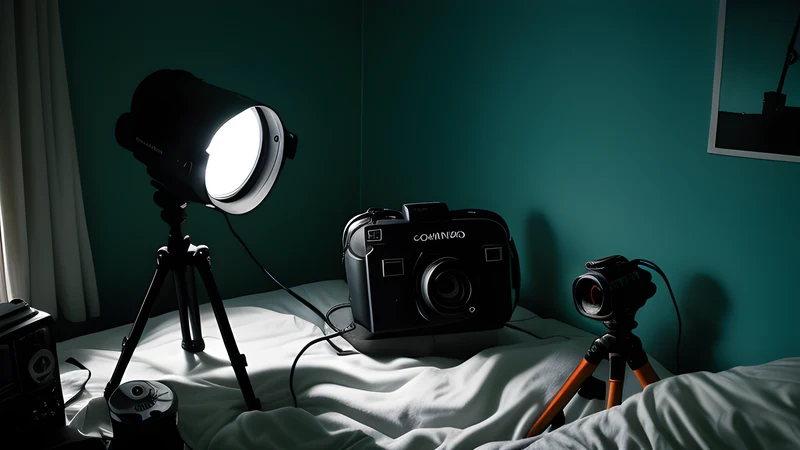
The second is coverage. A documentary crew has multiple operators, a sound recordist, tripods, spare rigs, and the professional instinct to leave a camera running in the corner of a room. That gives Banjong access to a shooting grammar found footage normally forbids — a static locked-off camera in an empty house, at night, for a long time, with nobody holding it — which is how the film’s best passages are constructed. There is no shaking hand to blame the horror on. The frame is steady and the thing in it is wrong.
The third act converts this into a fixed-camera assault: the household rigged with cameras, night vision on, a dozen angles, and an event running through all of them at once. It is a formal escalation that the film has earned by two hours of restraint, and it plays like a control room losing control.
The ancestor
The obvious reference point is Noroi: The Curse, Kōji Shiraishi’s 2005 Japanese film about a paranormal documentarian assembling a case that consumes him, and the debt is real: the fake-documentary register, the folk deity with a name and a procedure, the slow conversion of an investigation into an exposure. Noroi is the more rigorous film and the better one. But The Medium has something Shiraishi did not attempt, which is a genuine, unpatronising interest in the working life of a religious practitioner. A third of this film is a straight ethnographic portrait of a rural Thai shaman doing her job for people who need something from her, and Banjong films it without a nudge or a wink. When the horror arrives, it lands on an established world rather than a set.
The deeper ancestor is The Exorcist, obviously — the deterioration of a young woman under the eye of authorities who cannot agree on a diagnosis. Na’s variation is that Friedkin’s film ultimately confirms its religion. The Medium declines to.
The performance, and the co-production
Narilya Gulmongkolpech has the hardest job in the film and the one most likely to be dismissed, because possession acting is the most parodied register in horror. Her advantage is the documentary frame: she is being filmed by people who have been filming her for weeks, so the audience has a long baseline of ordinary behaviour to measure the deviation against. The escalation is therefore built from small subtractions rather than additions — a delay in answering, a stillness that lasts a beat past comfortable, an appetite. By the time she is doing anything overtly monstrous, the film has already established a person for the monstrosity to be happening to, which is the step The Exorcist took and most of its imitators skipped.
The co-production is worth a note, because films made across two industries usually show the seams and this one does not. Na’s involvement is invisible at the level of technique — there is nothing Korean about the shooting — and total at the level of structure. What Thailand supplied is the thing no Korean production could have faked: an actual regional religious practice with its own vocabulary, filmed by a director from that country, in the dialect, on location in Isan, with performers who are not translating anything for a foreign audience. The film never explains itself to the West. There is no anthropologist character, no expository foreigner, no scene where someone tells the camera what a medium is for the benefit of subtitles. That refusal is why the ethnography holds.
The case against
It is too long, and it knows it. The second act repeats its beat — Mink worsens, the family reinterprets, the crew films — three or four times more than the argument requires, and the film would be more frightening at 105 minutes. The English-language subtitle work on early streaming releases was poor enough to blur some of the deliberate contradictions in the testimony, which matters in a film built on them. And Banjong occasionally reaches for a jolt that the material does not need; the picture’s own best mode is a static shot and a long wait.
It won the Best Film award at Bucheon in 2021 and was a substantial hit in both Korea and Thailand. It streams in most territories under either title — Rang Zong in Thailand, The Medium elsewhere. If you are working through the form, ten found-footage films that actually work has the shortlist, and the possession film and the return of the religious is the argument this one is contributing to.
Spoilers below
The goddess is a red herring, and the film tells you so in a line you will not weigh properly until afterwards. Nim, midway through, admits to the camera that she is no longer certain Ba Yan is inside her at all — that she accepted the vocation, performed it faithfully for decades, and has never actually been sure. The confession sits in the middle of the film like a stone. Everything the family does with Mink is built on the assumption that Nim knows what she is talking about, and Nim has quietly told the camera that she does not.
What is in Mink is not an inheritance. It is an accumulation: the film gradually establishes that Noi’s husband’s family made their money in ways that generated a great many dead — a slaughterhouse, an eviction, a suicide — and that the thing wearing Mink is closer to a landfill than a deity. Na’s structural signature is all over this. The supernatural is real, the framework used to interpret it is a folk model that happens to be wrong, and the cost of the error is a child.
The exorcism fails, and the film’s final forty minutes are among the most sustained sequences of chaos the form has produced: the rigged house, the night vision, the shaman brought in from another village whose confidence is total and whose methods do not work. People die on camera in a way that makes plain the crew have stopped being observers.
Nim dies. That is the film’s real cruelty — the one competent, decent, funny person in the picture is killed doing her job for a family that refused her sister’s calling and then demanded her services anyway.
The last shot belongs to Noi, and it is the film’s verdict on itself. She has spent the picture as the sceptic, the convert, the one who got out. In the final footage she is in the frame, alone, and something in her face has changed, and the film ends without telling you whether Ba Yan finally arrived at the heir she was owed or whether the thing in the house simply moved next door. Na wrote the ending as a refusal. The crew filmed everything and understood nothing, and the footage — which is all we have — is exactly as unreliable as the people who shot it.
Related Content