The Man From Earth: A Whole Sci-Fi Film in One Room
Jerome Bixby's deathbed screenplay proves the genre's biggest idea needs no budget at all
Contents
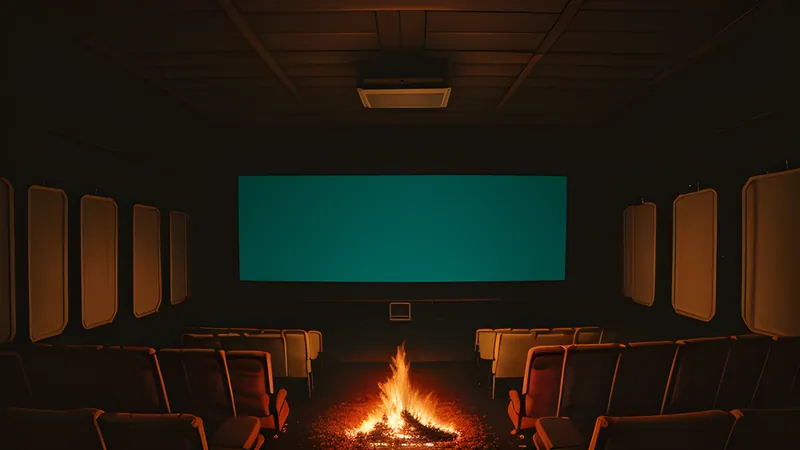
Somewhere on a shelf of overspent science-fiction blockbusters, there ought to be a small plaque that reads: this cost less than a used car and does more. The Man From Earth, released in 2007 and shot for a sum usually quoted around two hundred thousand dollars, is the proof of concept for the genre’s most heretical idea — that the biggest questions in science fiction can be staged in a living room, with no effects, no monster and no set beyond a fireplace and some folding chairs. Everything happens in one cabin over the course of a single afternoon and evening. Everything that matters happens in the talk.
It is also, quietly, a landmark of authorship. The screenplay was the final work of Jerome Bixby, a writer few people can name, though most have absorbed his sentences — he wrote the Star Trek episode “Mirror, Mirror” and the Twilight Zone nightmare “It’s a Good Life,” among a career of pulp with an unusual philosophical streak. Bixby dictated the last of The Man From Earth from his deathbed in 1998; the film reached the screen nearly a decade after he died. It plays like a lifetime’s thinking distilled into one long, controlled argument.
The premise, and the pleasure of watching people talk
A history professor named John Oldman (David Lee Smith) is abruptly leaving his university post and his home. His colleagues arrive unannounced to send him off — a biologist, an anthropologist, a psychologist, an archaeologist, a young student, a devout Christian. Pressed to explain why he keeps moving every ten years, John offers an outrageous confession: he is a Cro-Magnon, roughly fourteen thousand years old, a man who simply stopped ageing in the Upper Palaeolithic and has been walking through history ever since. He relocates every decade because people eventually notice he does not grow old.
He asks his friends to treat it as a hypothetical, a thought experiment among educated people. They cannot. Over the following two hours the room becomes a courtroom, a seminar and a confessional by turns, as each specialist interrogates the claim from the angle of their own discipline — the biologist on cell senescence, the anthropologist on migration and language, the historian on what a fourteen-millennium memory would and would not retain. John answers everything, plausibly, and the tension comes from a beautifully simple engine: he never overplays his hand, never performs the miracle that would settle it. He might be the most extraordinary being alive. He might be a lonely man having an elaborate breakdown. The film keeps both doors open almost to the end.
Director Richard Schenkman shoots it with total self-effacement — coverage, patience, faces. There is no visual flourish because a flourish would be a lie; the whole bet is that a well-built argument, performed by actors who believe it, is more gripping than any spectacle. The ensemble is largely genre journeymen (Tony Todd, John Billingsley, William Katt, Richard Riehle) and they are exactly right for it: these are recognisable, slightly rumpled academics, and their scepticism stands in for ours. When one of them gets angry, it is because the claim threatens something they have built a life on. That is the film’s real subject — how people defend their picture of the world when a single person asks them to expand it.
Why it works with nothing
The craft lesson here is austerity as a discipline. Bixby’s script front-loads its constraints — one location, real time, a fixed cast — and then treats those constraints as generators rather than limits. Because we never leave the room, every entrance and exit carries weight. Because there are no flashbacks illustrating John’s fourteen thousand years, the audience has to build those millennia in their own heads from his descriptions, which makes them more vivid than any effects budget could. The film outsources its spectacle to your imagination, and imagination has an unlimited effects department.
The structure is a slow escalation of stakes disguised as a friendly chat. It opens as anthropological curiosity — could a human survive that long, and what would they remember? It moves to psychology — is this man lying, deluded, or telling the truth, and what does each possibility cost his friends? And it climbs, in its final third, to theology, the moment the conversation stops being safe. Schenkman modulates the room’s temperature so gradually that you do not notice the send-off party has become an inquisition until someone is close to tears. That is dramaturgy of a high order, and it is achieved entirely through who speaks next and how the camera holds the listeners.
There is also a real-world footnote that belongs to the film’s legend. The Man From Earth was a commercial nonentity on release and then spread across the world through file-sharing, to the point that Schenkman publicly thanked the pirates for giving the film the audience distribution never did. A movie about a man who survives by quietly moving through the centuries found its own long life by quietly moving through peer-to-peer networks. The medium suited the message.
The one-room lineage
For the collector, The Man From Earth is the purest modern example of a tradition that runs deeper than its budget suggests: science fiction as chamber drama, the genre stripped to people in a confined space testing an impossible proposition. Its truest cousin is Coherence, James Ward Byrkit’s dinner-party film, which runs almost the identical experiment — a group of friends around a table, a single premise introduced, and the social bonds slowly deforming under its pressure. Byrkit’s premise is a fracturing multiverse and Bixby’s is a deathless man, and yet the machine is the same: watch civilised people negotiate a reality their worldview cannot hold.
Push the chamber-SF idea toward menace and you arrive at Ex Machina, which confines its argument about consciousness to a handful of rooms and three people, and generates dread from conversation the way Bixby generates wonder from it. And for the low-budget-brilliant lineage — the conviction that a great idea plus disciplined film-making beats money every time — set it beside Primer, the other great argument that the genre’s frontier is a garage, a script and nerve. These four films together are the syllabus for anyone who thinks science fiction requires a spaceship.
The verdict, above the line: The Man From Earth is one of the most rewatchable science-fiction films ever made precisely because there is nothing to see and everything to hear. It is the film to show a sceptic who thinks the genre is all lasers. Just be ready to argue about it afterwards, which is the point.
Spoilers below
The conversation’s second, riskier climb is where Bixby stakes his real claim. Pressed by his devoutly Christian colleague to account for what he has witnessed across fourteen thousand years, John reveals that he studied under the Buddha in the East, absorbed the teaching, and later carried a version of it westward — and that his attempt to share it in the ancient Near East was misremembered, mythologised and, after his apparent “death,” turned into the foundation of Christianity. John Oldman, in other words, gently suggests he is the historical figure behind Jesus, a moral teacher whose ordinary message was inflated into miracle by the people who outlived him.
It is a genuinely audacious move, and Bixby handles it with the same restraint as everything else: John does not proclaim it, he concedes it reluctantly under questioning, visibly aware of the pain it will cause the believer in the room, who is devastated. The scene is the film’s whole thesis in miniature — that the difference between a wise man and a god is mostly the retelling, and that a long enough memory would find the machinery of myth-making unbearable to watch from the inside.
Then Bixby springs the ending that lifts the film from clever to haunting. As the group breaks up, the psychologist among them — an older man named Gruber — connects a detail: John, telling one of his earlier lives, mentioned a name that was Gruber’s own father’s, a father who vanished decades earlier and never aged in the son’s memory. The implication lands that John is that man, that this is not the first time their paths have crossed, and Gruber, unable to absorb that the impossible story is literally true, dies on the spot of a heart attack. The film’s most sceptical mind is killed by proof. It is a brutal, elegant final argument: the truth John has been offering all evening is not comforting, and receiving it can cost you everything.
The last note is quiet and devastating. John, exposed and grieving, must move on again — the fourteen-thousand-year loneliness that the whole film has treated as an intellectual puzzle reveals itself, in the closing minutes, as simple grief. He drives away to begin another decade among strangers who will one day notice he does not age. The science fiction was real all along; the tragedy is that immortality is mostly the endless burial of everyone you let yourself know.
Revisit it for the argument and stay for that ending. Then run the chamber-SF programme in full — Coherence, Ex Machina — and notice how much of the genre’s power has always lived in a small room where clever people are forced to believe something they would rather not.
Related Content