The Lighthouse: Eggers's Two-Hander of Salt and Madness
A 1.19:1 frame, two men, one lamp, and nowhere to put your eyes
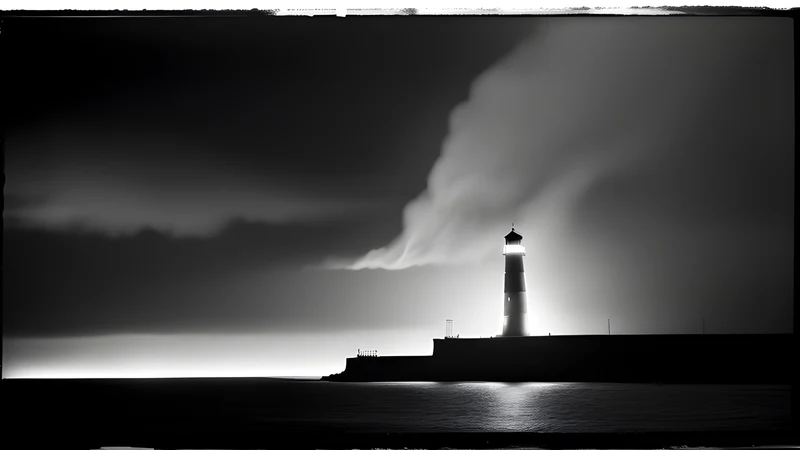
Contents
Robert Eggers followed The Witch with a film about two men in a tower shouting at each other for a hundred and nine minutes, shot in black and white, in a frame almost as tall as it is wide, in a dialect most of the audience would need a moment to tune into. A24 released it in October 2019 after a Cannes premiere in the Directors’ Fortnight. It made money. Nothing about that sentence should have been possible.
The Lighthouse is the most technically obstinate film of its decade and one of the funniest, and the two facts are related.
Two wickies and a lamp
Late nineteenth century, a rock somewhere off the New England coast. Thomas Wake (Willem Dafoe) is the senior keeper — a “wickie” — on a four-week posting. Ephraim Winslow (Robert Pattinson) is his new second, a former timberman with no sea experience and a manner that suggests he has not told anyone the truth about himself in some time.
Wake keeps the light. That is the arrangement, stated early and enforced absolutely: Winslow does the labour — the coal, the cistern, the whitewashing, the emptying of chamber pots — and Wake alone climbs to the lantern room, alone at night, with the door locked. Winslow does the work; Wake does the thing the work is for.
Then the relief boat does not come, and the film’s clock stops. What follows is a study of two men, a bottle, a seagull, and a hierarchy with nowhere left to point.
The craft: a frame designed to hurt
Start with the shape, because the shape is the film’s thesis.
Eggers and cinematographer Jarin Blaschke shot in 1.19:1 — the Movietone ratio, briefly standard around 1930 when sound-on-film ate part of the frame’s width, and abandoned almost immediately. It is a nearly square image, and it does two things at once. It gives the lighthouse its full vertical extent in a single shot, so the tower is always the tallest thing available and the men are always beneath it. And it makes a two-shot almost impossible. Put two adult men in a 1.19:1 frame and you cannot place them side by side with any air; you have to stack them, crowd them, or cut. So the film’s dominant grammar is faces filling the width of the frame with no escape at the edges, which is exactly the experience of the characters. There is nowhere else in the image to look, because there is nowhere else on the rock to be.
Then the stock. Blaschke shot on 35mm Kodak Double-X, filtered to approximate orthochromatic emulsion — the film stock of the silent era, blind to red. Orthochromatic photography does something specific to human skin: red tones go dark, so lips blacken, blemishes rise, veins surface, and eyes take on that unnerving pale gaze from 1920s cinema. Dafoe and Pattinson do not look like actors in a period film. They look like photographs of dead men. Blaschke then shot much of it on Bausch & Lomb Baltar lenses from the 1930s, which flare and soften at the edges in ways no modern glass would permit.
None of this is nostalgia. It is a set of tools chosen for what they do to a face, and the choice is defensible frame by frame. This is the strongest case in modern cinema for monochrome as an active decision rather than a mood.
The sound is the third weapon. Mark Korven’s score is built around a foghorn — a low, cyclical blast that repeats through the film at a rhythm just irregular enough that you cannot settle into it. The horn is diegetic and it is also the score, which means the film has arranged for its own environment to be its soundtrack, and there is no cue you can dismiss as commentary. By the second act your body is bracing for the horn.
The real ancestor
Bergman gets cited — Persona, two faces merging — and it is a lazy comparison that mostly means “black and white and European”.
The genuine ancestor is Vampyr. Dreyer’s 1932 film is where the idea originates that a photographic register can be made wrong — that by manipulating the stock, the exposure and the light you can produce images which are simply incorrect, and that a viewer’s eye will register the incorrectness before their brain finds a reason. The look is diagnostic rather than decorative. Eggers went and acquired Dreyer’s actual toolkit. The orthochromatic look, the near-square frame, the soft-flaring vintage glass: these are the technologies of the era Dreyer worked in, deployed for the same purpose.
The second ancestor is Repulsion. Polanski’s 1965 film established that architecture is a psychological instrument — that a room can be made to bear the weight of a mind coming apart, and that the audience will accept the room’s testimony. Eggers’s lighthouse is Carol’s flat: a structure with a fixed geometry that the film gradually reveals to be lying.
The third is Possession. Żuławski’s 1981 film is the model for what The Lighthouse actually is under the technique — two people in a confined space, escalating past any register a naturalistic film could contain, performing at a pitch that reads as either genius or embarrassment depending entirely on whether you have decided to go with it. Both films demand a surrender in the first twenty minutes and are unwatchable without it.
The performances
Dafoe is doing something almost nobody attempts. Wake’s speech is built from period sources — Eggers and his brother Max mined nineteenth-century maritime writing and Melville for the vocabulary and cadence — and Dafoe delivers it as though it is his native tongue rather than a costume. The famous curse monologue is a piece of sustained rhetorical construction that would sink most actors; Dafoe plays it as a man who has been waiting all his life for an excuse.
Pattinson’s is the harder job and the less praised. Winslow has to be opaque for an hour — a man managing a lie, performing deference, storing resentment — and then has to come apart without the film ever granting him the eloquence Dafoe gets. Wake owns the language. Winslow has grunts, evasions and eventually screaming, and Pattinson has to build a person out of that deficit. He does. This is the performance that ended the argument about whether he could act.
The case against
It is a stunt, and it knows it. The technical apparatus is so aggressive and so foregrounded that the film risks becoming a demonstration of its own craft, and there are stretches — particularly in the middle, where the drunkenness and the bickering cycle without developing — where you can feel Eggers enjoying the equipment more than the story.
The film also has almost no thematic content that survives being stated. Strip the technique and you have: hierarchy is degrading, isolation drives men mad, and there is something in the light. That is not much for 109 minutes, and the mythological apparatus — Prometheus, Proteus, the fire that must not be taken — is applied rather than grown. Eggers’s Witch had a genuine argument about theology. This one has a mood and a superb toolbox.
The defence is that the technique is the content. A film about two men who cannot escape a frame, shot in a frame nobody can escape, is not decorating its idea. And the mythology’s arbitrariness is arguably correct: these are two illiterate men on a rock inventing a cosmology out of a lamp because that is what people do with the only bright thing available.
Where it sits
The Lighthouse is the film that proved Eggers was a formalist rather than a folk-horror specialist, and everything since has confirmed it. It streams widely; the disc is worth owning because the grain structure and the black levels are the film, and streaming compression treats heavy 35mm grain as noise to be smoothed away.
Watch it in the dark, loud, in one sitting, with subtitles on for the first twenty minutes until your ear adjusts. It is also much funnier than its reputation — the fart jokes are load-bearing.
Spoilers below
Everything from here assumes you have seen it.
The name is the film’s first trapdoor. Ephraim Winslow is not Ephraim Winslow; he is Thomas Howard, and the real Winslow was a man he worked alongside in the timber camps and failed — or declined — to save. Eggers hands you this late and offhand, and it retroactively poisons every earlier scene: the deference, the drinking, the defensiveness about his past. He has been sharing a name with the man who ruined him and living beside a second Thomas who owns him.
The doubling is the film’s real structure. Two men called Thomas. Two accounts of what happened to the previous assistant. Two versions of the logbook — Wake writing Winslow up for insubordination while telling him to his face that the work is fine. And, crucially, two irreconcilable timelines: Winslow cannot account for how long they have been there, and neither can the audience, because Eggers has removed every reliable marker. The film is not ambiguous about whether Winslow is mad. It is ambiguous about whether the rock permits sanity as a category.
The gull is the hinge. Wake’s warning that it is bad luck to kill a seabird — the souls of dead sailors — is delivered as superstition, and the film treats Winslow’s eventual violence against the bird as the moment the weather turns. Whether the storm is a consequence or a coincidence is precisely the question the film refuses, and it refuses it because Winslow refuses it too: a man who has just done something appalling will find a cosmology to hold it.
The lantern room is the payoff and Eggers does the right thing with it. Winslow finally gets the light, and what he sees is not shown to us in any form we can hold. He screams, he falls, and the film cuts. Every other choice available — a monster, a vision, a revelation — would have been a lie about a film built on withholding. The final image, gulls at work on a body on the rocks, is the Prometheus myth delivered flatly and without a musical sting. He took the fire. The birds are eating him. Wake said it would go like this.
Related Content