The Lickerish Quartet: Metzger's Film-Within-a-Film Puzzle
A jaded family, a stag reel and a castle where reality keeps folding back on itself
Contents
If you want to prove that Radley Metzger belonged in the conversation with the European art directors he admired, you play someone The Lickerish Quartet and refuse to tell them what it is. Made in 1970, it is a hall-of-mirrors puzzle about the unstable boundary between images and reality, shot with the formal ambition of a Resnais or an Antonioni, and it happens to carry adult content of the kind that got it filed under exploitation for decades. Watched now, restored and taken seriously, it is the most intellectually daring film Metzger ever made, and one of the strangest films of its moment in any category.
The set-up sounds like a fable. A bored aristocratic trio — a middle-aged husband and wife and the wife’s grown son — occupy a crumbling Italian castle and pass their evenings watching a scratchy old stag film projected on the wall, bickering about whether the woman in it is convincing or a fraud. Then they attend a travelling fair in the nearby town, where a young woman (Silvana Venturelli) performs a daredevil motorcycle act inside a spherical cage, and they become convinced she is the same woman from the film. They bring her back to the castle, and from there the picture begins to fold in on itself, each apparent revelation dissolving into another layer of doubt about who this woman is, what has actually happened, and which images can be trusted.
The premise, kept above the line
Metzger and co-writer Michael DeForrest built the film as a deliberate riddle, and the pleasure of it above the line is the sensation of ground shifting underfoot. The family’s certainty that the fairground performer is the woman from their stag reel is never confirmed or denied; instead the film keeps restaging encounters between the four of them in ways that contradict what you have already seen. Scenes recur with variations. Identities blur. The stag film the family watches keeps changing — at one point the faces on the wall appear to be their own. By the midpoint you have stopped trusting any single image to be “really” happening, which is precisely the state Metzger wants you in.
The three permanent residents — Frank Wolff as the husband, Erika Remberg as the wife, Paolo Turco as the son — each construct a private version of the young woman, projecting onto her their own frustrations and desires, and the film refuses to arbitrate between their versions. Venturelli, for her part, plays the visitor as a genuine cipher, adapting to whatever each family member needs her to be, which keeps the question of her reality permanently open. Everything above this line is safe to describe, because there is no stable plot to spoil; the film is a structure, not a story, and its meaning lives in the pattern rather than the events. The one genuine twist, in the final movement, I keep below the line.
Why it works: the castle as a machine for doubt
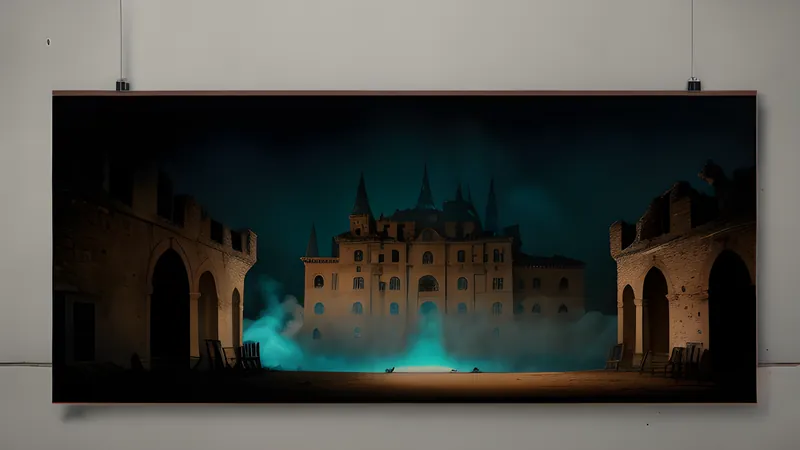
The single best decision Metzger made was the location. The Lickerish Quartet was shot largely at the Castello Piccolomini at Balsorano, a real medieval castle in the Abruzzo, and the building does an enormous amount of the film’s work. Its long stone corridors, its libraries and stairwells and echoing chambers, give the picture a labyrinthine geometry that mirrors its structure — a place where you can walk through a door and end up somewhere you did not expect, which is exactly what the narrative does. The castle is a physical diagram of the film’s theme. Metzger stages his blurrings of reality inside a space that already feels like a puzzle box, and the architecture makes the disorientation legible.
His visual craft is at its peak here. The cinematography by Hans Jura is gorgeous and precise, all deep-focus corridors and painterly interiors, and Metzger’s editing is where the real gamesmanship lives: he cuts between the stag film and the family watching it, between remembered and present encounters, between versions of the same scene, until the joins stop making ordinary sense and start making rhyme instead. This is the technique of high art cinema — the associative montage of Resnais’s Marienbad, the identity slippage of a European modernist — deployed by a director the critical establishment refused to take seriously because of what he was willing to show.
The film’s most celebrated single sequence is the library, and it is the key to Metzger’s whole method. Two characters come together in a room whose floor is printed with words — the vocabulary of eroticism in many languages, scattered across the stone like a scholar’s spilled index — so that even the most physical scene in the picture is literally overlaid with language, with text, with the idea that everything here is mediated through representation. It is a genuinely brilliant image, and it tells you what the film believes: that desire and its depiction are inseparable, that there is no getting behind the image to some unmediated real thing. The whole picture is that library floor writ large.
The collector’s note: art cinema in disguise
The value of The Lickerish Quartet for anyone building a mental map of erotic cinema is that it collapses the distinction between the art film and the adult film that the culture worked so hard to police. Its games with reality and representation belong to the same 1960s and 70s modernist project as Buñuel’s Belle de Jour, which likewise refuses to tell you which of its scenes are real and which are fantasy, and stages the same seductive uncertainty about a woman who may exist only as a projection of others’ desires. Set the two films side by side and the family resemblance is unmistakable; Metzger is playing Buñuel’s game on Buñuel’s level.
Within Metzger’s own work, the connective tissue runs straight to his other films. The theatrical control and wit of Score shows the same director working in a stripped-back register, and the design-forward excess of Camille 2000 shows him indulging the visual maximalism that here is turned toward metaphysical unease rather than mod spectacle. The Lickerish Quartet is the film where his intelligence and his formalism are most fully in charge, and it rewards the viewer who comes to it expecting a puzzle rather than a provocation.
The verdict, above the line
The Lickerish Quartet is the strongest case for Metzger as a genuine auteur, a film of real formal daring that uses adult material as the raw substance for an essay on images, memory and the unreliability of what we see. It is beautiful, disorienting and cleverer than it has any commercial reason to be, and its long relegation to the exploitation shelf says more about how the culture sorted its films than about the film itself. Everything above this line is safe. To discuss the closing revelation — the twist that recontextualises the family’s obsession — I have to give it away, so the rest goes below.
Spoilers below
The film’s final movement pulls the rug in the most Metzger way imaginable: it suggests that the entire premise may have been inverted. In the closing stretch the identities the family has been so sure of come apart, and the picture floats the possibility that the young woman was never the stranger the family imported into their sealed world — that the stag film, the fairground, the whole apparatus of the outsider arriving to disrupt them, was itself a story the family told, and that the visitor may have belonged to the castle, or to their own projections, all along. Metzger stages a series of substitutions in which the young woman and the wife, in particular, seem to trade places or merge, so that the boundary between the intruder and the family dissolves entirely.
The point of the twist is that it refuses to resolve. Metzger does not hand you a clean answer in which “actually, X was Y.” He leaves the substitutions hanging, so that on reflection you cannot reconstruct a single coherent chain of events at all — which of the encounters were real, whether the fairground woman and the stag-film woman and the wife are one person or three, whether anyone left or arrived. The film has spent its whole length teaching you that images cannot be trusted and that every character is authoring a private version of reality, and the ending simply declines to break that rule for your comfort. The riddle stays a riddle on purpose.
This is why the film reads as art rather than exploitation, and why it has outlasted almost everything it was once shelved beside. Its subject is the epistemology of the image — the impossibility of getting behind a representation to the real thing it claims to show — and it dramatises that subject through structure, through a castle, through a floor printed with words. My verdict: this is Metzger’s masterpiece and the film that ends any serious argument about whether he was a real filmmaker. Watch it as you would watch Marienbad, expecting to be lost on purpose, then chase it with Belle de Jour for the same games played by a surrealist, and Camille 2000 to see Metzger turn the same eye toward pure design.
Related Content