The Legend of Hell House: The Haunting's Nastier Cousin
Richard Matheson wrote the anti-Shirley-Jackson haunted house, and John Hough filmed it with an electronic score and no manners
Contents
Robert Wise made The Haunting in 1963 and settled the argument: the ghost you never see is the ghost that works, and the haunted house film is a chamber piece about a woman’s mind coming apart in the dark. It was so complete a statement that it functioned as a lid. Then Richard Matheson wrote Hell House in 1971 with the express intention of prising the lid off, and John Hough filmed it two years later with a physicist, a machine, a lot of ectoplasm and absolutely no interest in tact.
The Legend of Hell House is the rude answer to a polite masterpiece. It is a lesser film and a more useful one, because it went and looked at the things Wise had elegantly declined to look at.
The Mount Everest of haunted houses
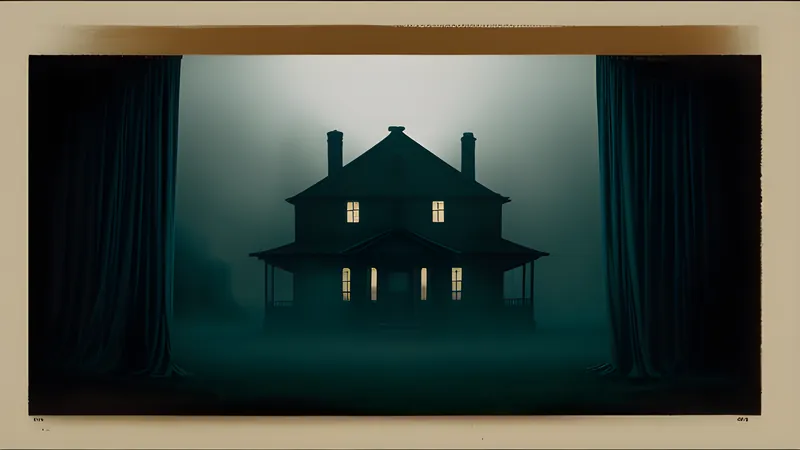
The premise is a wager dressed as research. A dying millionaire wants to know whether anything survives death, and pays a team to spend a week in the Belasco house in Maine — the property the film’s own dialogue calls the Mount Everest of haunted houses, on the grounds that two previous expeditions went in and only one man came out sane.
That man is Ben Fischer (Roddy McDowall), a physical medium who was a boy when the first team was destroyed, and who has spent twenty years perfecting the art of feeling nothing. He is joined by Dr Lionel Barrett (Clive Revill), a physicist who holds that hauntings are residual electromagnetic radiation and can be cleared with the right apparatus; Barrett’s wife Ann (Gayle Hunnicutt), who is the only person in the house with no theory; and Florence Tanner (Pamela Franklin), a spiritualist medium who believes the house holds a soul in torment that can be reasoned with and released.
Four people, three incompatible theories, one week. The house begins by testing which theory breaks first.
The Belasco backstory is the film’s great lurid gift. Emeric Belasco — the Roaring Giant, six foot five, a man who built a house with no windows and filled it with everything he could imagine — ran the place as a closed laboratory of appetite through the 1920s, and the survivors of that period did not survive it. Matheson gives you this as gossip rather than flashback, which is the correct choice: the house’s history arrives as things people are reluctant to say aloud.
The machine is the argument
The clean division of labour in Wise’s film is between belief and scepticism. Matheson’s structure is smarter, because he gives you three positions and lets the house eat them at different speeds.
Barrett’s device — a large humming cabinet he has had shipped in at enormous expense — is designed to drain the house’s accumulated electromagnetic charge, and it is the most interesting object in seventies horror. Here is a rationalist who is entirely correct about the existence of the phenomenon, has built working technology to address it, and is destroyed anyway, because his model is right about the mechanism and wrong about the intent. Florence is destroyed too, faster, because her model grants the house a soul that wants peace, and it turns out to want something else. Fischer survives longest by holding no position at all, shutting down completely and refusing to give the house a surface to grip.
That is a genuinely rigorous piece of construction. Each character’s death or damage is delivered through their thesis. The film is a chamber piece in which epistemology is the murder weapon, which is more than the average English haunted house was attempting in 1973.
Hough shoots it with a restlessness that dates the film in the good way — canted angles, wide lenses shoved into faces, cats and crucifixes and chapel doors. The masterstroke is the sound. The score is by Delia Derbyshire and Brian Hodgson, working as Electrophon, the pair from the BBC Radiophonic Workshop whose fingerprints are on the Doctor Who theme. There is no orchestra anywhere in Hell House. The house speaks in oscillator drones, tape manipulation and metallic scrape, so the boundary between score and sound effect dissolves entirely and you stop being able to tell whether what you are hearing is in the room or on the soundtrack. Wise achieved his dread with a creaking door and a bulging wall; Hough achieved a comparable effect by making the entire building sound like a machine that is thinking. I unpacked how far a score can carry a horror film in how a horror score rewires the audience — this is one of the purest cases in the canon.
Pamela Franklin, twice haunted
Casting Pamela Franklin as Florence is the sort of joke only a genre with a long memory can make. Franklin was the child in The Innocents, Jack Clayton’s 1961 adaptation of The Turn of the Screw, playing Flora — the little girl at the centre of the most exquisitely ambiguous haunting in British cinema, a film that hangs its entire meaning on whether the ghosts are real or the governess is ill.
Twelve years later she returns to a haunted house as an adult medium, and the film she is in has no ambiguity whatsoever. The ghosts are real, they are aggressive, they are sexual, and there is a corpse to find. Franklin plays Florence with a fervent, wide-open sincerity that makes her the most sympathetic figure on screen and the most obvious target — her openness is the wound. She had done ambiguity as a child and been terrified by implication; here she gets the literalist version, and the contrast between the two performances is a decent shorthand for what happened to British horror across the sixties.
McDowall, meanwhile, plays Fischer as a man doing a passable impression of furniture, and then gets the film’s best final act.
Why it works
The Legend of Hell House works because it is honest about being an argument. Matheson wanted to answer Shirley Jackson with a haunted house that would not hide behind ambiguity, and he built a machine for the purpose: four people, three theories, a lead-lined secret and a week to run the experiment. The film is at its weakest when it delivers on the promise — the physical manifestations are a lot of wind and crockery, and Wise’s restraint wins that particular exchange comfortably. It is at its strongest as a structure, where every scare is also a refutation.
It also permanently changed the sub-genre’s economics. The haunted house film after 1973 is largely Matheson’s model rather than Jackson’s: a team, a history, a mystery with a solution, a house that can be defeated if you correctly identify what it wants. That template runs straight through The Changeling and out the other side into every investigator-led haunting made since. I mapped the wider bloodline in the haunted house canon and the architecture that makes these films tick in the haunted house film and the architecture of fear.
Where to watch: it circulates in a decent Blu-ray with the Electrophon score intact, which matters more here than in almost any other film of its decade — a compressed streaming transfer flattens the low-frequency drone that does most of the work. Watch it in the dark with the volume up, and watch it after The Haunting rather than before, because it was written to be read as a reply.
The verdict is that this is the most intelligent B-picture England made about ghosts in the seventies: a film whose ideas outrun its effects budget by a distance, and which still supplies the blueprint every haunted-house investigation has been filling in since. Follow it with Burnt Offerings, which arrived three years later and asked the same question with the house doing the eating.
Spoilers below
Barrett’s machine works. That is the twist that most people misremember, and it is the film’s best idea. He fires up the reversor, drains the house, declares the job done — and he is right. The charge is gone. Everything the house had accumulated is discharged into his apparatus exactly as his physics predicted, and he is killed anyway, almost immediately afterwards, by the one thing his machine could not reach.
The reason is architecture. Belasco’s chapel — the room the film has been treating as a hostile space all week, the place where Florence is most savagely used — is lead-lined, and the lead shielded its occupant from the reversor’s field. Behind the wall sits Emeric Belasco himself, preserved, seated, waiting, having sealed himself in.
Fischer works it out and then does the only thing left: he insults him. Having spent the whole film refusing to open himself, he opens up entirely and goads. The Roaring Giant was not six foot five. Belasco was a small man, and had his legs surgically extended — a butchery he inflicted on himself so that he could loom over everyone who came to his house. The entire legend, the appetite, the twenty years of destroying investigators, all of it is a short man’s compensation, and being told so out loud in his own chapel is what finishes him. The house is not exorcised by physics or by love. It is dismantled by a heckle.
Florence’s fate is the film’s cruellest joke and its clearest statement of method. She dies believing she is helping a tormented soul called Daniel Belasco, a son she is convinced needs release. There is no son. The house fed her a theory shaped to her own compassion, and she was killed by her willingness to believe the ghost had a grievance worth hearing. Barrett is killed by his certainty, Florence by her charity, and the survivor is the man who arrived having already decided to feel nothing at all.
Related Content