The Last Starfighter: The Arcade Recruit
A trailer-park kid, a con man from space, and the first film to trust a computer with its spaceships
Contents
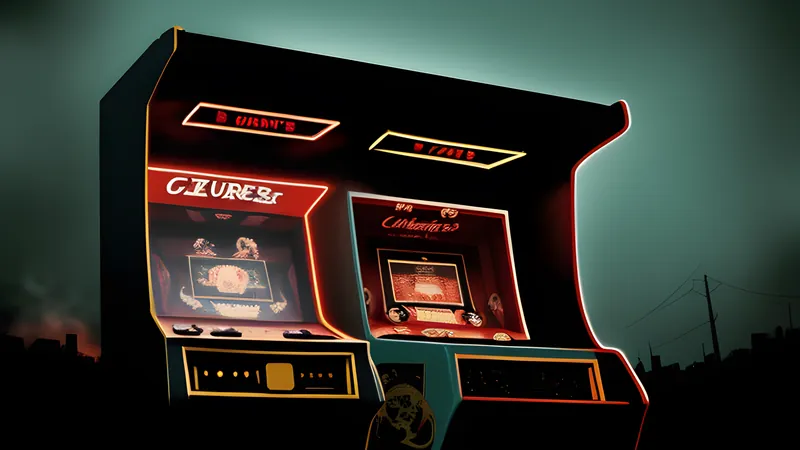
Alex Rogan is nineteen, lives in a trailer park called Starlight Starbright, fixes everybody’s plumbing, and has been turned down by the bank for a college loan. The only thing he is exceptional at is a stand-up arcade cabinet by the laundry that nobody else can beat. One night he beats it. That evening a car pulls up, and an elderly man in a loud jacket offers him a job.
The Last Starfighter is remembered for two things: for being the film where an arcade game turns out to be a recruitment test, and for its spaceships, which were the first substantial fleet of computer-rendered vehicles in a feature film. Both are worth the attention. Neither is the reason it still works.
The Robert Preston problem, which is not a problem
Centauri is a con man. This is the film’s best and least-discussed decision, and it is entirely a casting move.
Robert Preston was, to an American audience in 1984, one thing above all others: Harold Hill, the fraudulent travelling salesman from The Music Man, who blows into a town, sells the rubes an orchestra he cannot supply, and is redeemed only because the lie accidentally comes true. Preston had played that part on Broadway and on film and it defined him for thirty years. Nick Castle then cast him as an alien recruiter who arrives in a small town, dazzles a naïve boy with an impossible offer, and turns out to have been running a scam on both ends.
Because that resonance is doing the work, the film does not have to explain Centauri at all. Preston plays him at full throttle — the patter, the delight, the total absence of shame — and the character is immediately legible as a specific American type: the man who sells you something he has no right to sell and is somehow, infuriatingly, on your side. The film is a Star Wars-shaped wish fulfilment with a Broadway huckster at its centre, and that is why it does not taste like every other one.
The other performance holding it up is Dan O’Herlihy as Grig, the reptilian navigator, buried under prosthetics and playing warmth through about four square inches of available face. Grig’s function is to be the friend Alex has never had, and O’Herlihy plays him with a dry, delighted decency that is genuinely moving in a film that has no business being moving.
The Cray
The effects are the historical claim. Digital Productions, run by John Whitney Jr and Gary Demos, rendered the film’s ships, planets and battles on a Cray X-MP — at the time one of the most powerful computers in the world, rented at extraordinary cost, running for months.
The important distinction is what they were rendering for. Tron, two years earlier, used computer imagery to depict a world that was explicitly made of computer imagery: the abstraction was the subject. The Last Starfighter used it to depict physical objects — metal ships, rocky planets, a gun turret — that the audience was meant to accept as real. That had never been attempted. Every previous fleet in cinema was models on wires.
It does not entirely succeed, and the failure is instructive. The ships are clean, hard-edged and weightless; they have no dust, no scratches, no atmosphere, and they move with a mathematical smoothness that reads as animation rather than mass. The eye clocks it instantly, in 1984 and now. What the Cray could compute was geometry. What it could not compute was wear, and wear is most of what makes a spacecraft look like an object.
But the ambition was correct, and the specific thing they proved — that you could build a vehicle in a machine, light it, move it, and cut it into a live-action film — is the foundation of everything that followed. Nine years later a different team put dinosaurs into a jungle using the descendant of exactly this approach. Digital Productions went bankrupt.
The craft: the middle third
The best-made stretch of the film is the one nobody talks about, which is the section on Earth after Alex leaves.
Centauri leaves behind a Beta Unit — an android duplicate of Alex, played by Lance Guest in the film’s second role — to cover the gap. The Beta is a comic device on paper, and Guest plays it beautifully: the same face, the same voice, and an absolute vacancy behind the eyes, a machine gamely performing a boy it has read about. He fails at kissing. He fails at understanding what a mother is. He is not stupid, he is a very good copy of the outside of a person.
That subplot exists for structural reasons — the film needs Earth alive while Alex is away, and it needs a reason for the villains to come here — and Castle turns necessity into the emotional argument. The Beta shows you what Alex looks like from outside: a young man performing a life he does not feel inside. Alex spends the first act desperate to leave the trailer park, and the film’s answer is to show us the trailer park with a hollow Alex in it, and let us notice that everyone there loves him and he had not registered it.
Castle, incidentally, is not a sentimentalist by background. He was Michael Myers — the man in the mask in Halloween, an old friend of Carpenter’s from film school — and the shape of his direction here is a horror director’s shape. The Zando-Zan assassin sequences are staged as slasher beats: a thing in a house, a body count, a sudden reveal. Craig Safan’s score keeps the Korngold swagger going over the top of them.
Safan’s score is worth a sentence of its own, because it is doing something slightly sly. It is written in the full late-Romantic adventure idiom that Star Wars had made compulsory for the genre — brass, a big rising hero theme, no irony available anywhere — and Castle deploys it over a boy fixing a television aerial in a trailer park. The music takes Alex’s life seriously about forty minutes before the film’s plot does. By the time he is actually in a cockpit, the score has already told you he belongs there, which is why the transition costs the picture nothing.
The ancestor
The collector’s answer is not Star Wars, whatever the poster suggests. The Last Starfighter is a juvenile from the golden age of science fiction publishing, filmed. Specifically it is Heinlein: a competent, undervalued young man from an ordinary background is recruited into a real war by an adult who explains nothing, is trained too fast, and discovers that competence is transferable. Have Space Suit — Will Travel has this exact shape, and so do a dozen novels sold to teenage boys between 1947 and 1963. The arcade cabinet is the only modernisation, and it is a good one.
The second ancestor is The Music Man, discussed above, and the film’s structure is genuinely closer to a musical than to a space opera: a con man arrives, the town is transformed, the lie turns real, and everyone gets what they wanted.
For the neighbourhood, Explorers arrived a year later with the same faith that a bright kid from nowhere could get off the planet on the strength of enthusiasm, and reached a much stranger conclusion. And for the version of this era’s arcade-shaped anxiety with all the optimism removed, Tron had already established that the machine might have plans of its own.
The case against
The script is soft. The Ko-Dan Armada is a nothing threat commanded by a nothing villain, the Rylan politics are a paragraph of exposition, and the war has no cost — the film wants a galactic conflict and cannot bear to make it hurt. The traitor Xur is played broadly and remembered by nobody.
The pacing sags whenever the film is on Rylos and the effects have to carry a scene alone, which is exactly where they are weakest. And the film’s fundamental proposition — that the kid is special and the universe will notice — is the most-served fantasy of its decade, delivered without complication.
What survives all that is tone. There is no cynicism anywhere in this picture and no cruelty in it either. It likes its characters, including the ones it laughs at, and it likes the trailer park it spends its first twenty minutes wanting to escape. That is rarer than good effects.
Where to watch: it has had a decent disc life and turns up on rental platforms. Watch it with someone who has never seen a Cray render a spaceship. The seams are the pleasure.
Spoilers below
Centauri’s scam is total. There is no recruitment programme. The Rylan Starfighter corps has been destroyed by the time Alex is brought in, and the arcade cabinet was never a legitimate test — Centauri planted it on Earth without authorisation, as a private venture, because he needed a pilot and had no legal way to get one. He does not tell Alex any of this. He drops him on Rylos, watches him panic, and takes him home when he asks.
The film’s turn is that Alex chooses to come back. He goes back to the trailer park, understands within an afternoon that he is now the only person alive who can fly a Gunstar, and returns because Grig will die otherwise. That is a better motivation than destiny, and the film earns it by having Alex refuse first.
Preston’s last scenes are the ones that justify the casting. Centauri is fatally wounded getting Alex off Rylos, and the film has him die badly and then, forty minutes later, get up — a Rylan restorative process, played entirely as a joke, the old fraud grinning at having conned death as well. He then flies off to find more marks. There is no redemption arc. Harold Hill stays Harold Hill.
The final battle works because Castle has been rigorous about one thing: Alex is good at exactly one skill, which is playing the game, and the game is the Gunstar. He does not become a warrior. He does not learn courage in a montage. He sits in a chair, operates a targeting system he has already mastered on a cabinet next to a laundry, and wins because he has practised. The Death Blossom — the one-shot super-weapon buried in the cabinet’s manual — is the reward for having read the instructions.
Then he comes home, and the film’s actual ending is the one that lasts. Alex does not stay in space and does not settle for Earth. He lands the Gunstar in the trailer park, in front of everyone, and takes Maggie with him. The Beta Unit stays behind to be Alex Rogan forever, mowing the lawn, being a son to a woman who will never know. Castle plays it as a happy ending and it is quietly the most melancholy idea in any of these films: a machine left standing in the trailer park at dusk, having agreed to live out a life the real boy did not want, for people who will never be told.
Related Content