The Killers (1946): The Hemingway Noir Ambush
Twenty minutes of Hemingway, filmed almost word for word, and then ninety minutes of everything Hemingway declined to tell you
Contents
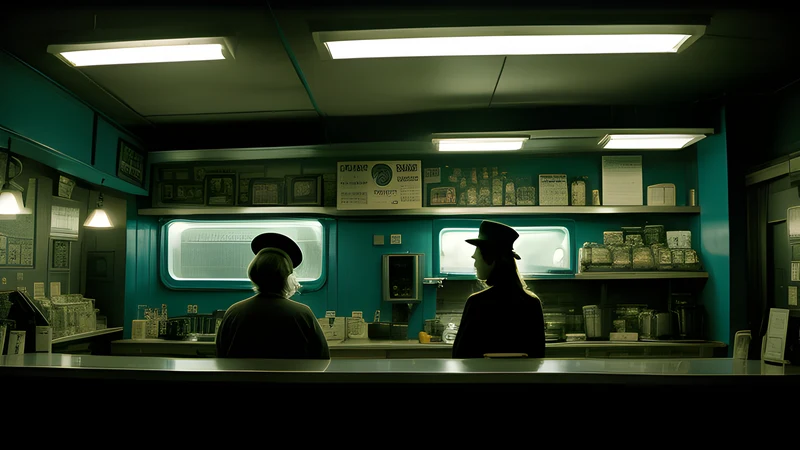
Two men in overcoats walk into a diner in a small town at night and start needling the counterman. They are waiting for someone. They make no secret of what they intend, and when they have established that their man is not coming in for his supper, they leave to find him. Someone runs ahead to warn him — and the man they are hunting, lying on a bed in a rented room in the dark, says he is not going to do anything about it. He knows they are coming. He is going to stay where he is.
That is Ernest Hemingway’s short story The Killers, published in 1927, and Robert Siodmak films it almost exactly as written for the first twenty minutes of his 1946 picture. Then he does the thing Hemingway spent his career refusing to do: he explains. The whole rest of the film — the flashbacks, the investigator, the woman, the heist — is an answer to the question the story pointedly leaves hanging. Why would a man lie still and wait for it?
Hemingway hated most adaptations of his work and is generally reported to have made an exception for this one. He had reason. The film understands that his story is a door, and it has the wit to know that walking through it is a different job from writing it.
The Swede, and the man with the file
The man on the bed is Ole Andreson, called the Swede, and he is Burt Lancaster in his first film. Lancaster was a former circus acrobat with no screen experience, and Siodmak uses the inexperience beautifully — the Swede is a big, slow, banked-down presence who does very little, and the camera simply waits on him. A trained actor would have found something to play. Lancaster lies there, and the stillness is the character.
After the diner, the film’s structure arrives in the shape of Jim Reardon (Edmond O’Brien), an insurance investigator looking into a small life-insurance policy the Swede left to a chambermaid in Atlantic City. This is the film’s most elegant piece of engineering, and it is worth stopping on. Reardon has no personal stake, no vendetta, no dead partner. He is doing paperwork. The company’s exposure is a few thousand dollars, and his boss keeps telling him to drop it. He keeps pulling, and the film is honest that his motive is curiosity, the same curiosity the audience has, which makes him the most purely functional detective in noir: he is us, with a per diem.
What Reardon assembles, interview by interview, is a life. And here the film borrows a structure that was five years old at the time and still radical: the Citizen Kane method, in which a reporter’s enquiry brings back flashbacks from people who each knew a different fragment of the dead man, none of them complete, some of them lying. Siodmak’s flashbacks arrive out of order and do not agree with one another. The Swede is assembled in front of you out of testimony, which is precisely how the film keeps a dead man as its protagonist.
The pieces: a failed boxer with a broken hand, a decent police friend (Sam Levene) who watched him go wrong, a prison stretch, a crew, a payroll job, and Kitty Collins. Ava Gardner, twenty-three and not yet a star, plays Kitty in her first significant part, and Siodmak shoots her the way he shoots the money — as an object the men in the film have decided to believe in.
Why it works: the heist in one crane shot
The film’s most audacious sequence is the Prentiss Hat Company payroll robbery, and it is a piece of formal bravado that most viewers do not consciously notice.
Siodmak stages the entire job — the arrival, the men crossing the yard, the entrance, the shooting, the escape — as a single unbroken crane shot, viewed from high overhead, with no dialogue. Over the top of it runs a newsreel-style narration, the voice of an insurance report or a newspaper account, giving the facts in the flat register of a filed document. So the one action the whole film has been circling, the crime that explains everything, is delivered as a distant aerial abstract with a bureaucrat talking over it.
The reason it works is thematic rather than technical. Every other scene in the picture is a close, subjective, contradictory memory told by someone with a reason to shade it. The heist is the only thing in the film that is documented, and Siodmak shoots it as documentation: no faces, no psychology, no point of view, a paragraph in a file rendered as an image. The distance is the meaning. The audience is being shown the difference between what happened and what people say happened, and the film never underlines it once.
Siodmak had come up through German cinema before Hollywood, and the expressionist inheritance shows in Woody Bredell’s photography — the diner’s cold pools of light, the Swede’s room in near-total darkness, faces cut in half by shadow. But the Kane structure and the newsreel heist are American formal experiments, and the collaboration of those two instincts is why this is the best-built noir of its year.
Miklós Rózsa’s score carries a hammering four-note figure that became so identified with menace that it went on to underpin the Dragnet theme, a resemblance that reportedly ended in a settlement in Rózsa’s favour. It is the rare case of a noir score becoming, quite literally, the sound of American law enforcement.
The real ancestor, and the family
The film’s parent is Citizen Kane (1941) for its structure and Hemingway for its first reel, and the strangeness of The Killers is how well the graft takes. Its immediate sibling is Siodmak’s own Criss Cross three years later, which reunites the director with Lancaster and Rózsa at the same studio and runs the same fatal shape — a big passive man, a woman, a robbery, a betrayal — with the flashback tightened and the doom concentrated. Watch them as a pair. They are effectively the same film told at two different temperatures, and Criss Cross is the more relentless.
The other essential companion is The Asphalt Jungle (1950), which took the heist itself — treated here as a single distant shot — and made it the whole subject, establishing the template every caper since has followed. Put simply, The Killers is a film about the aftermath of a robbery it barely shows; The Asphalt Jungle is the film that noticed the robbery was the movie.
Don Siegel remade The Killers in 1964 with Lee Marvin and John Cassavetes, restructuring it so the hitmen investigate rather than an insurance man, and making Ronald Reagan a gangster in his last screen role. Siegel’s version is harder, flatter, in colour, and made for television until it was judged too violent for it. It is a good film. It has no interest in the thing that makes the 1946 picture great, which is that Reardon does not matter, and the mystery is the man on the bed.
The honest case against
The middle sags. The interview-and-flashback machine is elegant in design and repetitive in practice, and there is a stretch around the hour mark where Reardon is essentially conducting admin — go to a person, hear a story, go to the next person — and the film’s own structure has told you roughly where it must be heading. Hemingway’s twenty minutes are so good that everything after them is, by definition, the explanation of a mystery that was better as a mystery. That is the risk any adaptation of this story runs, and the film only half escapes it.
O’Brien’s Reardon is also, deliberately, a blank, and deliberate blankness is still blankness for the audience sitting with him for ninety minutes. And Gardner, magnetic as she is, is given a character built almost entirely out of other people’s assumptions, which is thematically justified and dramatically thin.
Where to find it: it is a repertory staple and has a good restoration in circulation, usually programmed alongside Criss Cross, which is the correct double bill and should be watched in release order.
Spoilers below
The answer to Hemingway’s question is that the Swede thinks he deserves it, and he is wrong about why.
The payroll job goes as planned and comes apart afterwards, as these things do, in the divvying. The Swede is told that Kitty has been double-crossed by the crew and that the money is gone, and he takes the whole take himself and runs with her — believing he is rescuing her from Big Jim Colfax and the others. What he does not know, and what Reardon’s last interview establishes, is that the story was Kitty’s. She told it to him. The double-cross he thought he was avenging was the double-cross he was being used to commit, and the woman he stole it for went back to Colfax with it.
So the man on the bed is not waiting for the hitmen out of fatalism, or exhaustion, or some existential Hemingway blankness. He has spent years believing he betrayed his crew for a woman who then vanished, and he has decided that a man who did that has no argument to make when two men in overcoats come up the stairs. He lies down because he has been convicted by a fabricated version of his own life. The most terrible thing in the film is that he is a decent man executed for a crime that a lie persuaded him he had committed.
And Kitty’s final scene is the film’s coldest. Cornered, with Colfax dying and the whole thing in ruins, she does not confess or repent — she instructs. She tells the only man in the room who can still help her to say she is innocent, over and over, working right to the last second, because performing innocence is the only skill she has and it has never yet failed her. Siodmak lets her keep asking. The film does not grant her a moment of self-knowledge, and it is right to withhold it: the whole picture has been about the damage a good story does to a man who believes it, and Kitty is still telling one.
Related Content