The Killer-Car and the Machine That Hates Us
A robot is somewhere you visit; a car is parked outside your house
Contents
Count the killer robots that still frighten anybody and you will run out of fingers before you run out of hand. Now count the killer cars, and notice that a fifty-year-old television movie shot in under a fortnight for a network slot is still the benchmark for road terror, and that a Plymouth Fury with a personality problem remains one of the most recognisable antagonists in horror. The disparity is not about budget or talent — Michael Crichton, Douglas Trumbull and Stanley Kubrick all built machines that hate us, and they had better resources than Elliot Silverstein.
The difference is proximity. A killer robot lives in a facility you have to travel to: a theme park, a space station, a corporate research floor, a shopping centre after hours. The film has to get you there, and the getting-there is the audience’s escape hatch — decline the trip and you are fine. A car is on your drive. You bought it, you owe money on it, and you will get into it tomorrow morning because you have no alternative. The killer-machine film works in exact proportion to how little choice the audience has about the machine, and the car is the only one that scores full marks.
Matheson’s rule: never show the driver
Richard Matheson published Duel as a short story in Playboy in April 1971 and adapted it himself for ABC’s Movie of the Week, where a twenty-four-year-old Steven Spielberg shot it in roughly a fortnight on California highways. It is the founding text and it establishes the law that governs everything after it: you never see the man in the truck.
That decision does an extraordinary amount of work. A visible driver converts the film into a thriller about a psychopath, at which point the audience starts building a profile, looking for a motive and waiting for a confrontation. Withhold him and the tanker becomes the antagonist as a matter of grammar — Spielberg shoots the 1955 Peterbilt in low, long lenses that flatten it against the road, gives it a radiator grille full of licence plates from previous states, and lets the sound design do the acting. Every cut to the truck is a cut to a face. It played on American television in November 1971, was expanded with extra footage and released theatrically in Europe in 1973, and it has never been surpassed.
The rule holds negatively too. The moment a killer-machine film explains its machine, it deflates. The Car (1977) survives on the fact that Elliot Silverstein never opens the doors of the customised 1971 Lincoln Continental that George Barris built for the production — the windows are impenetrable black, the horn is wrong, and the film’s one great gag is that it will not cross onto consecrated ground and offers no reason.
The car as an extension of the man
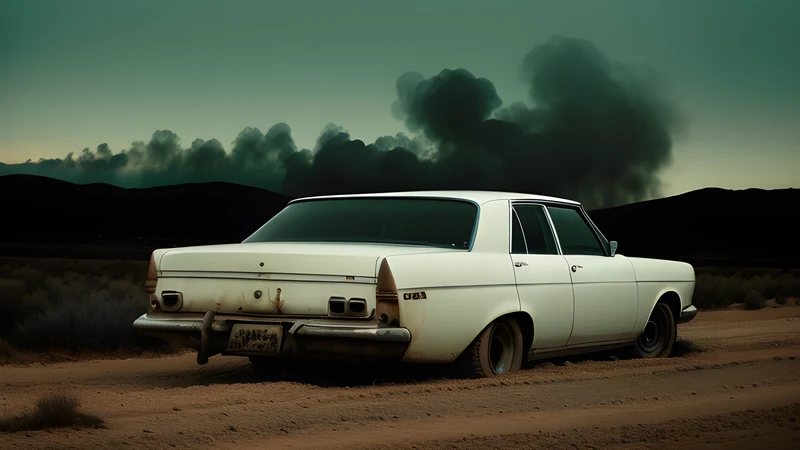
John Carpenter’s Christine (1983) is the subgenre’s most complete film because it understands that a car is a self-portrait. Columbia optioned Stephen King’s novel before publication and had the picture in cinemas by 9 December 1983 — a schedule that shows in the film’s economy and helps it, because Bill Phillips’s script has no time for mythology. Arnie buys a 1958 Plymouth Fury off a lawn for a couple of hundred dollars, and the film’s real horror is watching a boy’s taste in transport become his personality and then his character.
The craft is exemplary and almost entirely mechanical. The production went through a large number of Furys and their near-identical Belvedere and Savoy siblings, wrecking them systematically. The famous regeneration was achieved by building cars with hydraulic rams and pneumatic bladders inside the panels, crushing them on camera, and running the film backwards — so the healing has real metal in it, groaning at real speed. Nothing about it is a drawing. That physicality is why the sequence still lands and why every digitally reconstituted vehicle since has felt like a screensaver. Carpenter’s killer car is a study in ownership as identity, and it belongs squarely inside the cursed-object tradition, where everything haunted was acquired on purpose.
The robot problem
Set the cars aside and look at what the machine film does when the machine has legs. The record is a long series of interesting failures.
Michael Crichton’s Westworld (1973) had the best idea in the lane — a machine that malfunctions towards its programming rather than away from it — and it took the trouble to invent the technology to show you: the Gunslinger’s pixelated point-of-view was among the first uses of digital image processing in a feature, farmed out to John Whitney Jr and rendered a frame at a time. The sequel nobody remembers is a reasonable illustration of where the idea went, and Crichton spent another decade on the same premise with Runaway (1984), a killer-robot thriller with domestic ambitions.
Saturn 3 (1980) put Hector in a space station, hired Martin Amis to write it and Farrah Fawcett and Kirk Douglas to inhabit it, and built an enormous animatronic to menace them — and it does not frighten anybody, because a space station is somewhere three people are. The robot in the station is a museum piece with good bones. Chopping Mall (1986) is more honest, gets its Killbots into a location the audience actually uses, and is undone by the fact that the shopping centre still closes at six. The romp knows exactly what it is. Stephen Norrington’s Death Machine (1994) at least located the fear in the company that commissioned the thing. The corporate killer robot is the honest version, as is Screamers (1995), where Philip K. Dick’s self-replicating blades are a procurement problem.
The two that work bypass the proximity problem by other means. 2001 (1968) makes the machine the room — you are inside HAL, and there is nowhere in the film that is not HAL. Kubrick refuses to hold your hand and that is the point. Fritz Lang’s Metropolis (1927) makes the machine a worker, and the shift-change sequence is still the most frightening thing about industrial technology anyone has filmed. The blueprint everyone steals was drawn in 1927.
What a car does that a robot cannot
The mechanics are worth stating plainly, because they explain the whole disparity.
A car can be performed. There is a stunt driver inside it, the vehicle has mass, the tyres complain, the suspension loads in a corner — every physical cue an audience uses to read a living thing is available for free. A camera at kerb height watching a bonnet rise under acceleration reads as intent, and it reads as intent because it is intent: a professional is making the machine do that, in real time, at real speed.
A robot has to be built, and a built thing is a puppet. It moves at the speed of its own servos, it is lit to hide its rig, and the shot list bends around its limitations. The best animatronic in the world is still an object being operated, and audiences clock the operation in about two seconds.
Then there is sound. The car film has the richest sonic palette in genre cinema and it comes off the shelf: engine note, gearbox, gravel, horn, the doppler on a pass. Spielberg’s tanker is characterised almost entirely by its air horn and the rattle of its load. Carpenter and Alan Howarth scored Christine with synthesisers and then let the car’s radio do the emotional work, tuning itself to period rock and roll whenever it has something to say — a device that makes a Fury eloquent without a line of dialogue. Robot Carnival (1987) is the medium’s most thorough attempt to give machines an interior life, and it needs animation to do what a stunt driver does with a handbrake.
The road is a set you cannot dress
There is a production truth underneath all of this that nobody mentions: the killer-car film is cheap, and its cheapness pushed it towards its own best ideas.
Spielberg had a network television budget and a fortnight, so he could not build anything. What he had was a road, and a road is the most cinematic location in existence — free, infinite, pre-lit by the sun, and structurally a corridor. Duel is a chase film that is also a haunted-house film, because a two-lane highway has exactly the same property as a corridor in a haunted house: one way forward, one way back, and something in it with you. The budget produced the insight.
The same arithmetic runs through the whole tradition. Vanishing Point and Two-Lane Blacktop, both released in 1971 within months of Duel, spend almost nothing and get an entire continent. Peter Weir’s The Cars That Ate Paris (1974) made an Australian town’s economy out of engineered crashes for the price of a few wrecks. George Miller financed Mad Max (1979) partly on his own earnings as a doctor and had Australian roads, a handful of stunt drivers and the open desert — the most valuable asset in genre cinema, available to anyone with a permit.
Compare a robot picture, which cannot begin until somebody has fabricated the antagonist. That is a lead time, a workshop and a bill before a single frame exists, and it is why the killer-robot film is so often a good idea photographed too late.
Cronenberg’s inversion
The subgenre’s most serious film argues that the entire premise is backwards.
Crash (1996), from J.G. Ballard’s 1973 novel, takes the Special Jury Prize at Cannes and proposes that we are courting the machine, and the collision is the consummation. Cronenberg shoots Toronto’s ring roads with a cold, upholstered calm, and Peter Suschitzky lights chrome the way another film would light skin. Ted Turner reportedly tried to bury the American release; Westminster Council banned it in central London while the rest of Britain played it; the film went out and remains the only entry in this whole tradition that is genuinely about desire. It is the load-bearing wall of the flesh-and-machine project, and Julia Ducournau collected the Palme d’Or in 2021 for Titane, which takes Cronenberg’s premise at its word and gets a woman pregnant by a car. The body-horror lineage runs directly from one to the other.
The case against
The failure rate here is appalling and worth being honest about. Maximum Overdrive (1986) is the exhibit: Stephen King directing his own material, an AC/DC score, a truck with a Green Goblin face, and a film so incoherent that King has since described the state he was in while making it. The production also seriously injured its cinematographer, Armando Nannuzzi, who lost an eye in an on-set accident and sued. The concept — every machine on earth turns hostile at once — sounds like the subgenre maximised and is in fact the subgenre destroyed, because if everything is the antagonist then nothing is, and the audience has no relationship with a hostile electric knife.
That is the rule the whole tradition rests on. One machine. One that you own. One that you will use again tomorrow whatever it did last night. William Friedkin’s Sorcerer (1977) is the perfect control experiment — four damned men driving nitroglycerin over a mountain in trucks that harbour no malice whatsoever, and it is more terrifying than every killer robot listed above put together, because the physics is enough. Friedkin’s cursed masterpiece proves the machine never needed a motive.
The machine is indifferent. It is heavy, it is fast, it is parked outside, and the horror was always that we asked for it.
Related Content