The Jean Rollin Canon
Ten films by a man who made the same dream forty times and never apologised
Contents
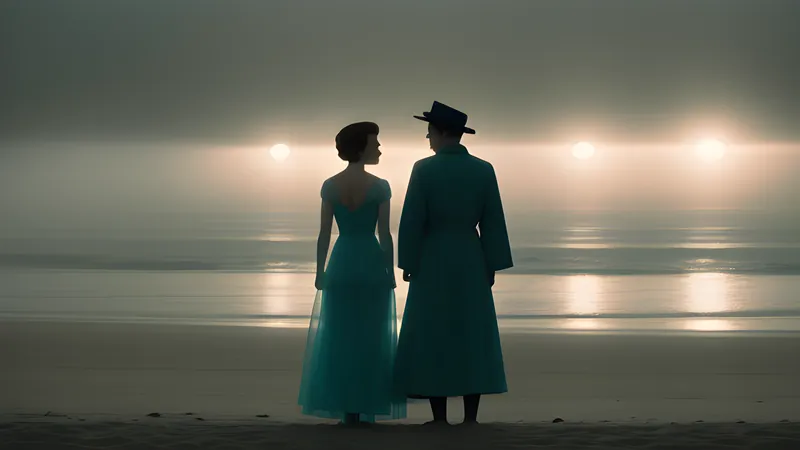
Every Jean Rollin film ends on the same beach: the grey shingle at Dieppe or Pourville in Normandy, with its two collapsed wooden groynes standing in the shallows like a gate to nowhere. He shot there for forty years. When he had money he went there. When he had no money he went there anyway, because the sand was free. By the end of his career the location had stopped being a setting and become a signature, and his admirers wait for it the way an opera audience waits for the aria.
Rollin (1938-2010) made roughly two dozen features and almost none of them made money. His first, The Rape of the Vampire, opened in Paris in May 1968 and caused riots in the auditorium — audiences tore up seats, critics denounced it, and the cultural revolution happening outside meant nobody could get to the cinema to see whether the reports were true. It was, he later said, the only time he was ever reviewed at length. The rest of his life was spent making surrealist reverie for producers who wanted nudity, funding it with pseudonymous pornography, and being told by everyone that he was doing it wrong.
He was doing it his way, and the way is the point. Take these ten in this order. The career read is Jean Rollin, the dreamer of vampire reverie; the tradition he belongs to is mapped in the French fantastique canon.
The entry points
Fascination (1979). The one to start with, and the only Rollin film that is also a good film by conventional criteria. A thief hides in a château in 1905 and finds two women there who are waiting for something; by midnight the guests have arrived and the thief understands he is the evening’s arrangement. Brigitte Lahaie walks the drawbridge in a black cape holding a scythe, and it is the single most famous image Rollin ever composed — a shot that took him nothing to achieve and that no amount of money would improve. The film has an actual plot, actual dread, and an ending of real cruelty. My longer piece is Fascination, Rollin’s château of blood.
Lips of Blood (1975). The most beautiful and the most personal. A man at a party sees a photograph of a ruined castle and remembers something that may not have happened: a girl in white, a night as a child, a promise. He walks across Paris looking for the place, and everyone who loves him lies to him about it. Rollin later said this was the film closest to his own memory, and it plays like one — the search is more real than any of the answers, and the vampires in it are less frightening than the mother. Covered fully in Lips of Blood, Rollin’s dream-logic vampire.
The Iron Rose (1973). No vampires at all. A young couple picnic in a cemetery, wander in, and cannot find the gate. That is the entire film. It was his commercial catastrophe — pulled from cinemas almost immediately, savaged, unseen for decades — and it was his own favourite, and both facts make sense. Ninety minutes of two people among gravestones as the light goes, with Françoise Pascal’s slow shift from irritation to something like ecstasy carrying the whole thing. It is the purest thing he made. The Iron Rose, Rollin’s cemetery reverie makes the case at length.
The vampire cycle proper
The Nude Vampire (1970). His first in colour, and the most stylised. A secret society in animal masks, a girl in a transparent shift running through Paris at night, a father conducting rituals in a Right Bank townhouse. The plot is nonsense involving immortality and a corporation. The film is worth it for the masks — beaked, blank, geometric, designed by Rollin’s collaborators on no budget — and for the colour, which arrives like a man who has been waiting years for it.
The Shiver of the Vampires (1971). The most fun. A honeymooning couple arrive at a château where the bride’s two cousins have become vampires and now dress like the front row at a psych festival; a servant emerges from a grandfather clock; the band Acanthus plays a fuzz-organ score over everything. Rollin’s castles are always real, always cold, and always visibly empty of production design, and here the emptiness reads as delirium. Nothing in it means anything. It is his most enjoyable film by a distance.
Requiem for a Vampire (1971). Two schoolgirls in clown make-up flee a shooting in a car and end up at a ruined castle where the last vampire is dying. The first twenty minutes are almost wordless — the clown costumes are never explained, because he thought explaining them would be vulgar — and the film sustains a genuine trance until a sequence in the dungeons that the producer demanded and that Rollin filmed with visible resentment. Requiem for a Vampire, Rollin’s convent-school eerie has the full account.
The late turn
The Grapes of Death (1978). His one attempt at a modern horror film, and it works. Pesticide sprayed on a vineyard turns the local population into something between zombies and lepers, and a woman walks through the French countryside in daylight while the people she asks for help decay in front of her. Rollin shoots it in the flat, empty, real rural France he grew up near, and the horror is loneliness. The film has one sequence — a blind girl left in a courtyard, calling — that is as good as anything in seventies horror.
The Living Dead Girl (1982). The gore film, made because his backers finally insisted, and it turned out he could do that too. A chemical spill revives a dead heiress with no capacity for anything except killing, and her living friend decides to feed her rather than lose her a second time. The concept is a Frankenstein riff. The execution is a love story about somebody covering up for someone they cannot save, and the last ten minutes are the most upsetting thing in his filmography. Argued in The Living Dead Girl, Rollin’s melancholy gore poem.
Night of the Hunted (1980). The outlier and the bleakest. People with a degenerative amnesia are kept in a Paris tower block by an institute that has no cure and no intention of finding one. Rollin shot it in a real La Défense high-rise, all glass and grey carpet, and the effect is a Rollin film with the dream drained out — no castles, no beach until the very end, only a woman trying to remember a sentence she said an hour ago. It is his hardest film to like and his most frightening.
Two Orphan Vampires (1997). The late resurrection. Two blind schoolgirls who can see only at night, wandering a Paris that has completely modernised around a director who has not changed a single instinct since 1968. He was almost sixty, working on nothing, adapting his own novel. It should be a sad film to watch. It is instead oddly triumphant, and it ends on the beach.
The money, and where it came from
Any honest account of Rollin has to deal with how the films got paid for, because the answer shaped every frame. Through the seventies and eighties he directed hardcore pornography under a string of pseudonyms — Michel Gentil is the one collectors know — turning out titles in a few days apiece for producers who never learned or cared that the man on the floor had a body of work. He was open about it in interviews and refused to be embarrassed. The porn paid the rent and occasionally paid for the reverie; the two careers ran in the same rooms, sometimes with the same crew, and the château he shot a vampire film in on Monday was available on Thursday for something else entirely.
The famous casualty of that economy is Zombie Lake (1981), which Rollin took over at forty-eight hours’ notice when Jess Franco walked away from it, shot with a swimming pool standing in for a lake and green greasepaint standing in for decomposition, and disowned for the rest of his life. It is genuinely one of the worst films ever released by anyone with talent. It is also the honest end of the same arrangement that produced Fascination three years earlier, and admirers who cite one while suppressing the other are telling you about themselves.
The other thing the money explains is his stubbornness. A director with no hits has nothing to protect and nothing to be talked out of. Rollin was offered, repeatedly, the chance to make ordinary horror films competently and be paid properly for them, and he kept declining and kept going back to the shingle. That is either integrity or an inability to do anything else, and after forty years the distinction stops mattering.
Why any of this works
Rollin’s method is worth naming precisely, because it is easy to mistake for incompetence. He shot with tiny crews, mostly in real locations he could access free or cheap: a friend’s château, the cemetery at Amiens, the Dieppe shingle, the Château de la Roche-Guyon. He cast for face rather than experience, and used the Castel twins — Catherine and Marie-Pierre — repeatedly because two identical women standing still is an uncanny effect that costs nothing. He wrote dialogue late and reluctantly. He cut for rhythm rather than sense.
Every one of those constraints produced the style. The long silences are there because he could not afford sound cover. The vacant, echoing rooms are vacant because there was no set dressing budget. The performances are stiff because he was working with actresses cast for their stillness. Encounter one Rollin film and this looks like a man failing at Hammer. Watch six and you realise he found what he wanted inside his poverty and then defended it against every producer who offered him a way out.
The vulgar defence — that the nudity is incidental — is untrue, and pretending otherwise does him no favours. The films are erotic, deliberately, and his producers were paying for exactly that. What is true is the trade he made: he gave them the scenes they demanded and spent the rest of the running time on ruined abbeys, on clocks, on two women looking at the sea, on images that no market anywhere wanted. He funded the reverie with the flesh, and he never once pretended the reverie was a side effect.
Start with Fascination, then Lips of Blood, then The Iron Rose when you are ready to be bored on purpose. Redemption and Kino have most of the run in restorations far better than the films ever looked in 1971. The neighbouring cottage industry — the same market, the same decade, a wholly different temperament — is catalogued in the Jess Franco starting ten.
Related Content