The House on Sorority Row: The Prank Gone Wrong
A De Palma assistant made the 1982 slasher that Hollywood spent the nineties remaking without credit
Contents
There is a plot that American horror has used so many times it has stopped registering as a plot. A group of young people do something reckless. Someone dies. They agree to say nothing and hide the body. A year later, something starts killing them one at a time, and the thing appears to know.
I Know What You Did Last Summer made a fortune from it in 1997 and gets the credit. The structure was already fifteen years old and it had been assembled, with more care than anyone gave it credit for, by a first-time director working from a script he wrote himself, on a budget in the low six figures, in a house in Maryland.
Rosman’s apprenticeship
Mark Rosman had worked as an assistant to Brian De Palma. That fact explains almost everything interesting about The House on Sorority Row, and it explains it in specific technical terms rather than as a name-drop.
De Palma’s obsession is simultaneity: two things happening at once in a way the audience can see and the characters cannot. Split screen is the crude version. The sophisticated version is a long take through a space where the camera knows something the people in the frame do not, and De Palma had been building those since the sixties — the technique that carries his split-screen slasher, where the whole film is an argument about looking at two things at the same time.
Rosman cannot afford a De Palma crane and he does not attempt one. What he takes instead is the structure. The centre of The House on Sorority Row is a party — a real party, loud, packed, a band, a hundred extras — happening on the ground floor of a house while people are being murdered on the floors above it. Rosman keeps cutting between the two, and the party never notices. That is a De Palma idea executed by someone with no money, and it is the reason this film outclasses its year.
The setup
Seven graduating sorority sisters want a last party. Their housemother, Mrs Slater, refuses; the house is closing for the summer and she wants them gone. She is unpleasant, immovable, and she carries a walking stick.
So they plan a prank. It involves a gun, and the gun is loaded with blanks, and the point is to frighten her. The prank goes wrong in the way pranks involving guns go wrong. Mrs Slater ends up dead, and the sisters — hours before a party that a hundred people are already coming to — make the decision the entire genre rests on. They put her in the swimming pool and they go ahead with the party.
The film is very good on this. The argument in the kitchen about what to do is played as a genuine ethical collapse, and the sisters split along the lines you would expect: one wants the police, one wants to go on, and the rest do what groups do, which is nothing, until the loudest one has decided for them. By the time the guests arrive the decision has been made by default and everyone is complicit and the music is on. Then a figure with a walking stick starts working the upper floors.
The craft
Three things Rosman does well, and they are all about geography.
The house is established with unusual thoroughness — the stairs, the attic, the pool, the bathrooms, the garden — before anything happens in it. This is the same discipline that makes the mine work in My Bloody Valentine: a location the audience can navigate is a location that can generate dread without a single line of exposition.
The party is used as a soundproofing device with total consistency. Every killing upstairs is scored by the band downstairs. Nobody screams effectively because nobody can hear a scream. The film never comments on this and never cheats it — there is no moment where the music conveniently stops.
And the walking stick is a superb weapon, because it is not a weapon. It is an old woman’s cane, an object of frailty, and the film has spent twenty minutes establishing it as the sound Mrs Slater makes when she is coming. Once she is dead, the sound continues. That is the whole apparatus of a ghost story installed in a slasher with one prop and no effects budget at all.
Richard Band’s score is the fourth thing, and it does more than it should have to. Band — who would go on to Re-Animator — writes the party music and the horror music, and the horror cues are strings in the Bernard Herrmann tradition, which is to say precisely the register a De Palma film would use, because De Palma hired Herrmann himself. The lineage is being performed rather than referenced.
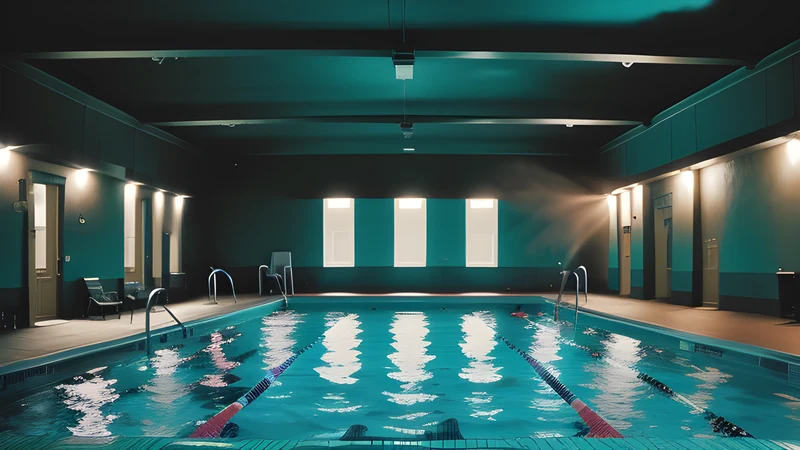
The pool is the other object doing double duty. Rosman lights it from below, so it is the only thing in the garden that glows, and once the body is in it the film has a lit box in the middle of the frame that everyone at the party is standing around with a drink. The camera keeps returning to it. Guests sit on the edge. Somebody nearly goes in. It is the most sustained piece of suspense in the film and it costs one underwater lamp, and it works because Rosman grasps the principle that De Palma built a career on: the audience knowing where the body is turns an ordinary party scene into ninety minutes of held breath.
The real ancestor
Psycho, and not for the reason people assume.
The mother-and-son architecture is the surface answer and it is fair. The deeper inheritance is Hitchcock’s structural trick: build a film around a group’s guilty secret and then reveal that the house has a secret of its own that predates them and has nothing to do with them. The sisters think they are being punished for the prank. The house has been waiting since long before they arrived.
Beyond that sits Bava’s A Bay of Blood, where a group of unpleasant people each conceal a killing and are then killed in an order that has nothing to do with justice — the film that supplied the American slasher with most of its furniture, as the twelve films that invented the slasher lays out.
And forward: the whole late-nineties cycle is downstream of this film’s first act. A prank, a death, a pact, a return. Rosman did not invent it either — the children’s game in Prom Night is the same engine two years earlier — and The House on Sorority Row is where it got its cleanest expression, and where Hollywood found it when it went looking for something to remake.
The case against
The sisters are underwritten. There are seven of them and about three characters between them, and the film’s habit of shooting them as a group means several are killed before you have established which one you are watching. Eileen Davidson’s Vicki is the only fully realised person in the house, and she is the antagonist within the group rather than the lead.
Rosman’s direction of actors is flat — the De Palma inheritance is structural and stops at the performances. And the film’s last twenty minutes make a swerve that either works completely or destroys it, depending entirely on the viewer, which I will come to below the line.
There is also a smaller, meaner objection: the film is polite. It has none of the grubbiness of its 1982 peers, no real transgression, and a residual good taste that keeps it from ever being frightening in the animal way that Halloween is frightening. It is a well-made film about a bad night. It is not a film that has been anywhere dark.
The whodunit is also barely a whodunit. The film puts almost no effort into offering an alternative solution, and a viewer paying attention has the shape of the answer well before the reveal. What holds the tension is the pool and the party, which are suspense devices rather than mystery devices — Rosman is running Hitchcock’s bomb-under-the-table rather than a puzzle, and the marketing sold a puzzle.
Where to find it: restored editions exist and are easy to obtain. Rosman, in one of cinema’s better jokes, went on to direct A Cinderella Story.
Spoilers below
The prank was worse than the sisters let themselves say out loud. The film is careful never to give them the comfort of a clean accident — the exact mechanics stay slightly out of reach, which is precisely how people who have done something terrible remember it, and it is why the pact holds. Nobody in that kitchen can prove to themselves that they are innocent, so nobody can afford to be the one who calls the police.
Mrs Slater’s secret is upstairs. She has a son, Eric, kept in the attic of the house since a difficult birth twenty years before the film starts — the prologue you half-forgot is the whole explanation. He is the thing that has been in the building the entire time the sisters have been living in it, and he is the reason she refused to let them stay for the party. She was protecting them from her own house.
That is the Psycho inversion. Norman kept his mother. Slater kept her son. And her death releases him, so the sisters’ prank is the act that opens the attic — they are killed by the consequence of the thing they were mocking her for.
Then the film does the swerve. Katherine is drugged, and Rosman stages the final act from inside the drug: the house dissolving, the party guests becoming a hallucination, a harlequin doll and a jack-in-the-box arriving in a register that has abandoned realism completely. The climax is a nightmare sequence that never signals a return to the real, and the audience has to do the last fifteen minutes without knowing what is happening.
I think it is a magnificent piece of nerve and I understand every viewer who finds it a cop-out. It arrives from nowhere; it has no roots in the film’s method; it is a 1982 independent slasher suddenly deciding to be Argento, whose colour-drenched irrationality is a different art form entirely and one Rosman has not earned. It is also the only thing in the film that is genuinely disturbing, and it lands the ending on an image of a woman who cannot tell the difference between the party and the attic — which, given what she agreed to in the kitchen six hours earlier, is exactly the right place to leave her.
The pact was the crime. The attic was the punishment. Neither had anything to do with the other, and the film is honest enough to let that stay a coincidence.
Related Content