The House of the Devil: Ti West's Slow-Burn Homage
The 2009 film that faked being a lost 1981 shocker and got the boredom exactly right
Contents
There is a category of film that only works if you can be persuaded to sit still, and The House of the Devil is the purest modern example I know. Ti West’s third feature arrived at SXSW in 2009 and reached most people the way its ancestors did — on a disc, at home, at the wrong hour of the night, with the sense that you had found something rather than been sold it. Magnet put it out. It cost, by the reported figures, somewhere around a million dollars. And for roughly seventy of its ninety-odd minutes almost nothing happens, on purpose, with a precision that most horror directors never attempt because they cannot imagine an audience that would tolerate it.
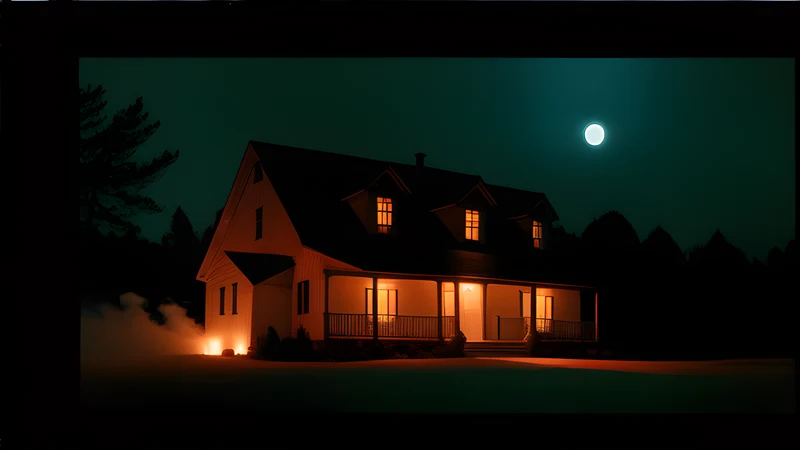
The setup is a bar of pure genre iron. Samantha Hughes, played by Jocelin Donahue, is a college student who needs a deposit on a flat and takes a babysitting job she has no business taking. The house is remote. The clients, Mr and Mrs Ulman, are wrong in ways she keeps deciding to overlook. There is no baby. There is a lunar eclipse that night, and the Ulmans are unusually interested in it. Every alarm the film has installed goes off in the first act, and Samantha ignores them all for the reason people in life ignore them: she needs the money, and the alternative is admitting she has driven a long way for nothing.
The forgery, and why it holds up
West shot on 16mm, with Eliot Rockett behind the camera, and the choice does more work than nostalgia. Sixteen-millimetre grain is not a filter on a digital image; it is an actual physical texture with an actual physical cost, and the cost shows up as restraint. You do not get infinite coverage. You choose your shot and you hold it. The film’s period surface — the feathered hair, the enormous car, the Walkman that Samantha wears like a talisman — is fastidious, and the freeze-frame title cards in blocky yellow type are the kind of joke that only lands if the person making it genuinely loves the thing being copied.
The tell that separates this from pastiche is that West copies the pacing rather than the iconography. Anyone can put a Trans Am in shot. What West reproduces is the structural habit of a certain kind of early-eighties low-budget picture: the long stretch of ordinary time in the middle, where the film is simply waiting for its own third act and cannot afford to fill the gap with incident. In the originals that dead air was a budgetary accident. West rebuilds it deliberately and turns it into the engine. The dread in this film is manufactured almost entirely from duration.
The pinnacle of that is the sequence everyone remembers, where Samantha puts The Fixx’s “One Thing Leads to Another” on the Walkman and dances through the empty house. It runs long. It is charming and entirely unironic, and Donahue plays it with a loose, unwatched physicality that makes you like her more than the plot strictly requires. It also does three jobs at once: it lets you learn the geography of the house, it plants a girl with headphones on in a place where hearing things matters, and it buys West the right to spend the next stretch doing nothing at all, because you have now agreed to spend time with this person. It is the most efficient scene in a film that is otherwise, by design, profoundly inefficient.
The camera as a patient thing
West’s other instrument is the slow move. The camera drifts toward a doorway and stops before it arrives; it pushes in on a face a half-second past the point where a normal edit would cut. He is exploiting something specific about how horror audiences have been trained. A modern viewer knows the grammar so well that a held shot reads as a loaded gun — we supply the threat ourselves, from experience, and West simply declines to fire for as long as he can stand it. When he does cut hard, the violence is abrupt and unglamorous and over in a moment, which is the correct ratio. The related trick of the unbroken drift is something the desk has written about elsewhere in the slow zoom and other lost camera moves; West is one of the few working directors who kept the tool in the box.
Jeff Grace’s score understands the assignment too. It is sparse to the point of rudeness, mostly low sustained tones that decline to tell you when to be frightened. Compare a contemporary studio horror mix, where the sound design is a continuous instruction manual, and you see what has been given up in the intervening years.
The casting is a collector’s argument
Then there are the Ulmans, and here West does something cleverer than good casting. Tom Noonan plays Mr Ulman with a soft-spoken, apologetic courtesy that is far more unnerving than menace would be — and Noonan is the man who played Francis Dollarhyde in Michael Mann’s Manhunter in 1986, so a certain kind of viewer arrives at the door already braced. Mary Woronov plays Mrs Ulman with a brittle, imperious chill, and Woronov is a walking index of American cult cinema, from the Warhol Factory through Death Race 2000 and Eating Raoul and Rock ’n’ Roll High School. Dee Wallace turns up as the landlady, warm and normal for ninety seconds, and Dee Wallace is The Howling and Cujo and E.T. Greta Gerwig plays Samantha’s friend Megan, a year before the mumblecore world she came from became a Hollywood pipeline.
That is a thesis expressed as a call sheet. West is not decorating the film with familiar faces; he is telling you which shelf of the video shop this is meant to sit on, and every one of those actors carries the era in their body.
The real ancestor
The obvious reference is Rosemary’s Baby, and the film knows it — the whole architecture of a young woman being handled by polite older people who have already decided what she is for runs straight back to 1968, and we have argued the deeper mechanics of that in Rosemary’s Baby and the horror of being not believed. But the truer ancestors are further down the shelf. The Sentinel supplies the sense of a building that is an appointment rather than a home. Let’s Scare Jessica to Death supplies the tempo — the American rural quiet that curdles by accretion. And the drive-in end of the tradition, the tyres-and-Winnebago paranoia of Race with the Devil, supplies the specific national anxiety West is excavating.
That anxiety is worth naming plainly, because it is the film’s real subject. The opening card asserts a statistic about how many American adults in the 1980s believed in organised, abusive Satanic cults. The Satanic panic was real, it ran for the better part of a decade, and it was assembled out of Michelle Remembers in 1980, the McMartin preschool prosecution that ground on from 1983 to 1990 and produced no convictions, and prime-time television that treated the whole apparatus as reportage. Careers and childhoods were destroyed over crimes that were never substantiated. West’s film is set inside the belief rather than inside the truth, which is the only honest way to make a Satanic panic picture in the twenty-first century. The horror is period-accurate because the credulity is period-accurate.
The case against
It is fair to say the film is a machine with a very narrow tolerance. If the tempo does not take hold in the first twenty minutes, you are left watching a competent young woman do errands, and no amount of grain will rescue it. West spends his capital so freely on the wait that the payoff has to be enormous, and it is instead merely good — fast, nasty, well-staged, and shorter than the appetite it has spent an hour building. Some viewers come away feeling the film wrote a cheque on the strength of its own patience and then partly declined to cash it.
I think that criticism is accurate and I think it barely matters, for the same reason the anticlimax in a great ghost story rarely matters. The dread is the deliverable. West’s later work confirms he knew exactly what he was doing here: the haunted-hotel comedy of The Innkeepers runs the identical structure with the tension replaced by affection, and by the time he reached X in 2022 he had learned to give the back half more meat. This film is the one where the method is naked.
It also arrived early enough to shape an argument. Everything the last fifteen years has filed under “elevated horror” — the withheld reveal, the ambient score, the trust in duration — was being demonstrated here in 2009 with none of the prestige-adjacent seriousness that later made the term a slur. The desk’s broader complaint about that whole movement lives in elevated horror and the backlash against the slow burn. The House of the Devil has a clean conscience about being a genre film, which is why it has aged better than most of its descendants. It streams and discs widely; find it late, alone, with the lights off, and do not check your phone. The film is entirely defenceless against a divided attention, which is a compliment.
Watch next: The Innkeepers for West’s warmer register, Let’s Scare Jessica to Death for the tempo, The Sentinel for the architecture.
Spoilers below
The Ulmans’ job is not childcare. Samantha has been hired to sit with Mr Ulman’s mother, which is the first lie collapsing into a second — there is no elderly woman to mind either, and the house’s real occupant is being kept for the eclipse rather than nursed through it. Samantha is the material.
The turn is signalled by Megan, and it is the film’s most brutal edit. Gerwig’s character, who has spent the film being the sensible one, is dispatched in the car with a suddenness that carries no music, no build and no reprieve. It is the moment West proves the patience was a strategy: he has trained you for an hour to expect nothing to happen, and then makes the one thing that happens arrive with no warning at all. Every subsequent held shot in the film is now genuinely loaded, because you have watched the gun go off once.
What follows is a drugged ritual — Samantha wakes bound in a pentagram, the Ulmans and their son Victor in robes, blood, the eclipse, a knife. Woronov’s Mrs Ulman does the talking and reveals the mother, and the sequence tips into a hallucinatory red-lit smear that is the only point where West’s control visibly loosens.
The ending is the interesting failure and the interesting triumph at once. Samantha fights out, kills, and survives — and then the coda finds her in a hospital bed, alive, pregnant, the impregnation having already succeeded. She puts a gun to her head and the shot does not kill her. The last image is a nurse noting the pregnancy is intact. The cult loses every member and still wins, which is the Rosemary’s Baby ending inverted: Rosemary is left holding a choice, and Samantha is left holding nothing at all. The final freeze-frame, in the same yellow type as the opening, closes the forgery. West’s real joke is that he has made a film about a woman who does everything right, escapes a house full of Satanists on her own, and is defeated anyway by a piece of biology that concluded before the fight began.
Related Content