The Haunting (1963): The Ghost You Never See
Robert Wise builds the scariest house in cinema and never lets anything walk out of it
Contents
There is a scene in The Haunting where two women lie in the dark, holding hands, while something the size of a locomotive pounds on the wall of Hill House, working its way down the corridor towards their door. You never see it. You never find out what it is. The camera stays on their faces and on the door, which begins, slowly, to breathe — the wood bulging inward as if the house itself were pressing a lung against it. Robert Wise’s 1963 film has been out for more than sixty years, and I have yet to find anything that frightens me more efficiently, with less shown, than that breathing door.
It is the great refutation of the idea that horror is a special-effects arms race. Wise had almost nothing to put on screen: a house, some actors, a sound department, and the nerve to withhold. The Haunting is what you get when a director decides that the most terrifying thing he can show you is the possibility that there is nothing there at all.
What Wise learned from Val Lewton
To understand why the film works you have to know where Wise served his apprenticeship. Before he directed West Side Story and The Sound of Music — the résumé that makes his name sound like the least likely author of a horror masterpiece — Robert Wise was a film editor at RKO, and he cut Citizen Kane. More important for our purposes, he directed The Body Snatcher (1945) for Val Lewton, the producer whose low-budget 1940s horror unit turned poverty into an aesthetic. Lewton could not afford monsters, so he made the absence of the monster the point: a shadow, a sound, a swimming pool where something might be circling. The audience’s own imagination did the expensive work.
Wise absorbed that lesson completely, and The Haunting is its grandest application. Shirley Jackson’s 1959 novel The Haunting of Hill House handed him the perfect material, because Jackson’s horror is entirely interior — a haunting that may be a house and may be the slow disintegration of a lonely woman named Eleanor. Screenwriter Nelson Gidding reportedly toyed with reading the whole story as one character’s nervous breakdown before deciding the film should keep both doors open. That ambiguity is the engine. You are never told whether Hill House is haunted or whether Eleanor is unravelling, and the film’s refusal to choose is what keeps it alive.
Holding that ambiguity together is Julie Harris, whose performance as Eleanor is the reason the film has a soul rather than just a technique. Harris — a Broadway actress of tremendous fragility — plays a woman starved of affection and purpose, who has spent years nursing a dying mother and now grasps at Hill House as the first place that has ever seemed to want her. Wise lets us hear her thoughts in voiceover, a running interior monologue of hope and dread and self-persuasion, so that the haunting and her breakdown are narrated in the same voice. Every creak the house makes, Eleanor takes personally. Harris pitches it so that you can never be sure whether the house is reaching for her or she is reaching for the house, and that uncertainty is the film’s whole engine made flesh.
The house that was built wrong
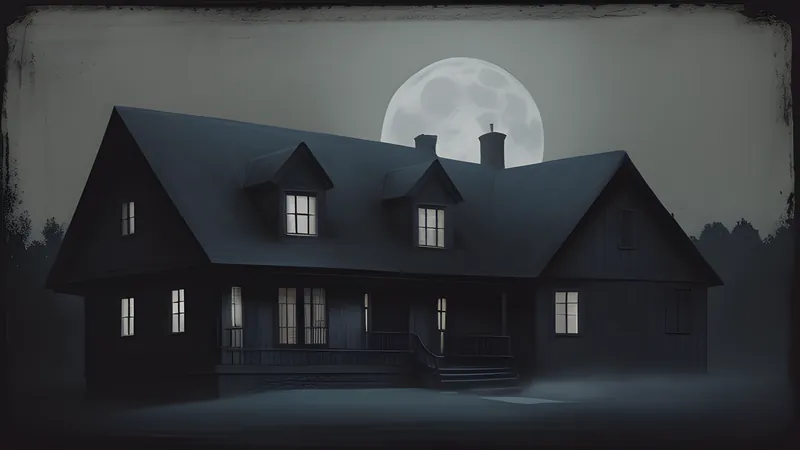
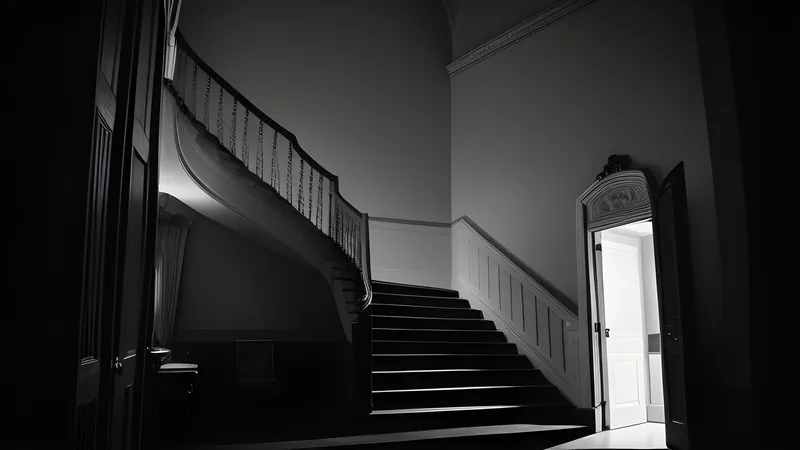
Hill House is a character, and Wise photographs it like an antagonist. The exterior was Ettington Park in Warwickshire, a Victorian Gothic pile with the right air of ecclesiastical menace; the interiors were built at MGM’s British studios at Borehamwood. But the real trick is in the lensing. Cinematographer Davis Boulton shot the film in stark black-and-white anamorphic widescreen using extremely wide-angle lenses, some as short as 30mm, which bow the verticals and make the rooms lean. Doorframes tilt. Corridors curve away. Statuary looms into the foreground with distorted, swollen features.
The narration tells us early that every angle in Hill House is subtly wrong — that the builder set the corners a few degrees off true, so nothing quite meets as it should, and doors swing shut on their own because the frames are not square. Wise then makes the camera confirm it. You spend the film in a space your eye keeps insisting is deformed, and the unease accumulates below the level of conscious attention. It is production design and cinematography working as a single instrument of dread. Compare it with the way Kubrick would later weaponise the impossible geography of the Overlook in The Shining — the corridor that cannot exist, the window where no window could be. Both films understand that a haunted house frightens you most when the architecture itself is lying.
Sound as the whole show
Strip The Haunting of its soundtrack and you have a group of people reacting to nothing. That is precisely the audacity of it. The hauntings are almost entirely aural: the booming, metallic hammering that stalks the halls at night; a cold laughter; a child’s voice; whispering that Eleanor hears and interprets. Wise and his sound editors built these effects to be unplaceable — you cannot say what instrument or object makes the pounding, only that it is enormous and getting closer. The human ear panics at sounds it cannot source, and the film exploits that hardwired reflex with surgical patience.
This is the same principle that Steven Spielberg would ride to the bank a decade later. The reason Jaws terrifies is that the shark is mostly a yellow barrel, a John Williams cue, and a fin — the creature you assemble in your own head is worse than any prop the effects team could float. Wise got there first, and with even less. His monster is a noise and a door. The mechanism is identical: give the audience a signal of threat and deny them the sight of it, so their imagination rushes to fill the vacuum with something tailored to their private fears.
Why the restraint still wins
Rewatching The Haunting now, after decades of horror that shows you everything in wet, articulated detail, the discipline reads as radical. There is no gore, no apparition, no rubber ghost lurching into frame. The 1999 remake — Jan de Bont’s version, stuffed with digital gargoyles and animated bedsheets — is the perfect controlled experiment, because it took the same story and answered every question the original left open. It is unwatchable, precisely because it shows you the ghost. The instant Hill House produces a visible monster, the pressure that Wise spent an entire film compressing simply escapes.
The film’s power is a grief-and-loneliness study wearing a haunted-house costume, and it belongs to a lineage of ghost stories that are really about wounded people. The haunting is inseparable from Eleanor’s isolation, her hunger to belong somewhere, her sense that the house has finally, terribly, chosen her. That marriage of the supernatural to a specific human ache is the tradition The Orphanage works in, and the one Ari Aster detonated in Hereditary. The ghost is a metaphor with teeth. The Haunting is the film that proved you could leave the ghost entirely off the screen and lose none of the terror — indeed, gain all of it.
Spoilers below
The film’s masterstroke is a single line, and I will describe rather than quote it to preserve the shock for anyone who has not seen it. During the night of the breathing door, Eleanor lies gripping Theodora’s hand in the pitch dark, holding on for dear life as the pounding reaches its worst — and when the lights finally come up, Theodora is across the room, in her own bed, nowhere near her. Eleanor asks, aloud, whose hand she was holding. There is no answer, and Wise offers none. The film simply lets the question sit there, cold, and moves on. It is one of the most efficient frights in the medium: a reveal that shows nothing and implies everything.
The ending completes the ambiguity. Eleanor comes to believe Hill House wants her, that it has been waiting for her, and that she finally belongs somewhere. Sent away by the others for her own safety, she drives her car at speed down the estate’s drive and swerves — or is swerved — into the same tree where the house’s first tragedy occurred, dying instantly. Her voice returns for the closing narration, echoing the opening: whatever walks in Hill House walks alone, and now she walks there too. Whether the house killed her or her own broken mind did is left, deliberately, unresolved. Wise refuses the autopsy. The house keeps its secret, the way the whole film keeps its ghost — just out of sight, doing its worst in the dark, and all the more real for never once stepping into the light.
Where to watch: it turns up on the Warner Archive stream and on physical media in a handsome Warner Blu-ray; seek out the widescreen transfer, because a panned-and-scanned Haunting throws away half of what makes it frightening. Pair it with the two ghost stories linked above, and you have an evening about houses that grieve.
Related Content