The Haunted Technology Film, From Videodrome to the Webcam
The genre fears anything that carries traffic both ways
Contents
Horror is routinely described as technophobic, and the charge does not survive contact with the films. The genre has almost no interest in machines as such — a lathe, a fridge and a jet engine have produced no lasting dread between them. What horror is obsessed with, to the point of monomania, is the interface: the small class of devices that carry traffic in both directions, that look like a window and function like a door. Every durable haunted-technology film is about a channel, and the plot is always the discovery that the channel was never one-way.
Once you use that as the sorting criterion, forty years of apparently unrelated films — a cathode-ray tube, a VHS cassette, a dial-up modem, a laptop camera — resolve into a single continuous argument, and the argument gets sharper each time the hardware changes.
The receiver, and the last age of innocence
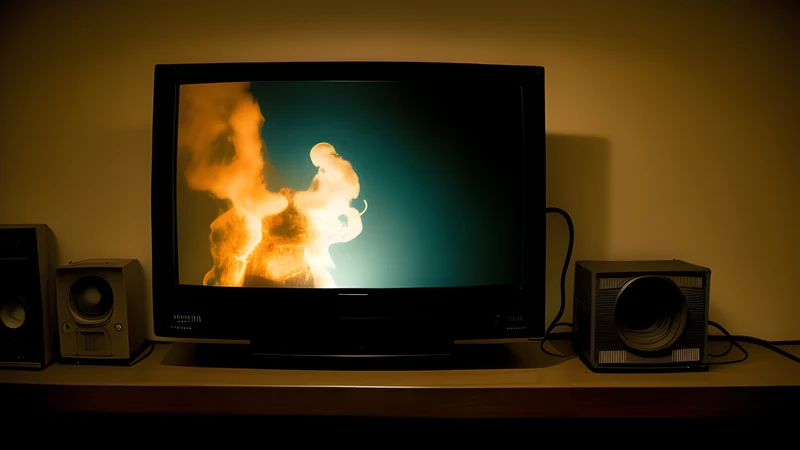
Early television horror treats the set as a passive object that something has climbed into. The set is a victim of trespass. Static means a breach in the signal chain, and the fix, conceptually, is an aerial. That framing had a decent run and it is the least interesting version of the idea, because a receiver cannot be complicit.
The cracks show up wherever a film lets the broadcaster into the story. The BBC’s Ghostwatch (1992) is the extreme case — a scripted drama transmitted on Halloween in the grammar of live outside-broadcast television, with the corporation’s own presenters playing themselves, which produced a genuine national incident and an effective decade-long ban on repeats. The panic was caused by a format the audience trusted being used to lie, which is the real subject of the entire subgenre and the reason the broadcast is still discussed thirty years on.
Cronenberg opens the door
Videodrome (1983) is the hinge, and everything downstream is a footnote to it.
Cronenberg’s move is to abolish the receiver entirely. The signal watches Max Renn, writes on him and eventually operates him. The film is explicit about its intellectual source — Professor Brian O’Blivion, who exists only as videotape and insists the television screen is the retina of the mind’s eye, is a Marshall McLuhan figure, and McLuhan had been teaching at Toronto until his death in 1980. Cronenberg took “the medium is the message” and asked the follow-up question nobody wanted: if the medium is the message, what is the medium’s message about you, and where does it store it?
Rick Baker’s effects work is the argument’s proof. The abdominal slot, the breathing cassette, the hand that becomes a gun — every one of them is a port. The body is being fitted with an interface, in prosthetics, on camera, physically. Universal released it in February 1983 to a substantial loss and the tape trade rescued it within five years, which is a joke the film would have appreciated. The prophecy about the screen has aged into a documentary, and it sits at the centre of Cronenberg’s flesh-and-machine project.
He returned to it twice. eXistenZ (1999) puts the port at the base of the spine and makes the console a wet organism, arriving the same year as The Matrix and losing the argument commercially while winning it on physical detail — the console war it predicted turned out to be about bodies. His son Brandon took the scalpel and pointed it at labour, with Possessor (2020) turning the interface into a workplace: an operator who wears people for a living. The family method survives intact.
The format is the ghost
Japan’s contribution was to notice that the channel’s properties are the horror.
Hideo Nakata’s Ringu (1998), from Kōji Suzuki’s 1991 novel, is built on the single defining fact of VHS: it duplicates. Sadako’s tape kills in seven days unless you copy it and show it to someone, which makes survival identical to distribution and turns every viewer into a relay. No other format would have produced that plot. Nakata’s restraint is what sells it — the tape is a nondescript black slab that he almost never dignifies with a dramatic angle, and the dread accrues in the sound design and in a well. The well, the tape and the slowest dread in the genre, and the whole thing was possible only because the video-shop era had trained an audience to think in copies.
Kiyoshi Kurosawa’s Pulse (2001) did the arithmetic on the next format and reached the correct answer. If the channel is free, infinite and instantaneous, the result is depopulation. His ghosts simply arrive, and people quietly stop. The film’s dial-up-era websites look like museum pieces and its thesis about connection producing isolation looks like this morning’s news. The lonely apocalypse is the most prescient film on this list.
The machine that wants something
The 1970s ran a parallel strand where the interface has an appetite of its own.
Donald Cammell’s Demon Seed (1977), from Dean Koontz’s 1973 novel, gives Proteus IV control of a fully automated house with Julie Christie inside it. The horror is domotic — the doors, the locks, the terminal and the laboratory’s robotic manipulator arm all belong to the machine because the household bought them. It is a home-automation nightmare filmed decades before the product category existed. The computer that wants a child is stranger and sadder than its reputation.
Douglas Trumbull’s Brainstorm (1983) built the purest interface film of the era and had a catastrophic production: Natalie Wood died during filming, MGM attempted to abandon the picture and claim on the insurance, and Trumbull fought it into cinemas in 1983 before effectively leaving the industry. The device records raw experience to tape and plays it into another skull. Trumbull shot the recorded sequences in 70mm to widen the frame when the playback begins — the aspect ratio is the interface, a formal idea nobody has bettered. Trumbull’s consciousness machine deserved a better studio.
Shin’ya Tsukamoto’s Tetsuo: The Iron Man (1989) is the same fear with the intermediary removed: metal simply arrives in the flesh, shot on 16mm in black and white with stop-motion and a crew of almost nobody. It is the most physical film about technology ever made. Richard Stanley’s Hardware (1990) made a killer-droid picture for around a million dollars and then lost a court case over its origins in a 2000 AD strip, which resulted in a credit being added. The cyberpunk nightmare on a shoestring is better than the litigation suggests.
The webcam era, and the craft problem it created
Screen-life horror looks like a gimmick and contains a genuinely difficult formal problem: the film has one frame, no coverage, no camera movement and no editing in the classical sense. Everything a director normally uses is gone.
What replaces it is cursor and silence. The technique that makes these films work is attention-direction through interface behaviour — a typing indicator that appears and stops, a window that gains focus, a video tile that freezes for a beat longer than the codec would explain. The audience has spent thousands of hours learning to read these signals, so the film can whisper. Rob Savage’s Host (2020) is the best of them and the most instructive: made in roughly twelve weeks during lockdown, entirely over Zoom, with actors operating their own cameras and rigging their own practical effects in their own houses, and running fifty-six minutes because that is how long the platform’s free tier lasted. The constraint wrote the runtime. It is a better film than most of its budgeted competition because every element of the interface is doing narrative work.
The lineage is found footage, and the debts are old. The Blair Witch Project (1999) established that a degraded image reads as evidence — and what that cost the genre is still being paid off. Kōji Shiraishi’s Noroi: The Curse (2005) built a fake documentary so patient it out-Blairs Blair. The Japanese variant is the format’s high-water mark. The cycle that followed Paranormal Activity industrialised it, and a small number of them actually work.
What the current channel has done to it
The interface horror always lags its hardware by about a decade, which means the subgenre is currently working through the thing that replaced the video shop. The tape was an object you chose, carried home and returned. The stream is a channel that chooses for you, holds no object at all, and can withdraw a film overnight without telling anyone. That is a genuinely new fear and the genre has barely started on it — the closest recent work still reaches for a physical artefact, because a haunted algorithm has nothing you can hold up to the light. The streaming era’s quiet killing of the video shop is the horror premise nobody has properly filmed yet.
The reason is craft rather than nerve. Every device in this essay gave a director something to point a camera at: a slot in an abdomen, a cassette on a table, a modem’s lights, a video tile freezing. Recommendation systems are invisible, distributed and boring to photograph, which is exactly the problem Soderbergh’s generation of procedural filmmakers ran into with epidemiology. The solution, when someone finds it, will almost certainly be the Ringu solution — locate the one property of the medium that is genuinely unique, and build a rule out of it. For VHS that property was duplication. For the stream, it is revocation. Somebody will work that out.
The cursed-object tradition has already half-solved it from the other direction, since every haunted thing in horror is something somebody acquired — and the horror of the stream is that there is nothing to acquire.
The case against
Haunted-technology horror ages worse than any other subgenre, and the reason is structural. A vampire is not a product. A dial-up handshake is, and once the product is obsolete, the film has to survive on whatever it built on top of the hardware — which for most of these films is nothing.
The test is easy to apply and brutal. Strip out the specific device: is there a film left? Videodrome survives because it is about appetite and authorship. Pulse survives because it is about loneliness and would work with letters. Ringu survives because the seven-day rule is a moral structure that happens to be implemented in tape. Peter Strickland’s Berberian Sound Studio (2012) survives because the technology in it — a Foley studio, mag tape, a sound engineer’s hands — is a craft, and the film is about what performing violence for a living does to the performer. Horror about the making of horror is the most honest version of this whole idea.
Everything else in the lane is a period piece with a modem in it. The films that last are the ones where the interface was a metaphor that also happened to be plugged in, and the ones that die are the ones that mistook a spec sheet for a fear. The device changes every eight years. The door in the middle of it has been the same door since 1983.
Related Content