The Haunted-House Film and the Architecture of Fear
Why the best ghost stories are really about floor plans, corridors and the shape of a room
Contents
There is a moment near the start of Robert Wise’s The Haunting (1963) when the camera pushes down a corridor of Hill House and the corridor seems to bend away from us, its perspective wrong, its angles refusing to resolve into anything a builder would recognise. No ghost has appeared. Nobody has died. The house has simply been photographed, and the photography alone is enough to make the skin tighten. That shot is the whole genre in miniature. The haunted-house film frightens through carpentry before it frightens through the supernatural, and the directors who understand this build fear the way an architect builds a stairwell — with sightlines, thresholds and the deliberate management of what you can and cannot see.
The house is the antagonist
Give a genre its most famous line and you have usually found its thesis. Shirley Jackson opens her novel with the observation that Hill House was not sane, that it stood alone against its hills holding darkness within, and that whatever walked there walked alone. Wise’s film keeps that idea front and centre by making the building itself the thing that acts. Doors close on their own. A statue looms where none should be. The camera treats the house as a body — Wise and his cinematographer Davis Boulton shot on a 30mm wide-angle lens for much of the interior work, distorting the walls so that rooms seem to breathe inward, and they mounted the camera low to make ceilings press down on the characters. The distortion is the performance. Hill House never grows a face, and it never needs one.
Compare that with the approach in Jack Clayton’s The Innocents (1961), where the terror lives in the deep-focus compositions of cinematographer Freddie Francis. Francis lit Bly House so that the foreground and the far background stayed sharp at once, which means the eye is always free to wander to the edges of the frame, always free to find the figure standing at the far end of the reeds or across the lake. The house and its grounds become a field of dread precisely because the image withholds nothing and confirms nothing. You can read my longer argument for that film in its own piece, but the point here is structural: the fear is a function of what the geometry of the shot permits you to look at.
Corridors, staircases and the grammar of the threshold
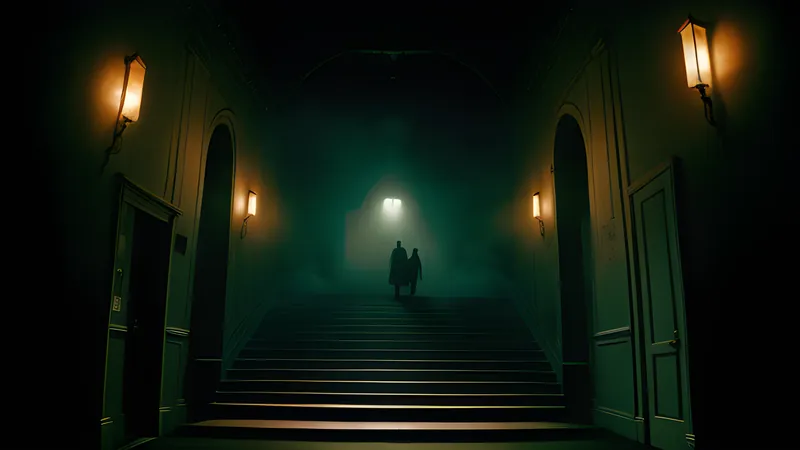
A haunted house is a machine for controlling movement, and horror directors exploit that machinery ruthlessly. Three architectural elements do most of the heavy lifting.
The corridor is a promise of arrival that keeps deferring. It has a vanishing point, and the vanishing point is where the dread collects. Stanley Kubrick understood this when he sent a tricycle down the hallways of the Overlook, the Steadicam gliding at child height so that every turn opens onto a new emptiness that might not stay empty. The corridor tells you something is coming and refuses to say when.
The staircase is the genre’s favourite instrument because it is a vertical threshold — a place where the film can put a character between two states, exposed on the treads with nowhere to hide. Peter Medak’s The Changeling (1980) uses its grand staircase as a resonating chamber, sending a rubber ball bouncing down it in a sequence that has terrified audiences for four decades. The ball is nothing. A child’s toy, thrown away years ago, returned. What makes it unbearable is the architecture: the long descent, the count of the bounces, the certainty of gravity in a house where nothing else obeys the rules. I have written at length about that film’s craft in my piece on its séance, and the staircase belongs to the same logic — space used as suspense.
The threshold — the doorway, the arch, the line between one room and the next — is where the genre stages its cruellest surprises, because a threshold is a frame within the frame. Every doorway a character walks through is a little cinema screen, and the audience learns to dread the empty rectangle. Alejandro Amenábar builds his entire film around this idea in The Others (2001), a picture in which the fog-bound house is a set of locked doors that must be opened one at a time, each key turned only after the last is turned. The rule that no door may be opened before another is closed is architecture as plot, and the film’s famous reversal — which I will keep behind a footnote here1 — is seeded in the way the rooms are used long before it is spoken aloud.
Why the empty room is scarier than the ghost
The oldest lesson in the genre, and the one most often forgotten, is that a room a camera lingers in becomes charged whether or not anything is there. Val Lewton’s producers understood this in the 1940s, when budgets forced them to suggest rather than show, and the suggestion turned out to be stronger than any rubber monster the studio could have afforded. The haunted-house film inherited that economy directly. When Wise refuses to show us what is bulging the great carved door of Hill House inward, when he gives us only the wood flexing and the sound of something vast breathing against it, he is trusting the audience to build the ghost out of the space. The imagination is a better set-dresser than any effects house.
This is why the modern haunted-house film gets into trouble the moment it over-explains its architecture with computer-generated distortion. A wall that ripples in CG announces that a machine did the frightening. A wall that merely stands there, photographed at a wrong angle, lets the viewer’s own eye do the distorting, and the fear feels authored from inside the skull. Ari Aster grasps this in Hereditary (2018), where the family home is shot to resemble the miniature dolls’ houses the mother builds — clean, exact, dispassionate, a place we are invited to look into as though through the roof of a model. The doll’s-house framing turns the family into specimens, and the horror is that the house watches them the way a collector watches a diorama. I have unpacked that grief-machine in its own review; the takeaway for this argument is that Aster made the house a lens rather than a haunt.
Sound is the floor plan you cannot see
Architecture in these films is not only a matter of the image. A house has an acoustic shape as well as a visual one, and the great haunted-house pictures build their space through the ear. The Changeling is again the model: Medak fills the mansion with the creak of settling timber, the knock of ancient plumbing and the specific, awful reverberation of a wheelchair rolling across a wooden floor overhead. Those sounds map rooms the camera has not yet entered. When George C. Scott’s character stands at the bottom of the stairs and hears the banging start above him, the audience has already toured the upper floor with its ears and knows exactly how far the sound has to travel to reach him.
Wise does the same in The Haunting with his celebrated use of off-screen pounding — the noise that circles the bedroom door, growing and receding, so that the women inside track an unseen thing by sound alone. The frame stays fixed on their faces while the house’s acoustic geometry does the acting. This is the cheapest and most durable trick in the genre, and it is the one CG cannot improve, because a sound has to arrive from a direction, and a direction implies a room, and a room the eye has never confirmed is the most haunted room of all. A film that fills every silence with a musical sting throws this away; the ones that trust an empty corridor to creak on its own keep the audience mapping the house long after the lights come up.
What the good ones share
Trace the line from The Innocents through The Haunting and The Changeling to The Others and the family in Hereditary, and a single principle holds across sixty years. These films frighten because they respect the plan of the building. The camera knows where the doors are, where the stairs turn, how the light falls at noon and how it fails at dusk, and it uses that knowledge to place the audience one step behind the character and one room ahead of the reveal. The ghost, when it finally arrives, is a confirmation of a dread the walls have already delivered.
The corollary is a warning. A haunted-house film that treats the house as mere backdrop, a place to stage jump scares in front of, has thrown away its strongest tool before the first act ends. The house is the story. When a director forgets that, no amount of shrieking violins on the soundtrack — a subject I take up in my essay on the horror score — will save the film, because the terror of these pictures was always structural, always a matter of load-bearing walls and the darkness they hold within.
If you want to see the argument assembled as a viewing list rather than an essay, I have gathered the films that get the architecture right in the haunted-house canon. Watch them in a row and the pattern becomes undeniable: the best ghost stories are floor plans that learned to frighten.
The Others withholds a late revelation about the true state of the household that recontextualises every locked door; naming it here would rob a first-time viewer of the film’s design, so I have left it under the floorboards where it belongs. ↩︎
Related Content