The Handmaiden: Park's Twisting Erotic Con
A Victorian novel moved to colonial Korea, told three times, with the ownership of the story changing hands each pass
Contents
Sarah Waters published Fingersmith in 2002: a Victorian novel about a young thief planted as a lady’s maid in a remote country house, in order to help a gentleman con an heiress out of her fortune. It is a book about class, about the ownership of women’s bodies by men who write things down, and about the fact that the person telling you the story is lying.
Park Chan-wook moved it to Korea in the 1930s, under Japanese occupation, and the relocation is the single smartest adaptation decision of the last twenty years. Waters’s Victorian England has a class system. Park’s colonial Korea has a class system and an occupation, which means his characters are stratified twice over — by money and by nationality — and the whole apparatus of the novel’s cruelty gets an extra axis to move along. A Korean woman serving a Korean-born aristocrat who has remade himself as a Japanese gentleman is a situation Waters did not have available, and it makes the film sharper than its source in exactly the place the source was strongest.
The setup, and where I stop
Sook-hee (Kim Tae-ri) is a pickpocket, raised in a house of thieves and forgers in Japanese-occupied Korea. A conman calling himself Count Fujiwara (Ha Jung-woo) — a Korean of no particular birth, passing as Japanese nobility — recruits her for a job. She is to be placed as a handmaiden to Lady Hideko (Kim Min-hee), a Japanese heiress who lives in a vast, isolated house with her uncle Kouzuki (Cho Jin-woong). Sook-hee’s task is to talk Hideko into marrying the Count. Then he will have her committed to an asylum and take the money.
Sook-hee arrives at the house. Hideko is beautiful, sheltered, terrified of her uncle, and reads aloud to gatherings of gentlemen in the library.
That is where I leave the plot, because The Handmaiden is told in three parts and the second part rewinds. That much is on the back of every disc release and in every review printed at the time, and it is not a spoiler; it is the film’s architecture, and you should know it going in. What the rewind reveals, and who has been lying to whom, stays below the line.
The craft: what the rewind is actually for
The three-part structure sounds like a twist delivery system, and it is not. Park and his co-writer Jeong Seo-kyeong — the same partnership behind Decision to Leave and Thirst — use it to change the author of the film.
Part One is Sook-hee’s, and it is shot as her story: her voice, her assumptions, her sympathy. We see Hideko from outside, as an object of pity and calculation, which is precisely how the con requires Sook-hee to see her. Part Two rewinds to the same weeks and reshoots them from inside Hideko’s head, and the effect is not “surprise, here is a secret.” The effect is that scenes you have already watched are now transparently about somebody else’s interior life, and you realise you watched them with the wrong person’s eyes.
This is why Park reshoots rather than replays. Several key sequences appear twice from different angles with different emphasis and, crucially, different sound. A line delivered in Part One as manipulation lands in Part Two as a plea. Nothing is retconned. The facts are identical and the meaning inverts.
Which makes the structure an argument about the whole genre. A con film is a machine for producing a superior viewer — you watch the mark get taken and feel clever. Park builds Part One so that you enjoy that superiority, and then Part Two makes you the mark. You were the one who believed the story you were told by a thief.
Chung Chung-hoon’s house, and Ryu Seong-hie’s
The mansion is the film’s other great invention. Kouzuki has built himself a house that is half English country pile and half Japanese estate, joined down the middle — a Korean man’s fantasy of two empires he wants to belong to and does not. Production designer Ryu Seong-hie won the Vulcan Award at Cannes in 2016 for it, and the prize is deserved because the building is doing the film’s thematic labour. Every wall in it is an act of aspiration by a colonial subject who despises his own origin.
Chung Chung-hoon shoots it with a mobility that is genuinely rare in period cinema. The camera glides through paper screens and along corridors, and Park’s coverage is obsessed with thresholds — doors, curtains, the gap under a floor, the space behind a wall. It is a film about people watching and being watched through architecture, and the architecture is designed to permit it.
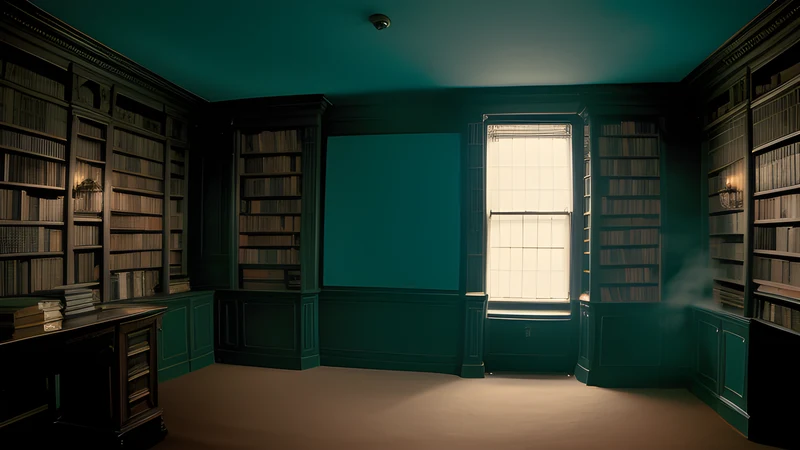
The library is the centre. Kouzuki’s collection is of erotic literature, and his gatherings are readings — Hideko performing texts aloud to seated, silent gentlemen who are also bidders. Park shoots these as the most obscene scenes in the film despite everyone being fully clothed and nothing happening, because the transaction is naked: a girl’s voice, sold by the syllable, to men who will pay for a book afterwards. The film’s sex scenes are famous; the library scenes are the ones that indict.
Cho Young-wuk’s score, again, is doing tonal misdirection — lush, classical, romantic — over material that is nothing of the kind.
The real ancestor
Everyone reaches for Clouzot’s Les Diaboliques, the con-within-a-con that turns on its own conspirators, and the debt is real. But the more precise ancestor is the sun-drenched con film in which the audience’s sympathy is quietly reassigned to a criminal — and the cleanest example is Purple Noon, Clément’s 1960 Highsmith adaptation, where the pleasure of watching an impostor work is deliberately weaponised against you.
Park’s other inheritance is the Gothic. The isolated house, the imprisoned heiress, the tyrannical guardian, the servant who arrives with a secret purpose: this is Rebecca furniture, and Park knows it. What he does with it is a straightforward act of theft in the film’s own spirit — he takes the Gothic’s central assumption, that the vulnerable woman in the house is the object of the plot, and hands her the plot.
And it is worth setting this against Oldboy, because the comparison shows the growth. Oldboy’s twist is a trapdoor: it exists to devastate. The Handmaiden’s rewind is a reallocation of authorship. Same director, twelve years apart, and the machinery has learned to be about something.
The case against
The film’s third part is its weakest, and the weakness is structural. Once the rewind has done its work, Part Three has to resolve a plot, and resolution is the least interesting mode this film has. It becomes propulsive and rather conventional, and the last twenty minutes deliver a satisfaction so complete that it slightly undercuts the moral seriousness of the preceding two hours.
The larger charge is the obvious one, and it has been made with force since the film opened: this is a story about two women’s desire, directed and photographed by men, and shot with a lavishness that is available for consumption in exactly the way the library scenes condemn. Park’s defence is built into the structure — the film is about men producing images of women for other men, and Kouzuki’s collection is the film’s own self-portrait — but a critique staged in the same visual grammar as the thing it critiques is a difficult trick, and the sex scenes are choreographed with a symmetry that reads more like design than desire. Reasonable people watch this film and find the argument does not clear the imagery.
I think it mostly does, and I think the “mostly” is honest.
Where it leaves you
The Handmaiden premiered in competition at Cannes in 2016 and took the BAFTA for Best Film Not in the English Language. Kim Tae-ri was cast from an enormous open audition and had never carried a film; she is the best thing in it. There is an extended cut running some twenty minutes longer, and the theatrical version is the better film — the extra material clarifies things the structure works better for withholding.
Save Fingersmith for afterwards. The novel does one thing the film declines to, and the comparison is where the adaptation’s argument becomes visible.
Spoilers below
Hideko is in on it.
The rewind reveals that Hideko and the Count have their own arrangement running underneath Sook-hee’s: Hideko knows exactly what the con is, and has agreed to it on the condition that the girl brought in as the handmaiden is the one committed to the asylum in her place. Sook-hee is the mark. Every tender moment in Part One — the toothache, the bath, the bed — was Hideko performing for a woman she intended to have locked away.
And then it fails, because she falls in love, which is the only genuinely sentimental beat in the film and the one it has earned.
Part Two also delivers what the library is. Kouzuki raised Hideko from childhood to be a reading machine: her aunt did it before her, was destroyed by it, and hanged herself from the cherry tree in the grounds. The basement — with its snake, its instruments, its lessons — is where the training happened. The gentlemen’s readings are auctions, and the last item is always Hideko herself. So the film’s structure is exact: Part One is a story about a girl being conned, Part Two reveals that the girl doing the conning was herself an object in a much older and more institutional con, and the difference between the two is that Sook-hee’s crime is theft and Kouzuki’s is publishing.
The resolution is the two of them destroying the library. Sook-hee, illiterate, tears the books apart while Hideko directs her — the single most cathartic sequence Park has shot, and its meaning is precise: the woman who cannot read is the only person in the film capable of ending the archive. They flood the room, they take the money, they leave.
The men are dealt with by Kouzuki himself, in the basement, with the Count — who has swallowed a cigarette laced with mercury and dies talking, having ensured his interrogator learns nothing and inhales enough of it to go with him. It is the most Oldboy scene in the film and it is deliberately placed at the very bottom of the house, so the women can be at sea.
And the last scene is the film’s real position. Two women on a ship to Shanghai, free, with an object from the library — and Park stages their reunion using the one prop the collection provided them, which is the joke he has been building for two and a half hours. The men wrote the entire vocabulary of desire in this world, printed it, bound it, and auctioned it. The women stole a page and used it on each other, and nobody is watching. That is the only ending the structure could permit: the con film’s final reveal is that the audience has finally been shut out of the room.
Related Content