The Golem: How He Came Into the World
Paul Wegener's clay giant, Hans Poelzig's ghetto, and the monster Frankenstein was built from
Contents
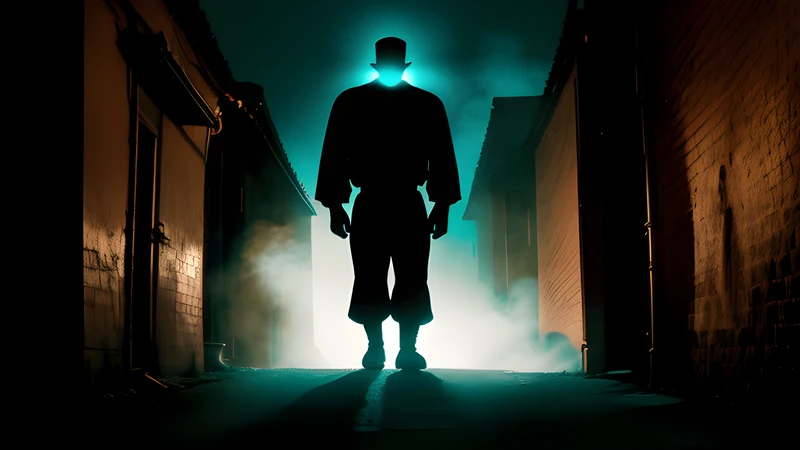
Eleven years before Boris Karloff walked backwards into a laboratory, a German actor in a clay wig and a belted tunic walked through a Prague alley that had been built by an architect, and every screen monster since has been imitating his shoulders.
Der Golem, wie er in die Welt kam was released in 1920, directed by Paul Wegener and Carl Boese, with Wegener playing the creature. It is the third Golem film Wegener made and the only one that survives complete. The 1915 Der Golem exists as fragments; Der Golem und die Tänzerin, a 1917 comedy in which Wegener spoofed his own monster, is lost entirely. So the film everybody knows is a prequel to two pictures nobody can watch — an origin story made after the fact by a man who had already worn the costume twice.
Poelzig’s ghetto
The single most important decision in the film was hiring Hans Poelzig, and it is the reason The Golem has aged better than most of its Expressionist cohort.
Poelzig was a working architect of real standing — he had built the Grosses Schauspielhaus in Berlin for Max Reinhardt the year before, and he would later design the IG Farben headquarters in Frankfurt. He was given the Ufa lot at Tempelhof and built a Prague ghetto out of it, at scale, in three dimensions.
The difference from Caligari, released the same year, is total. Wiene’s crew painted flats: shadows brushed on canvas, geometry that only resolves from the camera’s position. Poelzig sculpted. His ghetto is made of curves — doorways that sag like melted wax, houses that lean into each other, roofs that come to organic points, staircases that spiral through spaces with no right angles anywhere. Marlene Moeschke, the sculptor Poelzig worked with and later married, did much of the modelling, and her contribution has been steadily better recognised in recent decades.
The effect is that the ghetto looks grown. It has the quality of something excavated or exhumed, a warren shaped over centuries by pressure rather than planning. Because it is genuinely built, Karl Freund can move a camera through it, and the actors can walk around corners into depth. Caligari’s world collapses the moment you look at it from the wrong angle. Poelzig’s world holds up under inspection, which means the film can do something Wiene’s cannot: it can be about a place.
That matters, because the ghetto is the subject. The story is about a walled community under an eviction order from an emperor who has decided its people are a nuisance. Rabbi Loew builds the Golem to save them. The architecture is telling you what a community under permanent threat builds itself into.
Freund, and the light
Karl Freund shot it, and his career is the through-line of the entire first century of horror cinema. He photographed The Golem in 1920, Metropolis in 1927, and The Last Laugh in 1924 with its unchained camera; he went to Hollywood and shot Dracula for Tod Browning in 1931, then directed The Mummy himself in 1932. He ended up inventing the three-camera sitcom setup for I Love Lucy. One man carried the German shadow vocabulary to Universal and then to American television.
His work here is fire and torch. The conjuring sequence — Loew calling up the demon Astaroth to obtain the word that animates clay — is the film’s showpiece: a circle of flame, smoke pouring, and a floating spectral head that speaks the word in letters of fire. It is 1920, and it is done with in-camera exposure work and a great deal of genuine burning. The sequence has a heat to it that is missing from the cooler German films around it.
The monster who has one good day
Wegener’s Golem is the template, and the physical performance is more sophisticated than its reputation.
He is slow. He is enormously heavy — Wegener plays the weight constantly, planting each foot as though the floor might give. He has a flat, unblinking face under a wig that looks like it was struck from a mould. The design was by Rudolf Dworsky and Kurt Richter, and Jack Pierce’s Frankenstein makeup eleven years later is plainly in conversation with it: the flat head, the wide silhouette, the sense of a body assembled rather than born.
Where Wegener is doing something the sequels forgot is in the middle stretch, when the Golem simply works. Loew sends him to market with a basket. He chops wood. He stands in the corner of a room like an appliance. The film gives you a long, strange sequence in which a supernatural clay giant does the shopping, and it is funny, and the humour is what makes the violence land. The thing has been domesticated, so its turning has stakes.
The mechanism of the turning is the shem — a star-shaped amulet inscribed with a word, pressed into the Golem’s chest to animate him and removed to stop him. It is an off switch, which is the oldest and most reliable horror device there is: a monster you can switch off is a monster somebody will eventually fail to switch off.
The film’s other formal trick is the way it uses doorways. Poelzig’s openings are all irregular — pinched at the top, wider at the base, roughly the shape of a keyhole — and Wegener’s Golem is sized so that he almost fills them. Every time the creature passes from one room to another, the architecture squeezes him, and the composition tells you the ghetto has no room for what it has made. It is a designer and a director agreeing on a single idea and then executing it across ninety minutes without ever pointing at it. Compare a modern monster film, which will typically cut to a low angle and a horn stab to inform you that the creature is large.
What it built
The direct line runs to Universal. James Whale’s Frankenstein in 1931 is the same story — a scholar makes a man from dead matter, the man is gentle before he is dangerous, the community with torches comes for both of them — and its production design borrows the German vocabulary wholesale. The wider dynasty is covered in the Universal monsters, and the era’s other survivors in the silent horror canon.
Poelzig’s name has one more film credit, sideways. In 1934, Edgar Ulmer — who had worked in the German industry before emigrating — directed The Black Cat at Universal and named Karloff’s devil-worshipping architect villain Hjalmar Poelzig. Ulmer built him a Bauhaus fortress and gave him the surname of the man who had built the ghetto. That is one German craftsman tipping his hat to another across an ocean and fourteen years, in a film Universal thought was a Poe adaptation.
The film is available in a restoration by the Friedrich-Wilhelm-Murnau-Stiftung with the tinting reinstated, and the tinting is load-bearing — the fire sequences are amber, the night is blue, and the flat grey prints that circulated for decades wreck Freund’s whole scheme.
Spoilers below
The Golem turns for a reason the film is quietly clever about: he is not corrupted, he is reassigned.
Loew’s assistant, the Famulus, wants Miriam, the rabbi’s daughter, who is conducting an affair with the knight Florian, the emperor’s messenger. Having watched the Golem obey the shem, the Famulus takes the amulet, animates the creature himself, and points him at his rival. The Golem throws Florian off a tower and then, having been woken with a jealous man’s intent in him, keeps going. He sets the ghetto alight and drags Miriam through the streets by her hair.
The rabbi has already saved the community once, in the film’s best-staged sequence: at the emperor’s court, a magical vision of the Jewish exodus is projected for the amusement of the nobles, who laugh, and the palace begins to collapse on them until the Golem holds the roof up on his shoulders. The eviction order is rescinded out of gratitude. The Golem’s finest act is structural.
And then the ending, which is the image everyone remembers. The creature walks out through the ghetto gate to a meadow where children are playing. They are not afraid of him. One little girl is lifted up, and she reaches out and pulls the star from his chest, and he falls. She has no idea what she has done. She was playing with a shiny thing.
Whale filmed a version of that encounter in 1931 and it went badly for the child, and the censors cut it. Wegener’s version is gentler and considerably crueller. The monster is destroyed by the one person in the film who was not frightened of him, at the exact moment he had stopped being dangerous, and he is stopped by an accident of curiosity. Then the Jews of the ghetto carry the clay body back through the gate that has just been unlocked for them.
Related Content