The Giallo Canon
Ten Italian murder-mysteries that built the body-count thriller
Contents
The word means yellow, after the cheap paper covers of the Mondadori crime paperbacks that gave Italy its taste for lurid murder. On screen, giallo hardened into a recipe by the late 1960s: a black-gloved killer, a witness who saw something and cannot quite decode it, a series of elaborate murders, and a solution that usually turns on a buried trauma and a misremembered image. J&B whisky bottles, art-directed apartments, jazz-lounge scores, an amateur detective in over their head. The genre exported its DNA straight into the American slasher, which is why so much of it feels both foreign and familiar.
Giallo divides viewers because the whodunit machinery is frequently absurd and the pleasure lives elsewhere — in the choreography of a killing, the architecture of a set, the exact hue of a lamp. The killer’s identity is often arbitrary, revealed by a coincidence or a flashback that cheats; treat that as a feature and the films sing. What they are really about is the unreliability of sight itself. The witness always saw the truth and simply could not read it, and the film’s whole engine is the slow correction of a single misperceived image.
Take these ten as a working canon: the films that established the grammar, ran it to its baroque limit, and then turned the knife on the audience. The murder-mystery strand is the twin of the broader Eurohorror canon; start here for the pure form, and expect to leave with a longer watchlist than you arrived with.
The blueprint
The Girl Who Knew Too Much (Mario Bava, 1963). The one that started it all. A tourist in Rome witnesses a murder and finds herself stalked by an “alphabet killer,” and Bava, working in crisp black-and-white, assembles almost every convention the genre would later run on — the foreign witness, the doubted testimony, the murder glimpsed and misread. It is lighter than what followed, closer to a Hitchcock pastiche with a comic streak, and all the more instructive for showing the recipe before the colour arrived. Kino Lorber carries a clean edition; watch the Italian cut, which is markedly less jokey than the American recut.
Blood and Black Lace (Mario Bava, 1964). A year later Bava added the colour, the mannequin-cold fashion-house setting and the faceless killer, and the modern giallo snapped into focus. This is the film that invents the body-count as a self-sufficient structure, murder after murder with the plot as an afterthought, each death lit in candy reds and greens. Every stalk-and-kill picture of the next thirty years owes it a fee. Arrow’s restoration is the one to see.
The Argento explosion
The Bird with the Crystal Plumage (Dario Argento, 1970). Argento’s debut took Bava’s template and made it a phenomenon, launching the boom that flooded Italian screens for a decade. An American writer in Rome sees an attack through a gallery window and becomes obsessed with a detail he cannot place — the buried-image mystery that would become the director’s signature. Argento traps his hero, and us, behind glass at the crucial moment, so the whole film becomes a struggle to re-read one framing. It is tighter and more classical than his later work, an ideal second stop. Arrow’s Blu-ray restores Vittorio Storaro’s photography beautifully.
Deep Red (Dario Argento, 1975). For many the peak of the entire genre: a jazz pianist witnesses a murder and the film spirals through a labyrinth of clues, Goblin’s motorik score driving it forward. My full argument for why it is Argento’s perfect giallo stands; the clockwork of its central clue, hidden in plain sight in an early shot, is the genre’s cleverest piece of misdirection. Seek the longer Italian cut on Arrow, which restores scenes the export version lost.
Tenebrae (Dario Argento, 1982). Argento’s cold, glaring, daylight-bright reply to critics who called his films misogynist — a novelist stalked in a Rome of white marble and glass, the killings staged in a sun that offers no shadows to hide in. The film turns the knife on his critics and delivers his most audacious set piece, a two-minute crane shot that crawls over and around an entire house before a murder. Synapse’s restoration is essential.
The disreputable middle
A Bay of Blood (Mario Bava, 1971). Bava again, and the missing link to the American slasher — a body-count picture set around a contested lakeside inheritance, with a string of inventive killings later lifted almost frame-for-frame by the Friday the 13th films. There is barely a hero, barely a plot; the film is a cynical machine for staging deaths, and its greed-poisoned ending is pitch-black comedy. Kino Lorber’s disc restores the grubby beauty.
Don’t Torture a Duckling (Lucio Fulci, 1972). Fulci’s finest giallo trades the metropolitan apartment for a superstitious southern village where children are being murdered, and turns the genre toward genuine social anger about the Church, the media and rural cruelty. It is a real mystery with a real argument underneath, rare for the form, and its most notorious scene — a chain-whipping in a cemetery — is staged with an unusual, mournful beauty. Arrow keeps it in print.
Torso (Sergio Martino, 1973). The prime example of the sleazier commercial giallo, and better than its reputation — a masked killer among university students, building to a wordless final-act suspense sequence in which a woman must move silently through a house while a body is dismembered upstairs. Martino was the genre’s most reliable craftsman, and that closing half-hour would not shame Hitchcock. Available on Blu-ray from the boutique labels.
The late peak
Opera (Dario Argento, 1987). The last great giallo of the classic era: a young soprano tormented by a killer who tapes needles beneath her eyes so she cannot look away from his murders — a queasy image about spectatorship that turns the audience’s own gaze into the weapon. Argento’s camera has never been more mobile, swooping through the opera house and, memorably, through a raven’s-eye view of the stalls. Scorpion’s disc is the fullest.
Suspiria (Dario Argento, 1977). A cheat, and I will own it: this is a supernatural horror rather than a strict giallo. But it grows directly from the same soil — the same director, the same colour-as-weapon instinct pushed past realism entirely, the same set-piece murders staged as tableaux. Consider it the giallo dreaming, the point where the genre’s obsession with beautiful death floated free of the whodunit altogether. Synapse’s 4K is definitive.
The look and the sound
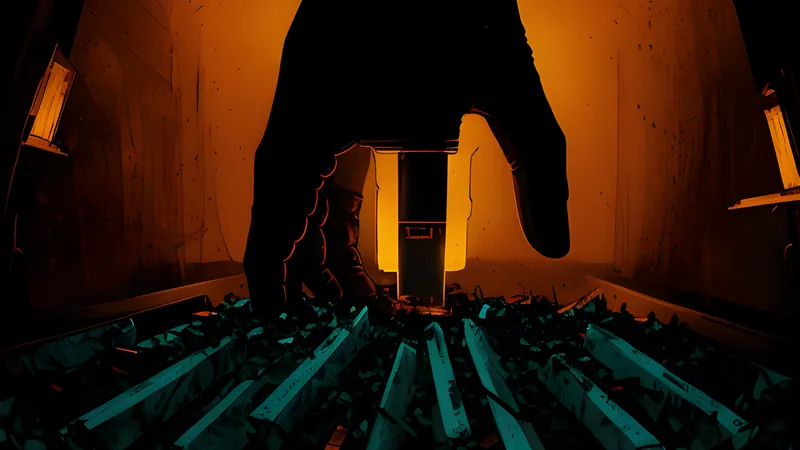
The giallo is as much a set of textures as a plot, and once you have watched a few you start collecting the signatures. The killer is anonymised down to hands: black leather gloves, a raincoat, a hat, the face withheld until the reveal, so that the murderer becomes a role anyone might occupy. The camera fetishises objects — a glinting blade, a child’s drawing, a whisky label — because the solution is always hidden in a thing the witness saw and could not read. Interiors are impossibly designed, all modernist glass and jarring colour, the wealth of the victims part of the appeal and part of the target.
The sound is half the pleasure. Where American thrillers reached for orchestral menace, the giallo hired jazz and prog musicians — Ennio Morricone in the early Argento films, Bruno Nicolai for Martino, and above all Goblin, whose pulsing, lopsided rock scores for Deep Red and Suspiria are inseparable from the images. The music rarely underlines the action; it runs alongside it, cool and strange, so that a murder plays out to something closer to a lounge groove than a scream. Learn to read these signatures and even the weakest giallo becomes legible as craft. The genre’s makers knew the mystery was disposable, so they poured their invention into surface, and the surface is where the art lives.
Where the trail leads
Watch these and the genre’s afterlife comes into focus: the black glove reaches straight into Halloween and every stalker picture since, a lineage I have traced in the giallo’s fingerprints on the modern slasher. For the man who shaped more of this canon than anyone, the career read on Argento is the companion piece, and the wider Eurohorror canon puts these murders in their continental context. The whodunit will rarely satisfy, and the more of these you watch the less you will care who did it. The images, the scores and the choreography of the killings are the reason to be here, and they always will be.
Related Content