The German Expressionist Shadow Over Horror
How a handful of Weimar productions taught the genre to use darkness as a load-bearing wall
Contents
There is a single technical decision at the root of nearly every horror image you can name, and it was made in Berlin in 1919 by three set designers with no money. Hermann Warm, Walter Reimann and Walter Röhrig were building the world of Das Cabinet des Dr. Caligari for Robert Wiene, and rather than light a set to produce shadows, they painted the shadows onto the flats. Streaks of black daubed on canvas. Windows shaped like knife wounds. Corridors that narrow towards a vanishing point which does not exist. The reason usually given is electricity rationing in a defeated Germany, which may be part of it and may be legend; the effect is beyond dispute. When The Cabinet of Dr Caligari opened in February 1920, cinema acquired a proposition it has never given back: that the frame can be an argument about a mind rather than a record of a place.
Everything that followed in horror is downstream of that proposition. The claim sounds like the sort of grand lineage-drawing a collector does to make his shelves feel important, so let me put weight under it. The debt is architectural. It travelled by named people, through named companies, into named films, and you can trace the handoffs with dates.
What the Weimar films actually invented
Expressionism as a movement predates the cinema — it was painting and theatre first, and Caligari’s designers came from that world. What the films added was a set of concrete devices that only work in a photographed image, and that is why they survived when the painted-flat style itself died within about five years.
The first is the shadow as a separate character with its own agency. F. W. Murnau’s Nosferatu (1922) contains the definitive statement: Orlok’s shadow ascending a staircase, arriving before he does, its fingers stretching along the wall. The shadow does the acting. Max Schreck’s body is elsewhere in the building. Once that image existed, every director who wanted menace without a monster on screen had a tool that cost the price of a lamp and a wall.
The second is the physically distorted environment. Paul Wegener and Carl Boese’s The Golem: How He Came into the World (1920) built a ghetto of leaning, organic, cave-like houses on a Berlin backlot — a whole quarter designed by the architect Hans Poelzig, which is a detail worth holding on to, because it means the horror set was taken seriously enough to hire a real architect. Space itself carries the dread. Rooms bulge. Doorways lean.
The third is the low-key lighting scheme that later gets renamed chiaroscuro whenever a critic wants to sound expensive: a hard key, no fill, the actor’s face carved into two halves, and a background that simply is not lit. Fritz Lang’s Metropolis (1927) and his first sound film M (1931) refine it — M in particular shows how much of the technique had outgrown the painted flats. The expressionism there is entirely a matter of lighting.
The fourth is the moving camera used as a subjective instrument. Murnau’s unchained camera in Der letzte Mann (1924) was a technical stunt about a doorman’s humiliation, and it was immediately available to anyone who wanted a camera to become a point of view with malice in it. Sam Raimi’s predatory prowl through the woods in The Evil Dead is a direct descendant, sixty years and one continent later.
The handoff came by boat
Vague talk about “influence” is where film history goes to die. The German style reached American horror by a mechanism you can name: German technicians got on ships and took jobs.
Karl Freund shot The Golem and Metropolis. He moved to Hollywood in 1929 and photographed Tod Browning’s Dracula in 1931 — which is why a film with an inert middle hour has an opening reel of genuine cathedral gloom — then directed The Mummy in 1932 and Mad Love in 1935. Paul Leni, who had directed Waxworks in 1924, came to Universal and made The Cat and the Canary (1927) and The Man Who Laughs (1928), the second of them starring Conrad Veidt, who had been Cesare the somnambulist in Caligari. Universal hired the specific men who had made the mood, and gave them the keys to the monster franchise it was busy inventing.
The second wave came for uglier reasons. Lang left Germany in 1933 and was in Hollywood by 1934. Robert Siodmak went to Paris, then America. Edgar G. Ulmer, who had worked in Germany before emigrating, made The Black Cat for Universal in 1934 — a film whose Bauhaus-modern fortress is a Weimar idea rebuilt in Hollywood plaster. Curt Siodmak, Robert’s brother, wrote The Wolf Man in 1941 and effectively authored the werewolf mythology that most people mistake for folklore. The exiles brought a visual habit and a temperamental one: a conviction that the horror is inside the house and inside the man, and that the camera’s job is to show you the man’s interior by photographing his exterior.
Where the shadow went next
The style then did something a movement is not supposed to do: it split into two traditions that both won.
One went into film noir. The venetian-blind bars across a face, the wet street lit from one side, the staircase shadow — those are Weimar devices repurposed for American crime. Look at what John Alton did with a single lamp in the late 1940s and you are watching Caligari’s logic applied to insurance fraud.
The other went into the poetic low-budget horror of the 1940s. Val Lewton’s RKO unit made a religion out of it. Cat People (1942), directed by Jacques Tourneur and photographed by Nicholas Musuraca, is the purest surviving demonstration that darkness is cheaper than a monster suit and more frightening than one. The Lewton unit had budgets that forbade spectacle, and the German grammar was sitting right there, already proven, requiring nothing except the confidence to leave a corner of the frame unlit.
Carl Th. Dreyer’s Vampyr (1932) belongs to this lineage while standing slightly outside it — a Danish director shooting in France, chasing a diffusion of light rather than a hardening of it. It is the proof that the Weimar innovation was general enough to be argued with. Dreyer took the premise that the image should express a state of mind and reached the opposite optical conclusion. The premise held.
The mechanics: why a painted shadow still works
Here is the craft reason the technique refuses to age, and it is perceptual rather than sentimental.
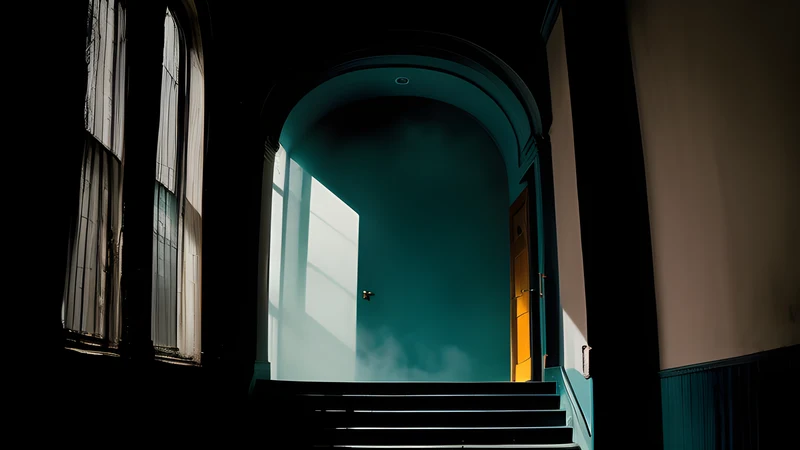
A hard shadow with no fill light removes information from the frame. The viewer’s visual system is intolerant of missing information and completes the pattern automatically, which means the audience builds the threat out of its own materials. This is why the Nosferatu staircase shot outperforms almost every modern equivalent: the shadow’s shape is legible enough to read as a hand and abstract enough that your brain has to finish it. Every finishing job is bespoke and every one lands.
Distorted geometry does a second thing. The human eye reads architectural lines as promises — a floor is level, a door is rectangular, a corridor recedes evenly. Break the promise and the viewer registers wrongness pre-consciously, before a single plot point has been delivered. Caligari front-loads its dread in the first shot of its first set, which buys the film enormous patience from the audience later on.
The third mechanic is contrast ratio as an emotional dial. The wider the gap between the lit and unlit parts of a face, the more the character reads as divided. Conrad Veidt’s Cesare works because his makeup and key light split him vertically. The technique gets used, unchanged, on every haunted protagonist through to Robert Eggers.
There is a fourth mechanic, and it is the one modern productions most often fumble: the shadow has to be drawn by something the audience can locate. Orlok’s staircase shadow works because the geometry is solvable — a body, a lamp behind it, a wall. The wrongness of the proportions lands precisely because the physics are otherwise obeyed. Digital shadow work frequently fails here, because a shadow generated in software owes nothing to a light source the eye can reconstruct, and the eye notices the debt going unpaid even when the viewer cannot say why. The Weimar cameramen were constrained to real lamps and real flats, and that constraint is doing quiet work in every frame that still frightens.
The case against my own thesis
Honesty demands the counter-argument, and it is a decent one.
Very little of what we call expressionist horror is actually expressionist. The painted-set style has an almost comically short life — Caligari, Genuine, Raskolnikov, a handful of others, and by the mid-1920s German studios had largely moved to the Kammerspiel and the street film, both of which prize built, plausible spaces. Nosferatu was shot substantially on location in Wismar and the Carpathians; the vampire in it stands in real sunlight in real streets. Calling it expressionist is a convenience.
The lighting grammar, too, has other parents. Scandinavian cinema was doing extraordinary things with darkness before Weimar got there — Victor Sjöström’s The Phantom Carriage (1921) contains double-exposure ghost work that no German film had matched, and Benjamin Christensen’s Häxan (1922) is its own strange planet. American cinematographers had discovered low-key lighting for their own reasons. A tidy German-origin story flatters a tidy shelf.
What survives the objection is the transmission mechanism. Warm, Poelzig, Freund, Leni, Veidt, Lang, Ulmer, the Siodmaks — that list is a payroll, and the payroll moved to Los Angeles and staffed the horror department. That is why the shadow on the wall is a German loan.
Where to look
Start with Caligari in one of the recent restorations, which recover the colour tinting and make the painted sets read as design rather than damage. Then Nosferatu, then The Golem for Poelzig’s architecture, then M to see the style survive the death of its own scenery. Then jump straight to Cat People and watch a 1942 American programmer speak fluent Weimar. The silent horror canon sets out the wider map; if you want the argument about why these particular films still work on a modern nervous system, that case is made here. Nearly all of it is in print from the boutique labels, restored to a standard the original exhibitors never saw, which is a decent joke on everyone who assumed the shadows were an accident of bad prints. They were the point.
Related Content