The Fountain: Aronofsky's Grief Across a Thousand Years
A conquistador, a scientist and a space traveller, all trying not to lose the same woman
Contents
Some films fail on arrival and then keep growing in the dark, and The Fountain is one of them. When Darren Aronofsky’s third feature reached cinemas in 2006 it was met with bafflement, mockery and thin box office, filed away as the folly of a young director who had let ambition outrun sense. Nearly two decades on it looks like something else — one of the few genuinely sincere films about mortality that mainstream cinema has produced this century, and a work whose reputation has quietly inverted. The people who loved it loved it fiercely, and their number has only grown.
The film’s own production history mirrors its theme of death and renewal. Aronofsky first mounted it as a much larger project with Brad Pitt and Cate Blanchett attached and a budget to match; that version collapsed on the eve of shooting when Pitt walked. Most directors would have moved on. Aronofsky rebuilt the film from the ground up at less than half the money, with Hugh Jackman and Rachel Weisz, salvaging his passion project out of its own ruin. The film that survived is haunted by that near-death, and it is stronger for the constraints the collapse imposed.
Three stories, one loss
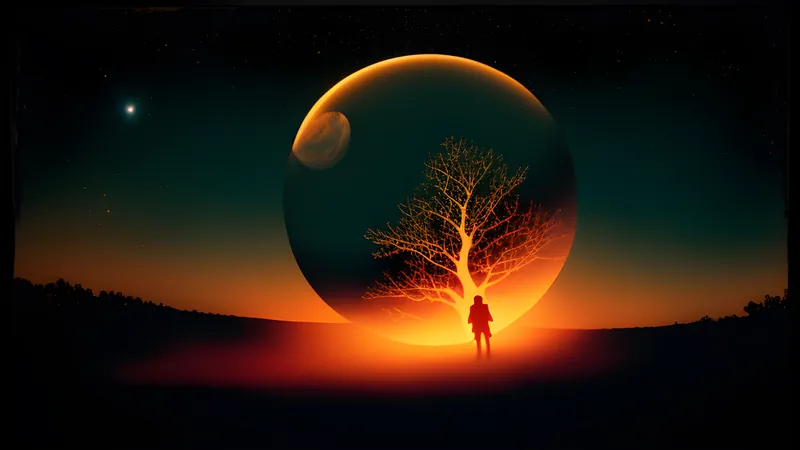
The Fountain braids three narratives that share two faces. In sixteenth-century Spain, a conquistador named Tomás is dispatched by Queen Isabella into the New World to find the Tree of Life, the biblical source of immortality, and so save her — and their kingdom — from a Grand Inquisitor closing in. In the present day, a research scientist named Tommy Creo works obsessively in a lab to cure the brain tumour killing his wife, Izzi, testing compounds derived from a Central American tree while she, dying, writes a book called The Fountain and begs him to stop working and simply be with her. And in a far future rendered as a man travelling through space inside a translucent bubble, a shaven figure tends a dying tree as he journeys toward a golden nebula the Maya called Xibalba, the underworld, a star wrapped around itself in the act of death.
Jackman plays all three men; Weisz is the woman he is trying to save in the two earthbound strands and the presiding spirit of the third. Whether the past and future stories are literally happening, or are the scientist’s grief refracted through his dying wife’s unfinished novel, the film leaves productively open. What is certain is the emotional spine running through all three: a man who cannot accept that the person he loves is going to die, and who will conquer, medicate or voyage across a thousand years rather than say goodbye.
Why it looks like nothing else
The craft is the reason the film endures, and one decision above all deserves study. For the future and cosmic sequences, Aronofsky and his cinematographer Matthew Libatique refused conventional computer-generated space imagery, which the director felt would date badly. Instead they hired the scientific photographer Peter Parks to shoot macro footage of chemical reactions in small tanks — fluids, bacteria, dyes photographed at extreme magnification — and those churning, organic, microscopic images became the golden nebula and the deep-space voyages. The gamble worked completely: because the “space” is really biology filmed up close, the cosmos in The Fountain looks alive, cellular, warm, and it has aged with none of the plasticky staleness that has claimed so many bigger effects films of its era. The universe and the dying body are rendered with the same footage, which is the film’s whole thesis expressed as technique.
The score does comparable work. Clint Mansell wrote it for the Kronos Quartet and the Scottish post-rock band Mogwai, and it builds through the film in slow, repeating swells toward a final movement that has escaped the film to become a modern concert-hall staple in its own right. The music is structured like the narrative — motifs that recur and transform across the three eras, the same theme grieving in the past, striving in the present, and finally releasing in the future. Aronofsky edits the three strands so that a gesture in one rhymes with a gesture in another, hair and ink and tree-bark and stars all folding into one another, until the film stops feeling like three stories and starts feeling like one prayer said three ways.
The performances are braver than the film’s reputation allows. Jackman, in the middle of his run as a comic-book action star, gives the present-day scientist a raw, unglamorous desperation, a man whose love has curdled into a refusal that is slowly destroying him. Weisz gives Izzi a serenity that the film needs as its counterweight — she has arrived at acceptance while he is still at war, and the whole picture turns on the distance between them.
The company it keeps
Magpie’s instinct is to name the ancestors, and The Fountain sits in a distinguished line of science fiction that uses the cosmos to think about grief. Its deepest kinship is with Tarkovsky’s Solaris, the space film where the void answers a bereaved man by returning the wife he lost, examined in Tarkovsky’s answer to Kubrick; both films understand that outer space is really inner space, and that a journey to a distant star is a journey into a mind that will not let go. The cosmic scale and the willingness to let images carry meaning that dialogue cannot descend from Kubrick — the picture that trusts the audience to feel more than it understands, discussed in the film that refuses to hold your hand.
Within Aronofsky’s own filmography it is the tender flowering of an obsession he had already filmed as a nightmare. The fixation, the man convinced that one more equation or one more dose will unlock the answer, is the same engine that drove his debut about a mathematician tearing himself apart, mapped in Aronofsky’s migraine in black and white. Pi is obsession as horror; The Fountain is obsession as love, and the two films are the same coin. For the loveliness of an ending that arrives as acceptance rather than rescue, its truest recent cousin is the beautiful apocalypse of von Trier’s Melancholia, another film that finds grace in surrendering to the one fact that cannot be fought.
Does it work? For a long time the received wisdom was that it did not, and I think the received wisdom was wrong. The film’s sincerity, which read in 2006 as embarrassing overreach, now looks like courage — a big studio-adjacent picture willing to be earnest about death without a wink of irony to protect it. It asks patience, and it asks you to accept a structure that withholds its logic until the end. Give it both. Where to find it: it streams widely and sits on a beautiful disc; watch it at night, uninterrupted, with the sound up for Mansell’s finale. This is a film that resolves in its last ten minutes, and the resolution is worth the wait.
Spoilers below
The key that unlocks the three timelines is that the present-day story is the true one, and the other two are its refractions. Izzi, dying, has been writing a novel called The Fountain about the conquistador and the Queen, and she has left it one chapter short — she asks Tommy to finish it for her. The sixteenth-century strand is that unfinished book; the future strand, the shaven traveller in the bubble carrying the tree toward Xibalba, is Tommy himself, either far in the future or, more resonantly, inside the space of his own grief, still refusing to let her go long after her death. The tree he tends and talks to is Izzi, or the last of her he has kept alive. He has become the conquistador of her story, questing across time for a cure that does not exist.
The film’s meaning turns on the Mayan idea Izzi gives Tommy before she dies: the belief that death is an act of creation, that a buried body becomes a tree, that the tree feeds the living, that ending is the seed of beginning. Tommy the scientist rejects this utterly — his whole life is a war on death — and the tragedy of the present-day strand is that his refusal robs him of the time he has left with his wife. He is in the lab achieving a medical breakthrough at the very hour she is dying alone, having chosen the fight over the goodbye. She wanted him to finish the book. He wanted to finish the cure.
Acceptance, when it finally comes, is the film’s release and its most moving stroke. In the future strand the traveller reaches Xibalba as the nebula goes supernova, and instead of fear he opens his arms to it — the dying star’s explosion rendered in that same golden, cellular light, an ending staged as a birth. Intercut, Tommy at last returns to Izzi’s grave, plants a seed above her, and speaks the words she needed him to say, completing both the book and his own grief. The traveller’s line, that he is going to die and is no longer afraid, is the whole film arriving at its one hard-won idea: that to love someone mortal is to eventually let them become part of everything else. Death as an act of creation. It is a thesis that sounded absurd in the trailers and lands, in the final movement, as something close to consolation.
For more cinema that treats the loss of a self or a loved one as a physical, transforming event, the colder path runs through Brandon Cronenberg’s Possessor, where identity dissolves under a scalpel rather than into a star — the same terror of ending, filmed as horror instead of hope.
Related Content